Credit: Clemson University
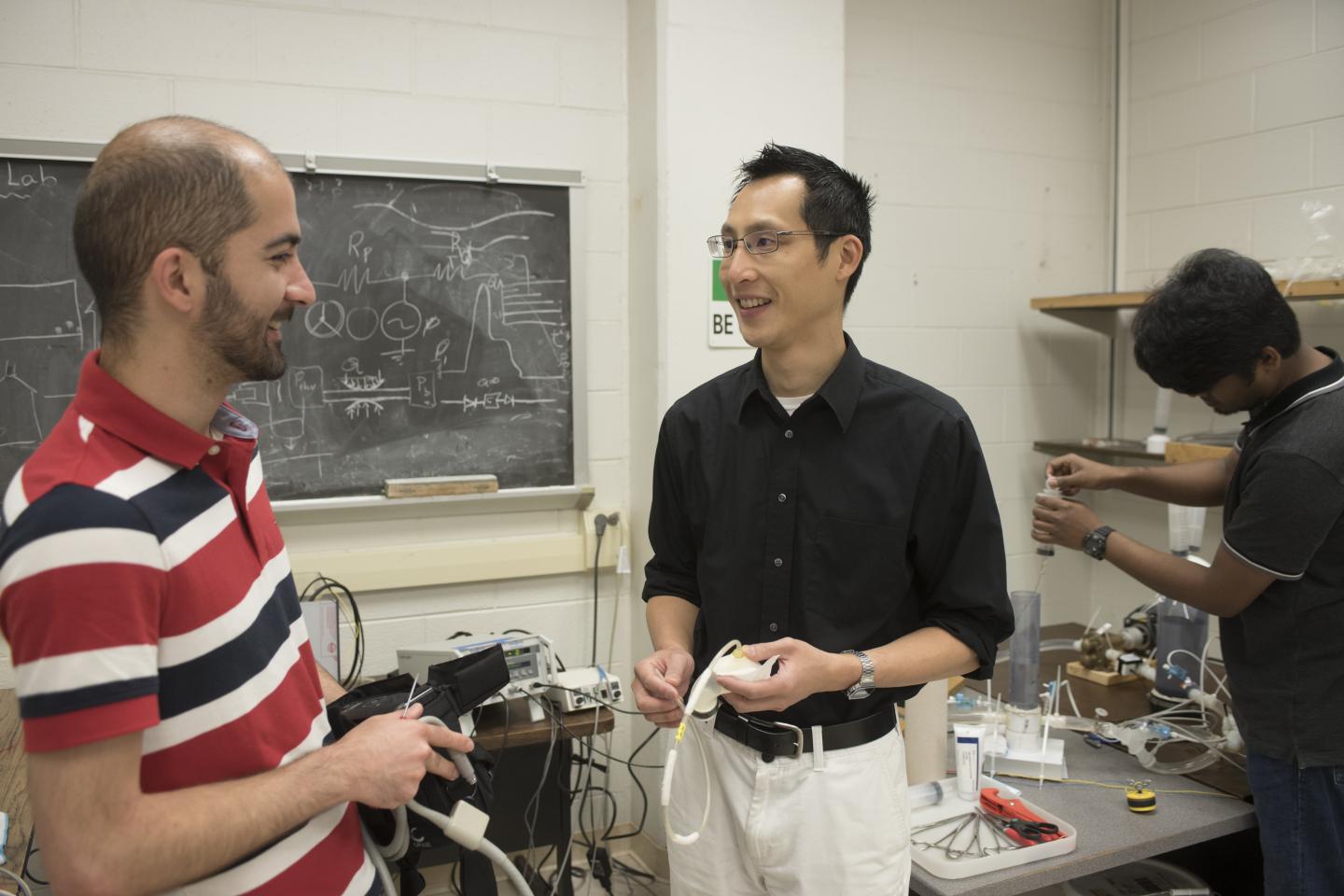
New treatments for potentially fatal heart conditions could be ready for patients more quickly and less expensively with the help of a new research project led by Ethan Kung, an assistant professor of mechanical engineering at Clemson University.
Kung is receiving a $513,729 CAREER award from the National Science Foundation, one of the nation's highest honors for junior faculty members.
The award will allow him to further develop a new way of modeling the cardiovascular system. It could enhance researchers' ability to test new devices, surgeries and other procedures on computers and in labs before experimenting on animals and humans.
In the latter part of the five-year project, Kung will validate his modeling on medical implants, including left ventricular assist devices, transcatheter replacement valves, and Fontan cardiopulmonary assist systems.
Kung's research is aimed at reducing human and animal testing and addressing concerns that the skyrocketing cost of developing new devices and surgeries is unsustainable. The average cost of bringing a high-risk medical device to market was estimated at $94 million, with $75 million going to securing regulatory approval, according to a Stanford University study.
It's too early to say just how many lives or how much money could be saved by Kung's new approach, but he believes it could be transformational.
What makes Kung's research unique is that he has found a way to merge numerical models run on computers and experimental models done with lab equipment into one unified hybrid model for cardiovascular research.
"Each of them has strengths and limitations, and each of them has led to significant advances," he said. "They are very powerful tools. So what we're going to do is just combine them."
Also as part of his project, Kung will be creating new educational activities based on his research, including an exhibit planned for Artisphere in downtown Greenville. Other programs will be aimed at the undergraduate and graduate levels.
Kung's innovative educational methods garnered worldwide attention in 2016. His lesson on fluid dynamics– involving a bee on a leash– became a viral video picked up by several news outlets, including this one: https://nypost.com/2016/10/04/professor-takes-pet-bee-to-class-on-a-leash-like-its-no-big-deal/
Richard Figliola, acting chair of the Department of Mechanical Engineering, said that Kung is highly deserving of the CAREER award.
"This is a testament to his hard work and ingenuity," he said. "He is helping solve one of society's most urgent medical problems, while creating a high quality education for students, which widens the pipeline to industry."
Kung describes his goal as helping "pioneer a new generation of cardiovascular biomechanics models."
"We will be combining a realistic, computational physiology model with fluid dynamic experiments," he said. "We will be able to capture the autoregulation response of the heart and allow the integration of actual medical devices within the hybrid modeling system."
Combining the different types of models is difficult, Kung said.
"People have tried to do this with cardiovascular modeling before and have not gotten good results," he said. "What we've done is figure out how to couple these two together."
Kung's lab implemented "the first high-fidelity coupling of a single-inlet, single-outlet experiment to a sophisticated physiology model, with results verified against state-of-the-art multiscale computational fluid dynamic simulations," he said.
The first aim of the project is to expand the coupling methods to handle a wide range of modeling scenarios. The second is to improve on the computational physiology model so that it can better reflect patient characteristics such as body size, body mass index, age, fitness, and auto-regulation. The third aim will be to validate the hybrid model his team is creating using scenarios involving various implants.
Kung has a joint appointment in the Department of Bioengineering.
Anand Gramopadhye, dean of the College of Engineering, Computing and Applied Sciences, congratulated Kung on his award.
"The CAREER award places Dr. Kung among the top junior faculty members in the country," Gramopadhye said. "The award is widely seen as a sign of future success. Dr. Kung is richly deserving."
###
Media Contact
Ethan Kung
[email protected]
864-656-5623
@researchcu
http://www.clemson.edu