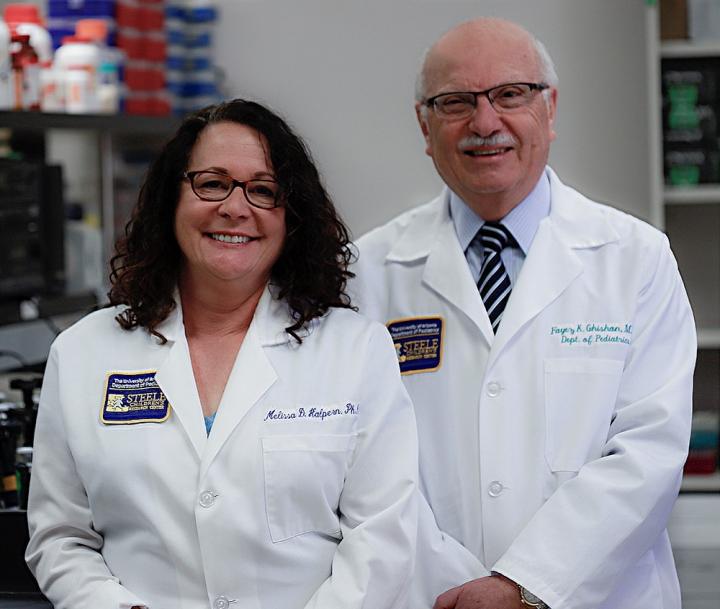
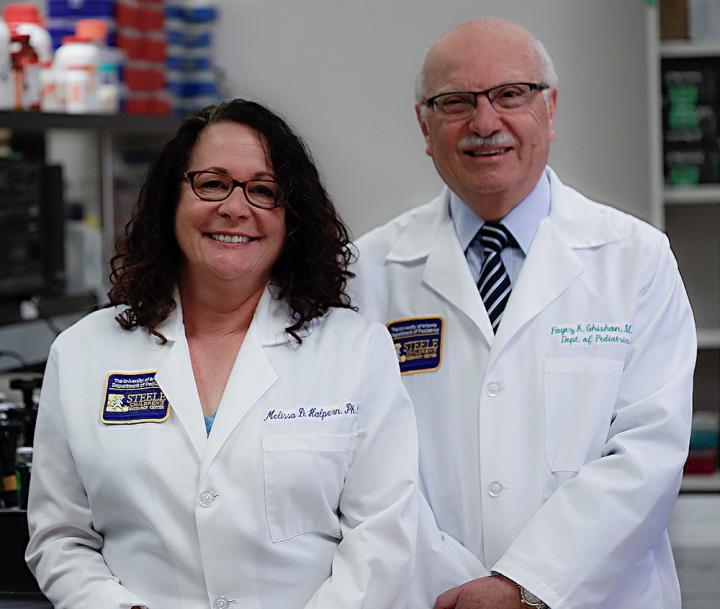
Credit: University of Arizona Health Sciences
A new $1.9 million grant at the University of Arizona Steele Children's Research Center will help researchers discover ways to prevent a deadly disease that affects thousands of premature infants annually.
Necrotizing Enterocolitis (NEC), an inflammatory gastrointestinal disease, is one of the leading causes of illness and death among premature infants, affecting about 9,000 in the United States each year.
"We want to create the first test that will accurately predict if a premature baby may be susceptible to NEC, so we can treat and prevent it from developing," explained UA Steele Center researcher and associate professor, Melissa Halpern, PhD.
Dr. Halpern will lead the study; Fayez K. Ghishan, MD, professor and UA Steele Center director, will provide his expertise in intestinal microbiome analysis and development of small-intestine organoids from stem cells harvested from surgical specimens.
The four-year grant is funded by the National Institute of Diabetes and Digestive and Kidney Diseases (NIDDK) of the National Institutes of Health (NIH).
"Once NEC develops, the infant will face serious GI problems, so our goal is to prevent it," said Dr. Halpern.
Dr. Halpern knows from personal experience how devastating NEC can be. Her son, Ryan, was born eight weeks prematurely and developed the disorder.
"We were lucky," said Dr. Halpern, who changed her research focus to NEC after her son's birth. "Ryan's NEC wasn't severe enough to require surgery, but this was a wake-up call to a disease that is fairly common among preemies, but not well-known or understood."
"This potentially life-saving research is a much-needed area of investigation and it could have huge impact in the lives of the families whose children are affected by necrotizing enterocolitis," said UA President Robert C. Robbins, MD. "There is no better person than Dr. Halpern to lead this investigation and I am looking forward to following the results of her work."
In severe cases of NEC, a premature infant's inflamed intestines may tear or perforate, which enables bacteria to leak into the abdomen–potentially causing life-threatening sepsis. As a result, damaged intestines may have to surgically be removed. These children often face lifelong severe digestive problems.
This study expands Dr. Halpern's earlier research that discovered changes in intestinal bile acid levels in neonatal rodents with NEC, compared to those that did not develop the disease. Bile acids (a normal component of digestion) are produced in the liver and transported to the intestine to break down fats for digestion. They easily can be measured in fecal material and early data suggest fluctuations in bile acid levels occur prior to clinical symptoms in premature infants who develop NEC.
"Accumulation of bile acids within cells can be destructive, which is why a complicated process moves bile acids in and out of cells," Dr. Halpern explained. "This process also controls the amount of bile acids produced. In NEC, we believe the process of bile acid transport is faulty, allowing bile acids to accumulate within intestinal cells, causing cellular injury. Enough injury and the tissue eventually is destroyed."
The new grant will study if these fluctuations can be utilized as the first predictive test for NEC.
"We also want to determine if these fluctuations are influenced through activation of bile acid transporters or changes in the intestinal microbiome," said Dr. Halpern.
To obtain a reliable sample size, fecal material will be collected from premature infants at Banner – Diamond Children's Medical Center, Banner – Cardon Children's Medical Center and Banner – UMC Phoenix. Once collected, fecal bile acid levels will be determined and correlated with the type and amount of feeding, medications given, gestational age and baby's birth weight.
"Knowing which babies are at highest risk for NEC could lead to significantly fewer developing this devastating disease," Dr. Halpern said. "And while NEC can be deadly for premature infants who are already weakened, early, aggressive treatment saves lives."
"The UA Steele Center has been a leader in NEC research for years, and I believe Dr. Halpern is on the cusp to develop the first predictive test to identity and prevent this deadly disease," said Dr. Ghishan. "We are very proud of Dr. Halpern's dedication to helping premature infants through research."
###
The study, "Bile Acids in Necrotizing Enterocolitis," is funded by NIH grant No. 1R01DK117652-01.
About the UA Steele Children's Research Center
The UA Steele Children's Research Center is one of the prestigious Centers of Excellence within the UA College of Medicine – Tucson at the University of Arizona Health Sciences. It is the state's only academic pediatric research center designated by the Arizona Board of Regents, and the only facility in Southern Arizona where researchers and physician-scientists are dedicated to advancing medical knowledge through basic and translational research to improve children's health. As researchers, they seek to discover answers to children's medical mysteries. As physician-scientists, they provide compassionate care to hospitalized patients at Banner Children's – Diamond Children's Medical Center and pediatric outpatient clinics throughout Tucson and the state. And, as faculty members with the UA Department of Pediatrics, they teach and train the next generation of pediatricians and researchers.
Media Contact
Rebecca Ruiz Hudman
[email protected]
520-626-8434
http://uahs.arizona.edu/
Original Source
http://opa.uahs.arizona.edu/newsroom/news/2018/new-ua-research-study-aims-predict-and-prevent-deadly-disease-premature-infants