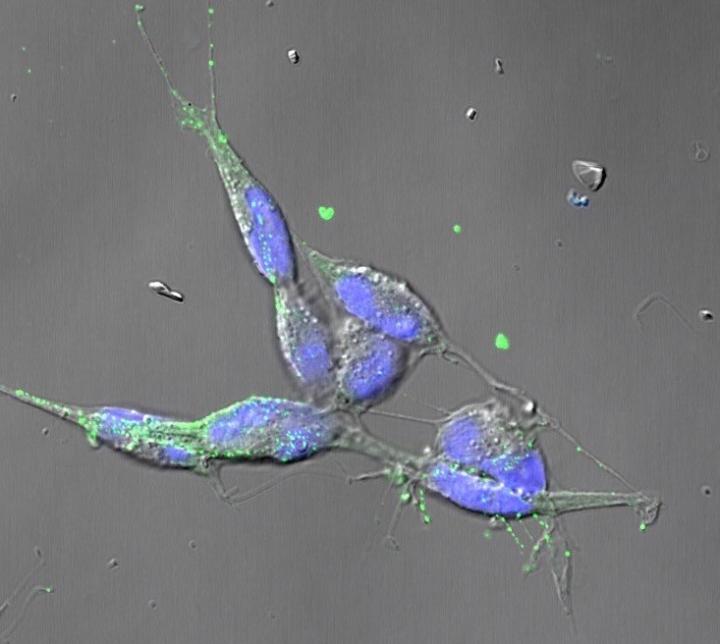
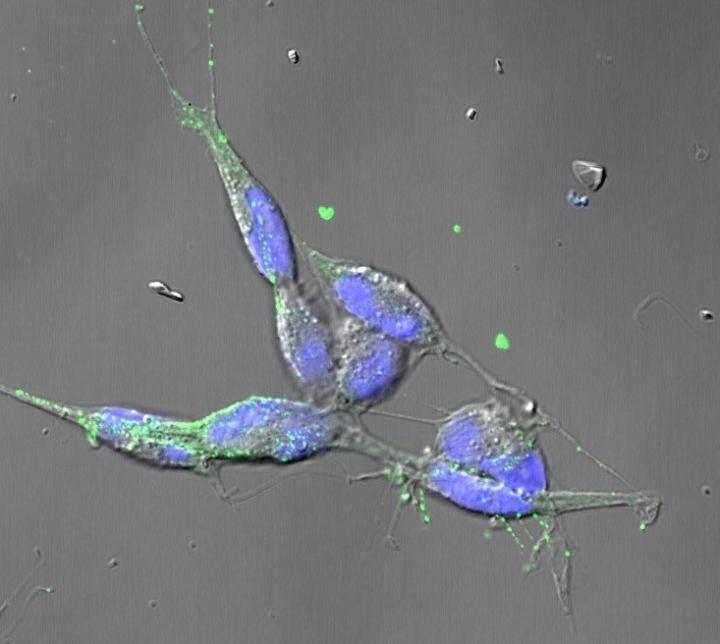
Credit: Valeria Solari, MD, MRCS; Children's Hospital Los Angeles
Investigators at the Children's Center for Cancer and Blood Diseases at Children's Hospital Los Angeles provide preclinical evidence that the presence of tumor-associated macrophages–a type of immune cell–can negatively affect the response to chemotherapy against neuroblastoma. Macrophage survival is supported by colony-stimulating factor-1 (CSF-1). Using a small molecule inhibitor of CSF-1 named BLZ945, in combination with chemotherapy, investigators significantly reduced the number of macrophages within neuroblastoma tumors and improved the efficacy of chemotherapy in T cell deficient mice. These findings suggest the possibility that this combination therapy might be effective in patients with high-risk disease, even those who have limited anti-tumor T cell responses. The study was recently published in the International Journal of Cancer.
Neuroblastoma is the second most common solid tumor effecting children, and individuals with high-risk disease have a mortality rate of approximately 50 percent. Tumor-associated macrophages (TAMs) are a type of immune cell in tumors that is known to promote cancer growth. In neuroblastoma, the presence of TAMs is an important predictor of poor outcomes for patients with high-risk disease.
While T cells are critical to the human body's immune system, and act as a defense against cancers, certain cancers–like neuroblastoma–can evade the T cell response. The research team at CHLA, led by Robert C. Seeger, MD, studied neuroblastoma in T cell depleted mice in order to determine the impact of specific immune cells on the efficacy of chemotherapy.
"On average, children's cancers have far fewer mutations than adult cancers, which means there is much less for a T cell to recognize on a child's cancer. If there is less of a T cell response, you may want to consider using therapies that can work even in the absence of T cells," explained Seeger.
According to Seeger, previous studies combining CSF-1R blockade with chemotherapy have examined the relationship of tumors and macrophages in immune competent mice, and much of the efficacy of CSF-1R inhibition has been attributed to infiltrating T cells. To date, no studies have evaluated the role of macrophages on the efficacy of chemotherapy against neuroblastoma in a specific breed of mice that allows the effect of macrophages to be examined without a contribution from T cells. Seeger's team believed such an evaluation was of interest because the anti-tumor activity of T lymphocytes in patients with neuroblastoma may be limited.
To examine whether the depletion of TAMs from within neuroblastoma tumors could improve response to chemotherapy, the investigators co-cultured neuroblastoma cells with monocytes–a blood cell that gives rise to macrophages. When they administered the chemotherapeutic agent topotecan alone, they found that the neuroblastoma cells actually increased their release of the protein CSF-1, adding fuel to promote the number of TAMs. Promisingly, pairing topotecan with the CSF-1 blockade, BLZ945, successfully inhibited neuroblastoma cell growth by reducing the number of macrophages and improved mouse survival.
"Our findings not only show that reducing the number of tumor-associated macrophages from neuroblastoma tumors can be associated with an improved response to chemotherapy, but that this can occur without requiring a contribution from T cells," said Seeger, who is a professor of pediatrics with the Keck School of Medicine at the University of Southern California.
This finding represents an important step toward testing BLZ945 in clinical trials for neuroblastoma. Seeger and his colleagues hope that these findings will enable the development of new combination therapies with the potential to improve survival in children with high-risk neuroblastoma. Additionally, the findings may have implications for other cancers in which anti-cancer T cell responses are limited.
###
Additional contributors to the study include Mathew W. Webb, from Texas Children's Hospital, Houston, TX, along with Michael A. Sheard, Wei-Yao Liu, Hong-Wei Wu, Jeremy R. Jackson, Richard Sposto, all of Children's Hospital Los Angeles, Jemily Malvar, of the Keck School of Medicine of USC, and Dylan Daniel, of Novartis Institutes of BioMedical Research, currently of MI Bioresearch, Ann Arbor, MI. Seeger and Sposto are also faculty members of the Keck School of Medicine of USC. This work was supported in part by grants P01 CA81403 and R01 CA182633 from the National Cancer Institute, and from the T.J. Martell Foundation.
Media Contact
Ellin Kavanagh
[email protected]
323-361-8505
@childrensLA
http://www.childrenshospitalla.org