

• HOME
  • NEWS
  • EXPLORE
    • CAREER
      • Companies
      • Jobs
    • EVENTS
    • iGEM
      • News
      • Team
    • PHOTOS
    • VIDEO
    • WIKI
  • BLOG
  • COMMUNITY
    • FACEBOOK
    • INSTAGRAM
    • TWITTER
Saturday, February 7, 2026
BIOENGINEER.ORG
No Result
View All Result
  • Login
  • HOME
  • NEWS
  • EXPLORE
    • CAREER
      • Companies
      • Jobs
        • Lecturer
        • PhD Studentship
        • Postdoc
        • Research Assistant
    • EVENTS
    • iGEM
      • News
      • Team
    • PHOTOS
    • VIDEO
    • WIKI
  • BLOG
  • COMMUNITY
    • FACEBOOK
    • INSTAGRAM
    • TWITTER
  • HOME
  • NEWS
  • EXPLORE
    • CAREER
      • Companies
      • Jobs
        • Lecturer
        • PhD Studentship
        • Postdoc
        • Research Assistant
    • EVENTS
    • iGEM
      • News
      • Team
    • PHOTOS
    • VIDEO
    • WIKI
  • BLOG
  • COMMUNITY
    • FACEBOOK
    • INSTAGRAM
    • TWITTER
No Result
View All Result
Bioengineer.org
No Result
View All Result
Home NEWS Science News Health

Johns Hopkins performs first total penis and scrotum transplant in the world

Bioengineer by Bioengineer
April 23, 2018
in Health
Reading Time: 2 mins read
0
Share on FacebookShare on TwitterShare on LinkedinShare on RedditShare on Telegram
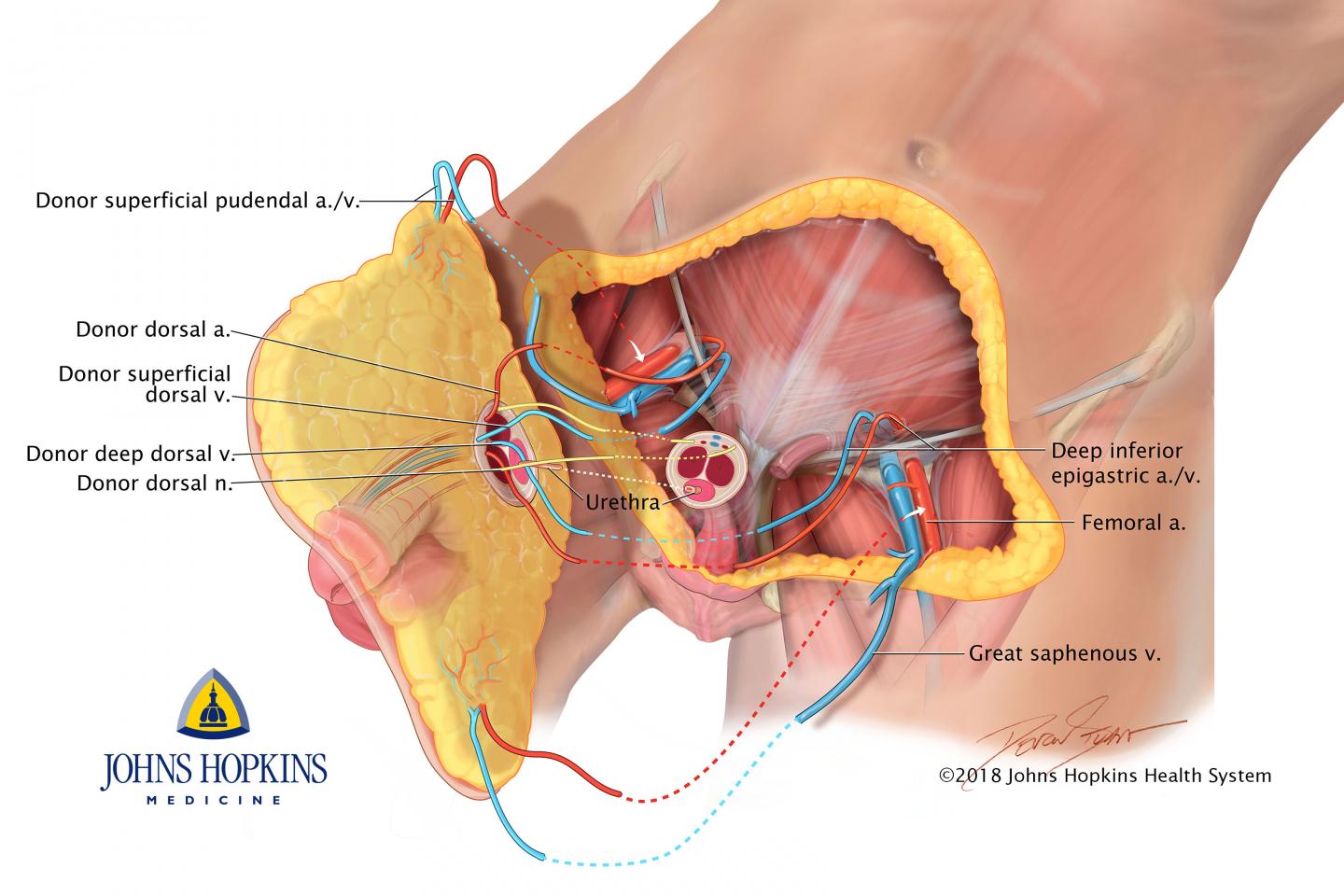
IMAGE

Credit: Devon Stuart for Johns Hopkins Medicine

Many soldiers returning from combat bear visible scars, or even lost limbs, caused by blasts from improvised explosive devices, or IEDs. However, some servicemen also return with debilitating hidden injuries — the loss of all or part of their genitals. Now, the Johns Hopkins reconstructive surgery team that performed the country's first bilateral arm transplant in a wounded warrior has successfully performed the first total penis and scrotum transplant in the world.

"We are hopeful that this transplant will help restore near-normal urinary and sexual functions for this young man," says W.P. Andrew Lee, M.D., professor and director of plastic and reconstructive surgery at the Johns Hopkins University School of Medicine.

A team of nine plastic surgeons and two urological surgeons was involved in the 14-hour surgery on March 26. They transplanted from a deceased donor the entire penis, scrotum (without testicles) and partial abdominal wall.

"It's a real mind-boggling injury to suffer, it is not an easy one to accept," says the recipient who is a veteran who sustained injuries in Afghanistan and wishes to remain anonymous. "When I first woke up, I felt finally more normal… [with] a level of confidence as well. Confidence… like finally I'm okay now," he says.

The recipient is a veteran who sustained injuries in Afghanistan and wishes to remain anonymous. He has recovered from the surgery and is expected to be discharged from the hospital this week.

While it's possible to reconstruct a penis using tissue from other parts of the body, says Lee, a prosthesis implant would be necessary to achieve an erection, and that comes with a much higher rate of infection. Additionally, due to other injuries, servicemen often don't have enough viable tissue from other parts of their bodies to work with.

This type of transplant, where a body part or tissue is transferred from one individual to another, is called vascularized composite allotransplantation. The surgery involves transplanting skin, muscles and tendons, nerves, bone and blood vessels. As with any transplant surgery, tissue rejection is a concern. The patient is put on a regimen of immunosuppressive drugs to prevent rejection. Lee's team has developed an immune modulation protocol aimed at minimizing the number of these drugs needed to prevent rejection.

###

To view or download the diagram and other digital assets, such as b-roll, please click here.

Media Contact

Archana Nilaweera
[email protected]
410-502-9468
@HopkinsMedicine

http://www.hopkinsmedicine.org

Original Source

https://www.hopkinsmedicine.org/news/media/releases/johns_hopkins_performs_first_total_penis_and_scrotum_transplant_in_the_world

Share12Tweet8Share2ShareShareShare2

Related Posts

Digital Health Perspectives from Baltic Sea Experts

February 7, 2026

Exploring Decision-Making in Dementia Caregivers’ Mobility

February 7, 2026

Succinate Receptor 1 Limits Blood Cell Formation, Leukemia

February 7, 2026

Palmitoylation of Tfr1 Drives Platelet Ferroptosis and Exacerbates Liver Damage in Heat Stroke

February 7, 2026
Please login to join discussion

POPULAR NEWS

  • Robotic Ureteral Reconstruction: A Novel Approach

    Robotic Ureteral Reconstruction: A Novel Approach

    82 shares
    Share 33 Tweet 21
  • Digital Privacy: Health Data Control in Incarceration

    63 shares
    Share 25 Tweet 16
  • Study Reveals Lipid Accumulation in ME/CFS Cells

    57 shares
    Share 23 Tweet 14
  • Breakthrough in RNA Research Accelerates Medical Innovations Timeline

    53 shares
    Share 21 Tweet 13

About

We bring you the latest biotechnology news from best research centers and universities around the world. Check our website.

Follow us

Recent News

Digital Health Perspectives from Baltic Sea Experts

Florida Cane Toad: Complex Spread and Selective Evolution

Exploring Decision-Making in Dementia Caregivers’ Mobility

Subscribe to Blog via Email

Enter your email address to subscribe to this blog and receive notifications of new posts by email.

Join 73 other subscribers
  • Contact Us

Bioengineer.org © Copyright 2023 All Rights Reserved.

Welcome Back!

Login to your account below

Forgotten Password?

Retrieve your password

Please enter your username or email address to reset your password.

Log In
No Result
View All Result
  • Homepages
    • Home Page 1
    • Home Page 2
  • News
  • National
  • Business
  • Health
  • Lifestyle
  • Science

Bioengineer.org © Copyright 2023 All Rights Reserved.
