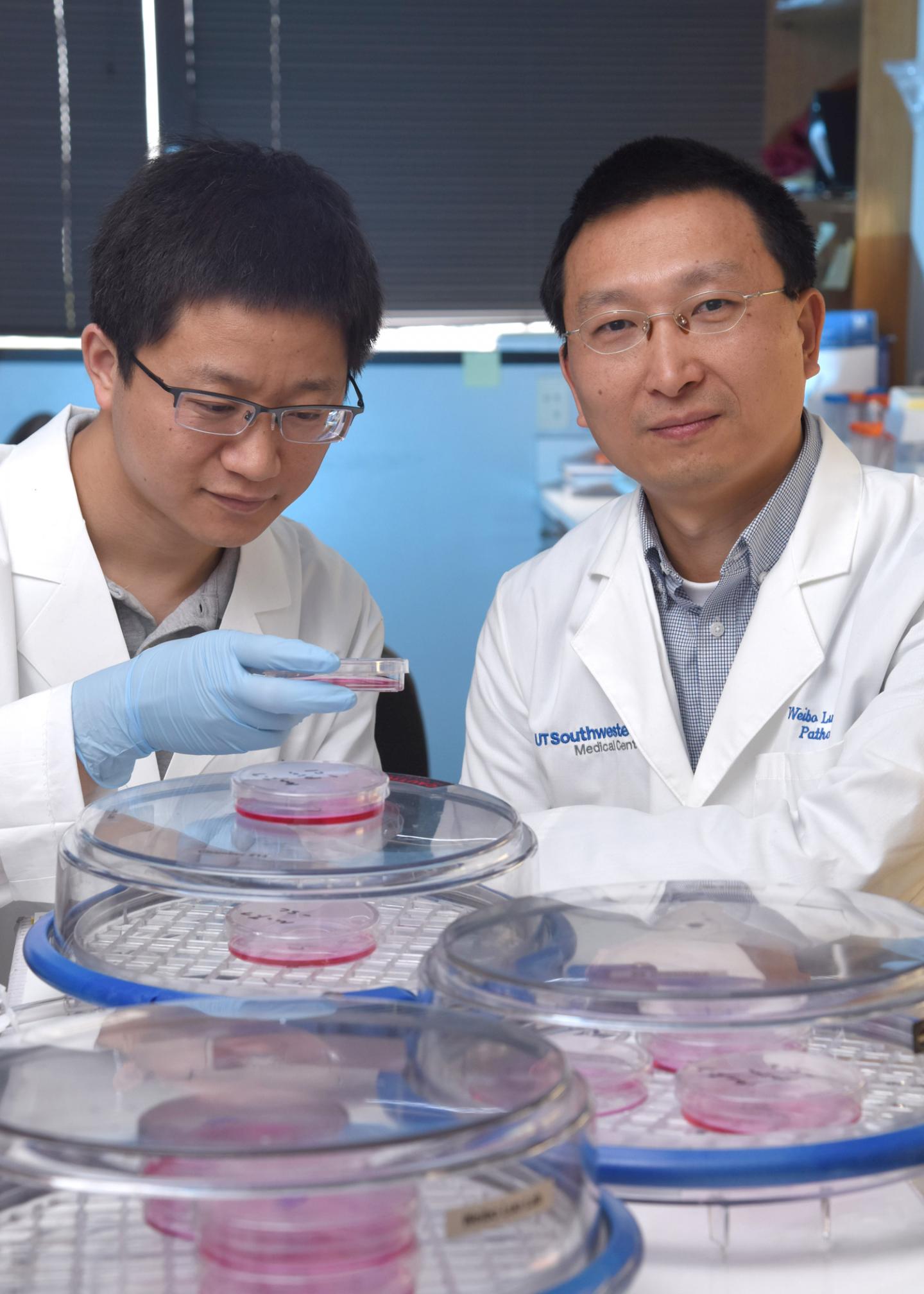
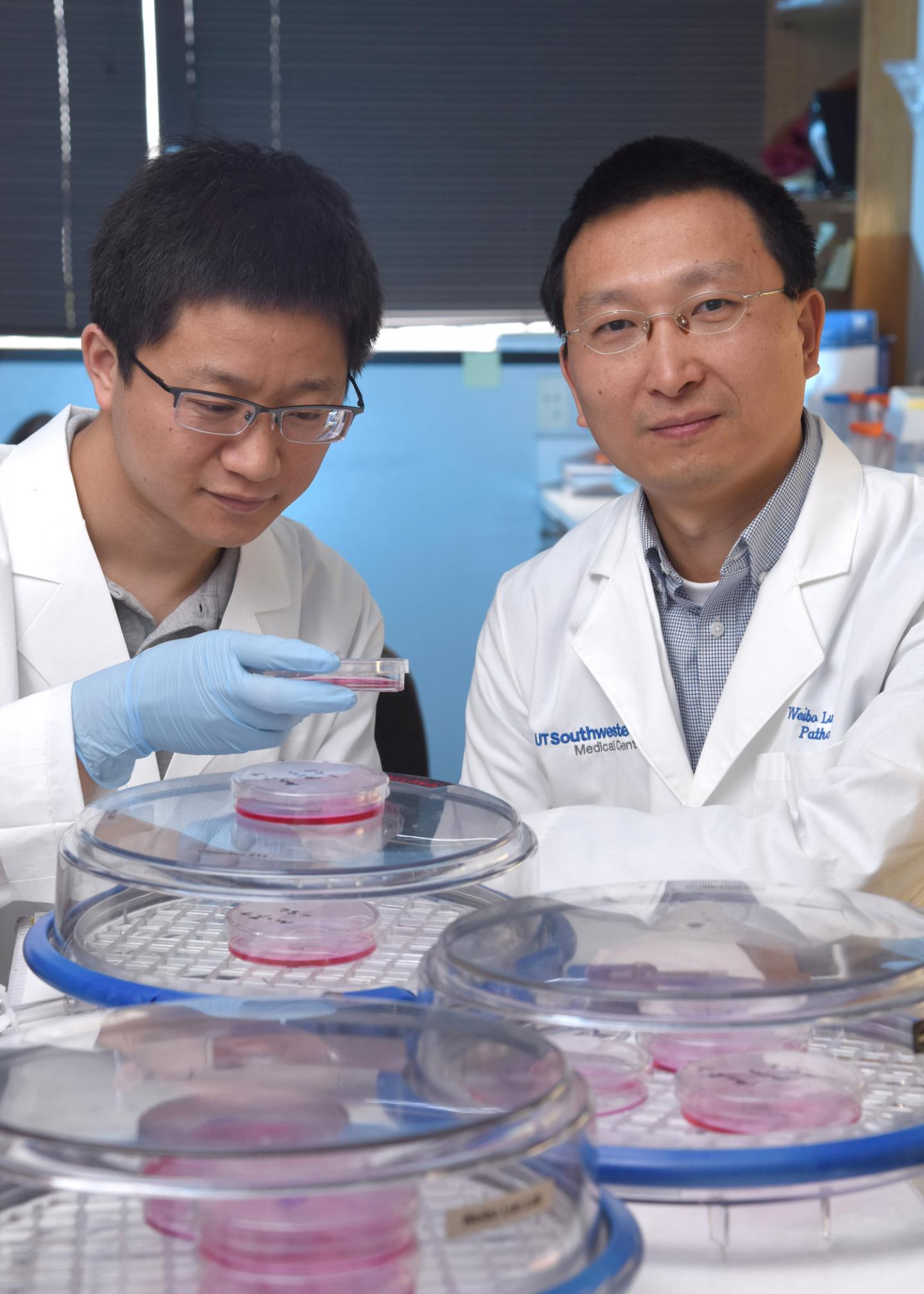
Credit: UT Southwestern Medical Center
DALLAS – April. 18, 2018 – Researchers at UT Southwestern Medical Center have identified a protein that is strongly associated with metastatic breast cancer and that could be a target for future therapies.
High levels of the protein ZMYND8 are correlated with poor survival in breast cancer patients, said Dr. Weibo Luo, Assistant Professor of Pathology and Pharmacology, and with the Harold C. Simmons Comprehensive Cancer Center.
Previous research has shown that breast cancer cells that are more aggressive in an oxygen-deprived, or hypoxic, environment. A protein family called hypoxia-inducible factor (HIF) controls responses to hypoxia, switching on pathways that lead to cancer cell growth and spread. "Our research shows that ZMYND8 is a regulator that activates hundreds of HIF-dependent oncogenes in breast cancer cells," Dr. Luo said.
Research with a mouse model of breast cancer showed that depletion of ZMYND8 blocks the growth of new blood vessels in tumors and leads to breast cancer cell death.
"Our studies uncovered a feedback loop that amplifies HIF-controlled oncogenes to drive breast tumor malignancy," said Dr. Yingfei Wang, Assistant Professor of Pathology, of Neurology and Neurotherapeutics, and with the Simmons Cancer Center and the Peter O'Donnell Jr. Brain Institute.
More about breast cancer
Breakthroughs: First-in-class drug holds promise for therapy-resistant breast cancer
Tips: Reducing the Risk of Breast Cancer
Services: Breast Cancer Services at Simmons Cancer Center
Affiliations: Peter O'Donnell Jr. Brain Institute, CPRIT
Research: Weibo Luo Lab, Yingfei Wang Lab
Approximately 250,000 women were diagnosed with breast cancer in 2017, according to National Institutes of Health figures, and about 40,000 died of the disease. Metastatic breast cancer is cancer that has spread to other sites in the body, and the vast majority of breast cancer deaths occur in patients in whom the cancer has metastasized.
"This work uncovers a primary epigenetic mechanism of HIF-mediated breast cancer progression, and reveals a possible molecular target for diagnosis and treatment of aggressive disease," Dr. Luo said.
The research appears in the Journal of Clinical Investigation.
###
Other UT Southwestern faculty members who contributed to this research are Dr. Yan Peng, Associate Professor of Pathology; and Dr. Chao Xing, Associate Professor of Bioinformatics and Clinical Sciences and with the Eugene McDermott Center for Human Growth and Development.
Other UT Southwestern researchers who participated in this work are first author Yan Chen, post-doctoral researcher; Bo Zhang, post-doctoral researcher; Lei Bao, post-doc researcher; Mingming Yang, research assistant; Ashwani Kumar, computational biologist; Jennifer Wang, research assistant; and Chenliang Wang, postdoctoral researcher.
This work was supported by the Susan G. Komen Foundation, the National Institutes of Health, the Cancer Prevention and Research Institute of Texas, and the American Cancer Society.
The Harold C. Simmons Comprehensive Cancer Center, one of 49 NCI-designated Comprehensive Cancer Centers in the U.S. and the only one in North Texas, is among just 30 U.S. cancer research centers to be designated by the NCI as a National Clinical Trials Network Lead Academic Participating Site.
About UT Southwestern Medical Center
UT Southwestern, one of the premier academic medical centers in the nation, integrates pioneering biomedical research with exceptional clinical care and education. The institution's faculty has received six Nobel Prizes, and includes 22 members of the National Academy of Sciences, 17 members of the National Academy of Medicine, and 14 Howard Hughes Medical Institute Investigators. The faculty of more than 2,700 is responsible for groundbreaking medical advances and is committed to translating science-driven research quickly to new clinical treatments. UT Southwestern physicians provide care in about 80 specialties to more than 100,000 hospitalized patients, 600,000 emergency room cases, and oversee approximately 2.2 million outpatient visits a year.
Media Contact
Cathy Frisinger
[email protected]
@UTSWNews
http://www.swmed.edu
Original Source
http://www.utsouthwestern.edu/newsroom/articles/year-2018/protein-breast-cancer.html