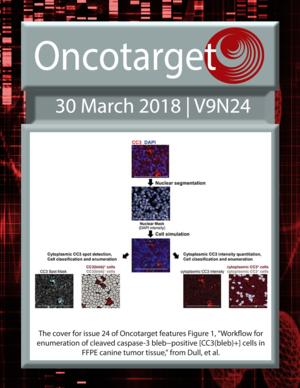
Credit: Oncotarget
Existing microscopy-based methods of detecting apoptosis, such as TUNEL (terminal deoxynucleotidyl transferase dUTP nick-end labeling), have limited quantitative capabilities due to insufficient signal-to-noise ratios. Researchers at the National Cancer Institute and National Cancer Institute-Frederick have addressed this issue via development of a highly specific apoptosis assay designed for immunofluorescence microscopy analysis of fixed core needle biopsy specimens.
The high specificity of this novel assay is due to the measurement of colocalization of two independent markers of apoptosis. The first marker is γH2AX, the serine 139-phosphorylated form of histone H2AX that is found at sites of DNA double-strand breaks and can arise either as a consequence of DNA damage or due to the DNA laddering that occurs during apoptosis. The second marker is the formation of cleaved caspase-3 aggregates or puncta, which arise concurrently with apoptosis-associated plasma membrane blebbing.
Cleaved caspase-3 (CC3) is used as a marker of apoptosis in sandwich ELISA and immunohistochemical analyses, but detection of this activated caspase in many non-apoptotic cells has confounded its use as a specific, quantitative marker of apoptosis. In this work, the researchers exploited apoptosis-associated changes in morphology to develop a CC3-based assay that is highly specific for detecting apoptotic cells. By employing an image analysis spot algorithm to identify CC3 puncta, the authors were able to quantitate apoptotic cells with an accuracy and precision superior to measurement of CC3 cytoplasmic signal intensity alone.
The authors applied this new methodology for apoptosis quantitation to address a long-standing issue in the pharmacodynamic analysis of cytotoxic anticancer agents: the mechanistically ambiguous nature of γH2AX which can indicate either direct DNA damage from a genotoxic agent or double-strand breaks from the result of DNA laddering that occurs during apoptosis. Consequently, though there are numerous examples of γH2AX positivity in preclinical and clinical specimens, a positive γH2AX signal has been associated both with tumor volume reduction and tumor progression.
Through their quantitation of γH2AX and CC3 blebbing cellular colocalization in tumor specimens from xenograft models treated with various agents, the authors demonstrated that the γH2AX/CC3 blebbing colocalization assay is highly sensitive and allows for detection of even relatively low levels of apoptosis in a clinically suitable fashion. Application of this assay to needle biopsy specimens collected from canine lymphoma patients treated with indenoisoquinolines revealed significant γH2AX/CC3 blebbing colocalization in post-treatment tumor specimens from two patients experiencing tumor shrinkage and no such γH2AX/CC3 blebbing colocalization in tumors that were not responsive to these agents, providing further evidence that this assay generates reliable readouts of cell death associated with tumor reduction.
By developing a microscopy method to enumerate cells containing both γH2AX and membrane blebbing-associated CC3 structures, the authors were able to quantitate apoptotic tumor cells harboring DNA fragmentation and demonstrate the suitability of this assay for pharmacodynamic analyses of preclinical and clinical tumor specimens. This highly specific apoptosis assay can provide important insights into agent mechanisms of action across various drug classes.
###
Full text – http://www.oncotarget.com/index.php?journal=oncotarget&page=article&op=view&path%5B%5D=24936&path%5B%5D=78182
Correspondence to:
Deborah Wilsker at [email protected]
Ralph E. Parchment at [email protected]
About Oncotarget
Oncotarget is twice-weekly, peer-reviewed, open access biomedical journal covering research on all aspects of oncology and publishing sub-sections on topics beyond oncology such as Aging, Immunology and Microbiology, Autophagy, Pathology and Chromosomes and more. Oncotarget is published by Rapamycin Press, the publishing division of Impact Journals LLC.
Media Contact
Ryan James Jessup
[email protected]
202-638-9720
Original Source
http://www.oncotarget.com/news/pr/development-of-a-quantitative-pharmacodynamic-assay-for-apoptosis-in-fixed-tumor-tissue-and-its-application-in-distinguishing-cytotoxic-drug-induced-dna-double-strand-breaks-from-dna-double-strand-breaks-associated-w