• HOME
  • NEWS
  • EXPLORE
    • CAREER
      • Companies
      • Jobs
    • EVENTS
    • iGEM
      • News
      • Team
    • PHOTOS
    • VIDEO
    • WIKI
  • BLOG
  • COMMUNITY
    • FACEBOOK
    • INSTAGRAM
    • TWITTER
Saturday, February 7, 2026
BIOENGINEER.ORG
No Result
View All Result
  • Login
  • HOME
  • NEWS
  • EXPLORE
    • CAREER
      • Companies
      • Jobs
        • Lecturer
        • PhD Studentship
        • Postdoc
        • Research Assistant
    • EVENTS
    • iGEM
      • News
      • Team
    • PHOTOS
    • VIDEO
    • WIKI
  • BLOG
  • COMMUNITY
    • FACEBOOK
    • INSTAGRAM
    • TWITTER
  • HOME
  • NEWS
  • EXPLORE
    • CAREER
      • Companies
      • Jobs
        • Lecturer
        • PhD Studentship
        • Postdoc
        • Research Assistant
    • EVENTS
    • iGEM
      • News
      • Team
    • PHOTOS
    • VIDEO
    • WIKI
  • BLOG
  • COMMUNITY
    • FACEBOOK
    • INSTAGRAM
    • TWITTER
No Result
View All Result
Bioengineer.org
No Result
View All Result
Home NEWS Science News Health

Basel researchers succeed in cultivating cartilage from stem cells

Bioengineer by Bioengineer
April 16, 2018
in Health
Reading Time: 2 mins read
0
Share on FacebookShare on TwitterShare on LinkedinShare on RedditShare on Telegram
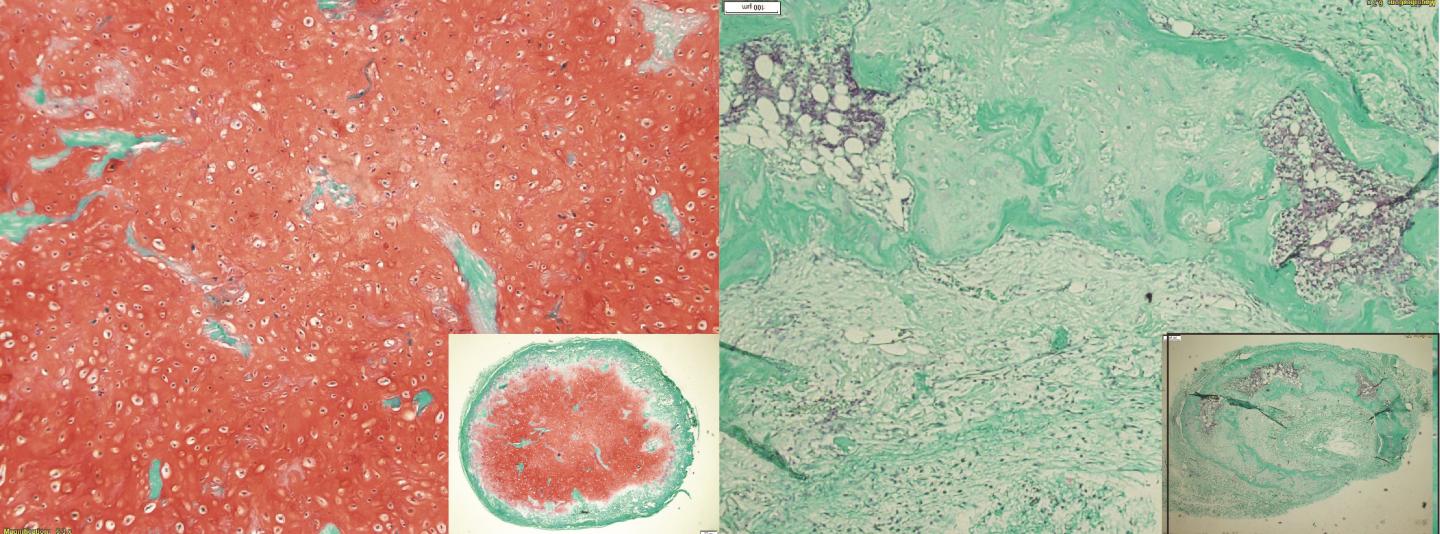
IMAGE

Credit: Image: University of Basel, Department of Biomedicine

Stable joint cartilage can be produced from adult stem cells originating from bone marrow. This is made possible by inducing specific molecular processes occurring during embryonic cartilage formation, as researchers from the University and University Hospital of Basel report in the scientific journal PNAS.

Certain mesenchymal stem/stromal cells from the bone marrow of adults are considered extremely promising for skeletal tissue regeneration. These adult stem cells usually develop into cartilage tissue which later naturally remodels into bone tissue. Even if the stem cells are induced to differentiate into cartilage cells, they spontaneously mature into a so-called "hypertrophic" state, ultimately leading to the formation of bone tissue; this is similar to the cartilaginous tissue temporarily formed after a fracture.

Inhibiting signaling pathways

Prof. Dr. Ivan Martin's research group at the Department of Biomedicine has now been able to demonstrate that by forcing certain molecular events occurring during the embryonic development of articular cartilage it is possible to generate stable cartilage tissue from adult human mesenchymal stem cells. This can be achieved by inhibiting the signaling pathway of a specific protein (Bone Morphogenetic Protein, BMP). The Basel team generated these results after many years of cooperation with the Novartis Institutes for Biomedical Research, which produced and supplied the inhibitors.

Specifically, the scientists investigated two highly specific BMP receptor inhibitors in a special device (microfluid platform) developed in cooperation with Politecnico di Milano. With the use of this new technology, they were able to show that the temporary blocking of specific BMP receptors ­- even if only for a limited time – is sufficient to maintain stable cartilage tissue, both in the laboratory and in a mouse model.

Embryonic cartilage formation as a model

These results open new perspectives in the regeneration of articular cartilage as well as in the establishment of stem cell-based models of cartilage development, physiology, and possibly pathology. "Importantly, we have achieved our insights by mimicking molecular processes occurring during embryonic cartilage formation," says Ivan Martin. This confirms the vital role of "developmental engineering," in which natural processes are mimicked to control the development and specification of adult stem and progenitor cells.

###

Media Contact

Iris Mickein
[email protected]
41-612-072-495
@UniBasel_en

http://www.unibas.ch/

Related Journal Article

http://dx.doi.org/10.1073/pnas.1720658115
Share12Tweet8Share2ShareShareShare2

Related Posts

Personalized Guide to Understanding and Reducing Chemicals

February 7, 2026

Inflammasome Protein ASC Drives Pancreatic Cancer Metabolism

February 7, 2026

Phage-Antibiotic Combo Beats Resistant Peritoneal Infection

February 7, 2026

Boosting Remote Healthcare: Stepped-Wedge Trial Insights

February 7, 2026
Please login to join discussion

POPULAR NEWS

  • Robotic Ureteral Reconstruction: A Novel Approach

    Robotic Ureteral Reconstruction: A Novel Approach

    82 shares
    Share 33 Tweet 21
  • Digital Privacy: Health Data Control in Incarceration

    63 shares
    Share 25 Tweet 16
  • Study Reveals Lipid Accumulation in ME/CFS Cells

    57 shares
    Share 23 Tweet 14
  • Breakthrough in RNA Research Accelerates Medical Innovations Timeline

    53 shares
    Share 21 Tweet 13

About

We bring you the latest biotechnology news from best research centers and universities around the world. Check our website.

Follow us

Recent News

Personalized Guide to Understanding and Reducing Chemicals

Inflammasome Protein ASC Drives Pancreatic Cancer Metabolism

Phage-Antibiotic Combo Beats Resistant Peritoneal Infection

Subscribe to Blog via Email

Enter your email address to subscribe to this blog and receive notifications of new posts by email.

Join 73 other subscribers
  • Contact Us

Bioengineer.org © Copyright 2023 All Rights Reserved.

Welcome Back!

Login to your account below

Forgotten Password?

Retrieve your password

Please enter your username or email address to reset your password.

Log In
No Result
View All Result
  • Homepages
    • Home Page 1
    • Home Page 2
  • News
  • National
  • Business
  • Health
  • Lifestyle
  • Science

Bioengineer.org © Copyright 2023 All Rights Reserved.