• HOME
  • NEWS
  • EXPLORE
    • CAREER
      • Companies
      • Jobs
    • EVENTS
    • iGEM
      • News
      • Team
    • PHOTOS
    • VIDEO
    • WIKI
  • BLOG
  • COMMUNITY
    • FACEBOOK
    • INSTAGRAM
    • TWITTER
Saturday, February 7, 2026
BIOENGINEER.ORG
No Result
View All Result
  • Login
  • HOME
  • NEWS
  • EXPLORE
    • CAREER
      • Companies
      • Jobs
        • Lecturer
        • PhD Studentship
        • Postdoc
        • Research Assistant
    • EVENTS
    • iGEM
      • News
      • Team
    • PHOTOS
    • VIDEO
    • WIKI
  • BLOG
  • COMMUNITY
    • FACEBOOK
    • INSTAGRAM
    • TWITTER
  • HOME
  • NEWS
  • EXPLORE
    • CAREER
      • Companies
      • Jobs
        • Lecturer
        • PhD Studentship
        • Postdoc
        • Research Assistant
    • EVENTS
    • iGEM
      • News
      • Team
    • PHOTOS
    • VIDEO
    • WIKI
  • BLOG
  • COMMUNITY
    • FACEBOOK
    • INSTAGRAM
    • TWITTER
No Result
View All Result
Bioengineer.org
No Result
View All Result
Home NEWS

Stanford bioengineers introduce 'Bi-Fi'

Bioengineer by Bioengineer
August 31, 2013
in NEWS
Reading Time: 2 mins read
0
Monica Ortiz, PhD candidate, bioengineering. Photo: Norbert von der Groeben

Monica Ortiz, PhD candidate, bioengineering. Photo: Norbert von der Groeben

Share on FacebookShare on TwitterShare on LinkedinShare on RedditShare on Telegram

The technology uses an innocuous virus called M13 to increase the complexity and amount of information that can be sent from cell to cell. The researchers say the Bi-Fi could help bioengineers create complex, multicellular communities that work together to carry out important biological functions. Cells naturally use chemicals to communicate with the chemical signals typically acting as both the message and the messenger. However, this method of communication is extremely limited in terms of complexity and bandwidth. “If your network connection is based on sugar then your messages are limited to ‘more sugar,’ ‘less sugar,’ or ‘no sugar’” explains Drew Endy, PhD, an assistant professor of bioengineering. By separating the messenger and the message, Endy and Monica Ortiz, a doctoral candidate in bioengineering, have been able to greatly increase the amount of data that can be transmitted.
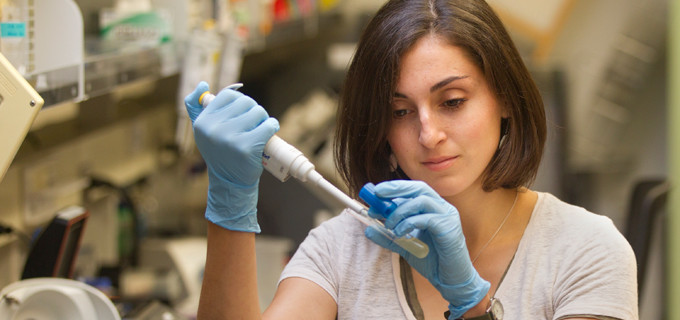
Monica Ortiz, PhD candidate, bioengineering. Photo: Norbert von der Groeben

They chose the virus M13 to act as the messenger because when it infects bacteria, it doesn’t kill its host but makes itself at home indiscriminately sending out DNA strands that it reproduces within its host. The engineers are able to control these strands of DNA, so custom DNA messages can be wrapped within proteins produced by M13 and sent out to infect other cells. Once they arrive in a new host, they release the packaged DNA message.

 The researchers liken their M13-based system to a wireless internet connection that allows cells to send and receive messages but doesn’t care about the content of the messages. “Effectively, we’ve separated the message from the channel. We can now send any DNA message we want to specific cells within a complex microbial community,” said Ortiz. Using DNA to store the message means that it can contain any sort of genetic instruction. M13 is known to have packaged DNA strands containing as many as 40,000 base pairs, which is far in excess of the majority of genetic messages of interest in bioengineering that range from several hundred to many thousand base pairs. Ortiz has also used M13 to broadcast genetic messages between cells that are separated by over seven centimeters (2.7 in) of a gelatinous medium, which she says is considered a very long-range, cellularly speaking.

The researchers believe that their Bi-Fi biological internet could lead to the development of biosynthetic factories consisting of huge masses of microbes collaborating to produce complex fuels, pharmaceuticals and other useful chemicals. Even more exciting, the researchers say that with improvements, the technology could one day be used in more complex three-dimensional programming of cellular systems, such as the regeneration of tissue of organs. “The biological Internet is in its very earliest stages,” says Ortix. “When the information Internet was first introduced in the 1970s, it would have been hard to imagine the myriad uses it sees today, so there’s no telling all the places this new work might lead.”

The team’s findings appear online in the Journal of Biological Engineering.

Source: Stanford University And Gizmag

Share12Tweet8Share2ShareShareShare2

Related Posts

Phage-Antibiotic Combo Beats Resistant Peritoneal Infection

February 7, 2026

Boosting Remote Healthcare: Stepped-Wedge Trial Insights

February 7, 2026

Barriers and Boosters of Seniors’ Physical Activity in Karachi

February 7, 2026

Evaluating Pediatric Emergency Care Quality in Ethiopia

February 7, 2026
Please login to join discussion

POPULAR NEWS

  • Robotic Ureteral Reconstruction: A Novel Approach

    Robotic Ureteral Reconstruction: A Novel Approach

    82 shares
    Share 33 Tweet 21
  • Digital Privacy: Health Data Control in Incarceration

    63 shares
    Share 25 Tweet 16
  • Study Reveals Lipid Accumulation in ME/CFS Cells

    57 shares
    Share 23 Tweet 14
  • Breakthrough in RNA Research Accelerates Medical Innovations Timeline

    53 shares
    Share 21 Tweet 13

About

We bring you the latest biotechnology news from best research centers and universities around the world. Check our website.

Follow us

Recent News

Phage-Antibiotic Combo Beats Resistant Peritoneal Infection

Boosting Remote Healthcare: Stepped-Wedge Trial Insights

Barriers and Boosters of Seniors’ Physical Activity in Karachi

Subscribe to Blog via Email

Enter your email address to subscribe to this blog and receive notifications of new posts by email.

Join 73 other subscribers
  • Contact Us

Bioengineer.org © Copyright 2023 All Rights Reserved.

Welcome Back!

Login to your account below

Forgotten Password?

Retrieve your password

Please enter your username or email address to reset your password.

Log In
No Result
View All Result
  • Homepages
    • Home Page 1
    • Home Page 2
  • News
  • National
  • Business
  • Health
  • Lifestyle
  • Science

Bioengineer.org © Copyright 2023 All Rights Reserved.