Credit: Credit: PHOTO CREDIT: Maricruz Kwon, UTHealth
Researchers at McGovern Medical School at The University of Texas Health Science Center at Houston (UTHealth) have been awarded grants from the National Institutes of Health (NIH) to explore how the buildup of protein deposits in the brain can trigger dementia and stroke.
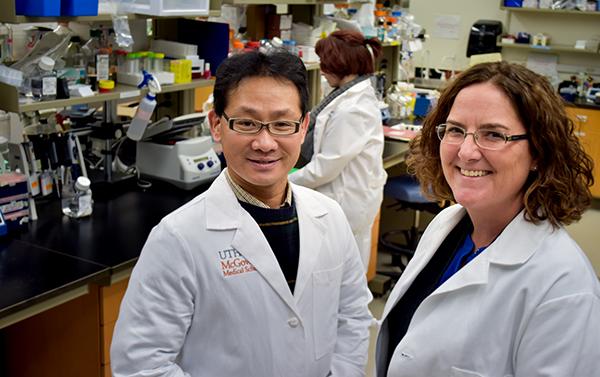
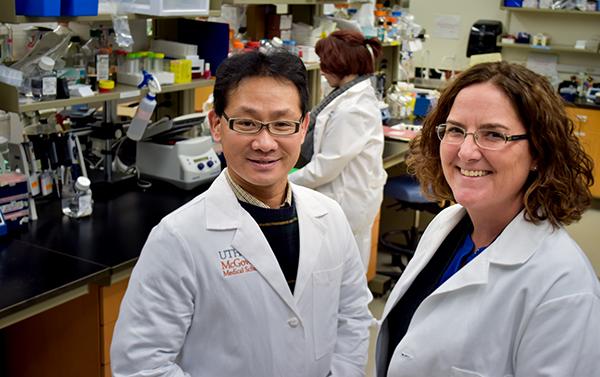
Louise McCullough, M.D., Ph.D., professor and Roy M. and Phyllis Gough Huffington Distinguished Chair in the Department of Neurology at McGovern Medical School at UTHealth, and Robert Bryan, Ph.D., of Baylor College of Medicine, were awarded a $3.7 million grant to study the gut-brain connection in dementia and aging.
Akihiko Urayama, Ph.D., assistant professor of neurology at McGovern Medical School, received $2.2 million to examine the brain's clearance system.
Both teams are part of the Brain, Rejuvenation, Aging, Inflammation, Neurodegeneration and Stroke (BRAINS) research laboratory at McGovern Medical School. In addition to McCullough and Urayama, Sean Marrelli, Ph.D., Jun Li, Ph.D., Fudong Liu, M.D., and Venugopal Venna, Ph.D. , in the BRAINS laboratory are studying how to reverse age-related inflammation, treat vascular dementia and enhance recovery after brain injury.
McCullough and Urayama are focused on a major cause of dementia and stroke – cerebral amyloid angiopathy (CAA). This is caused by a buildup of a protein called amyloid on the walls of the blood vessels of the brain, which makes them leaky and prone to rupture.
Most people with Alzheimer's disease have CAA and many stroke survivors have it as well.
"The way in which the brain communicates with peripheral organs such as the gut changes with age," said McCullough, the chief of the neurology service at Memorial Hermann-Texas Medical Center and member of UT Physicians. The bacteria that live in the gut (the microbiome) have been increasingly recognized as a major factor in diseases as diverse as autism, diabetes, obesity and stroke.
"This work will examine how manipulating the microbiome, the population of bacteria residing in the gut, influences the onset and progression of CAA," she said. "We will look at how gender and age affect progression of disease, and try to alter the microbiome to slow down memory deficits."
In a mouse model of CAA, McCullough hopes to stem the amyloid buildup by altering the microbiome. She and Bryan will identify pathogenic bacteria and hope to alter them to improve disease progression.
Urayama's team is examining how the brain's clearance system can become impaired by aging and stroke.
Conducting tests in a mouse model of Alzheimer's and CAA, Urayama has identified a mechanism associated with amyloid-β clearance. "We want to confirm our results and develop clinical trials that will help patients with dementia," he said.
Awarded by the NIH's National Institute on Aging, McCullough' grant (RF1AG058473) is titled "Dynamic Non-Neuronal Interactions between the Gut Microbiota and the Brain in Aging and Cerebral Amyloid Angiopathy" and Urayama's award (RF1AG057576) is called "Glymphatic Clearance of Amyloid-β is Impaired by Fibronectin in the Basement Membrane."
McCullough and Urayama are both on the faculty of The University of Texas MD Anderson Cancer Center UTHealth Graduate School of Biomedical Sciences.
"The team effort with others in the BRAINS laboratories, neurology, the Graduate School of Biomedical Sciences, Baylor College of Medicine and superb new collaborators throughout the Texas Medical Center will help us tremendously in our mission to treat brain disease," McCullough said.
"A collaborative approach is the only way we will be able to make great discoveries that will help us treat patients," Urayama said.
###
Media Contact
Robert Cahill
[email protected]
713-500-3030
http://www.uthouston.edu