Credit: Carla Shaffer / AAAS
A team of chemical and biomedical engineers from the Cockrell School of Engineering at The University of Texas at Austin, in collaboration with researchers from the University of Pennsylvania, have discovered that HIV-infected patients experience a dysfunction in a certain type of immune cell: the follicular helper T (Tfh) cell.
In a paper published today in Science Immunology, the authors outline how, through combining a sophisticated sequencing technique with a mass cytometry method (the measurement of cell characteristics), they discovered the Tfh cell dysfunction.
According to the latest figures from the World Health Organization, about 40 million people worldwide are living with HIV/AIDS. In the U.S., about 1 million are living with the virus, and 1 in 7 of those infected don't know it. Overall, the number of recorded cases has been in steady decline — thanks to medical advances and greater public awareness. Still, major information gaps remain in our understanding of the fundamental nature of HIV, making every new insight important.
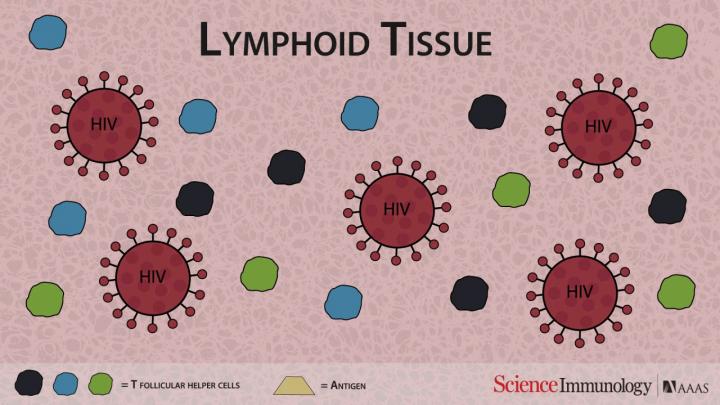
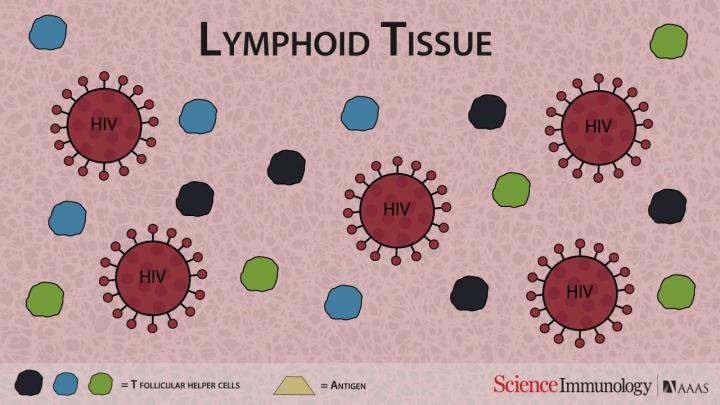
The UT Austin research team's finding is significant because the Tfh cells — which are present in greater numbers in HIV-infected patients than in healthy individuals– typically help fight off infection by communicating with other immune-supporting cells in the lymph nodes (the immune system's command center) about an impending viral attack. The researchers found that the Tfh cells present in those infected with HIV are not playing their usual part to defend against viral infections.
Led by UT Austin assistant professor Jenny Jiang in the Department of Biomedical Engineering, the research team combined techniques and approaches developed by Jiang and Laura Su, assistant professor of medicine in Penn's Perelman School of Medicine. Together, these technologies allowed the team to comprehensively profile T cells in the lymph node glands of HIV patients.
"These types of cells play a critical role during viral infections of any kind," Jiang said. "They communicate with other immune cells and provide instructions to B cells, for example, to produce virus-neutralizing antibodies that not only kill it off but also help prevent future infections."
Although the CD4+ T cell is notoriously depleted in patients infected with HIV, the population of Tfh cells is actually more elevated in the lymph nodes of those infected with HIV than it is in healthy individuals. This paradox is what makes further analysis of Tfh cell behavior by anyone studying HIV so vital.
Based on their central role in generating protective antibodies, it would be intuitive to assume that the increased presence of Tfh cells should result in greater resistance to infection. However, the researchers found this not to be the case, suggesting that Tfh cells in HIV patients are ineffective at sending signals to B cells to request help to fight off the infection.
"We believe Tfh cells behave differently when fighting chronic infections like HIV versus when fighting off acute infections like the common cold, potentially making them an easy target for HIV," Jiang said. "Our next step is to determine why the Tfh cell dysfunction occurs in HIV-infected patients, moving us one step closer to better understanding the virus."
###
Other investigators include graduate students from UT's Institute for Cellular and Molecular Biology. The team also collaborated with the Instituto Nacional de Enfermedades Respiratorias in Mexico.
The study was supported in part by the UT Austin Cockrell School of Engineering Graduate Fellowship, the Smith Charitable Trust Foundation, the Penn Center for AIDS Research, the Veterans Affairs Merit Award, the National Institute of Allergy and Infectious Diseases, the National Institute on Aging, the National Institutes of Health Shared Instrumentation Grant Program and the Welch Foundation.
Media Contact
Johnny Holden
[email protected]
512-471-2129
@UTAustin
http://www.utexas.edu
Original Source
http://immunology.sciencemag.org/content/3/22/eaan8884