• HOME
  • NEWS
  • EXPLORE
    • CAREER
      • Companies
      • Jobs
    • EVENTS
    • iGEM
      • News
      • Team
    • PHOTOS
    • VIDEO
    • WIKI
  • BLOG
  • COMMUNITY
    • FACEBOOK
    • INSTAGRAM
    • TWITTER
Saturday, February 7, 2026
BIOENGINEER.ORG
No Result
View All Result
  • Login
  • HOME
  • NEWS
  • EXPLORE
    • CAREER
      • Companies
      • Jobs
        • Lecturer
        • PhD Studentship
        • Postdoc
        • Research Assistant
    • EVENTS
    • iGEM
      • News
      • Team
    • PHOTOS
    • VIDEO
    • WIKI
  • BLOG
  • COMMUNITY
    • FACEBOOK
    • INSTAGRAM
    • TWITTER
  • HOME
  • NEWS
  • EXPLORE
    • CAREER
      • Companies
      • Jobs
        • Lecturer
        • PhD Studentship
        • Postdoc
        • Research Assistant
    • EVENTS
    • iGEM
      • News
      • Team
    • PHOTOS
    • VIDEO
    • WIKI
  • BLOG
  • COMMUNITY
    • FACEBOOK
    • INSTAGRAM
    • TWITTER
No Result
View All Result
Bioengineer.org
No Result
View All Result
Home NEWS Science News Health

One in 3 older patients die following emergency department intubation

Bioengineer by Bioengineer
April 4, 2018
in Health
Reading Time: 2 mins read
0
Share on FacebookShare on TwitterShare on LinkedinShare on RedditShare on Telegram
IMAGE

Credit: Kei Ouchi, Brigham and Women's Hospital

Intubation in the emergency department is common and can prevent a patient from dying from a reversible condition. While the benefits of such intubation for young and otherwise healthy patients are clear, it is less obvious whether the benefits of intubation outweigh the risks in older patients. A new study by researchers at Brigham and Women's Hospital investigated the outcomes for patients aged 65 and older after emergency department intubation across a variety of conditions and disease. Their results are published in Journal of the American Geriatrics Society.

"A surprisingly large number of older patients who underwent intubation in the emergency department either died in the hospital or were discharged to a nursing home," said lead author Kei Ouchi, MD, MPH, of the Department of Emergency Medicine at BWH. "On average, one-third of patients over 65 who received intubation in the emergency department died in the hospital."

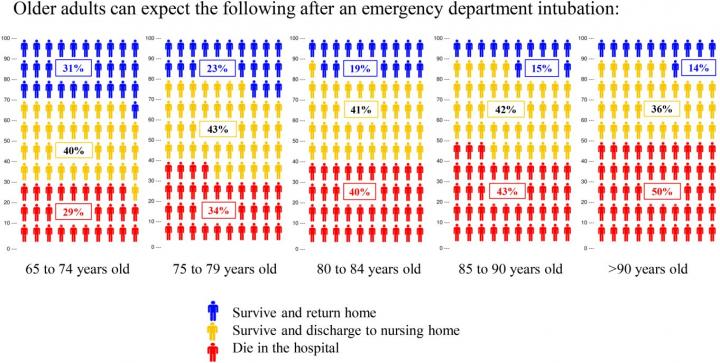
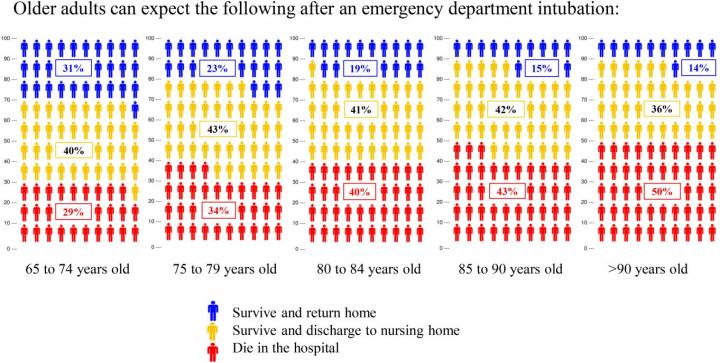
The retrospective study examined the outcomes of more than 41,000 adults aged 65 and older who were intubated in the emergency departments from 262 hospitals across the U.S. between 2008 and 2015. The study found that, overall, 33 percent of these patients died in the hospital after receiving intubation, 24 percent were discharged home, and 41 percent were discharged to a location other than home, such as a nursing home.

The researchers found that in-hospital mortality following intubation was worse for patients over 90 than any other group, with 50 percent of those patients dying in the hospital following intubation, and 14 percent of these patients being discharged home. However, the outcomes were not drastically better for patients on the younger side of the study, with 29 percent patients between 65 and 74 dying in hospital following emergency intubation, and only 31 percent of these patients being discharged home.

"It's important that older patients, their families and their care team are aware of this information and can use it to make informed, shared decisions about whether the patient should receive emergency intubation should such intubation be needed," said Ouchi. "It is difficult to make informed decisions on whether to provide intubation in older patients in an emergency situation because this is a very stressful and emotional time. Older patients, their families, and care providers are encouraged to make this decision before emergency situations requiring emergency department admission and intubation arise.

###

There was no conflict of interest or sponsor for any of the authors of the study.

Paper cited: Kei Ouchi, MD, MPH et al., "Prognosis After Emergency Department Intubation to Inform Shared Decision-Making". Journal of the American Geriatrics Society DOI: https://doi.org/10.1111/jgs.15361

Media Contact

Haley Bridger
[email protected]
617-525-6383
@BrighamWomens

http://www.brighamandwomens.org

Related Journal Article

http://dx.doi.org/10.1111/jgs.15361

Share13Tweet8Share2ShareShareShare2

Related Posts

Decoding Prostate Cancer Origins via snFLARE-seq, mxFRIZNGRND

February 7, 2026

Digital Health Perspectives from Baltic Sea Experts

February 7, 2026

Exploring Decision-Making in Dementia Caregivers’ Mobility

February 7, 2026

Succinate Receptor 1 Limits Blood Cell Formation, Leukemia

February 7, 2026
Please login to join discussion

POPULAR NEWS

  • Robotic Ureteral Reconstruction: A Novel Approach

    Robotic Ureteral Reconstruction: A Novel Approach

    82 shares
    Share 33 Tweet 21
  • Digital Privacy: Health Data Control in Incarceration

    63 shares
    Share 25 Tweet 16
  • Study Reveals Lipid Accumulation in ME/CFS Cells

    57 shares
    Share 23 Tweet 14
  • Breakthrough in RNA Research Accelerates Medical Innovations Timeline

    53 shares
    Share 21 Tweet 13

About

We bring you the latest biotechnology news from best research centers and universities around the world. Check our website.

Follow us

Recent News

Decoding Prostate Cancer Origins via snFLARE-seq, mxFRIZNGRND

Digital Health Perspectives from Baltic Sea Experts

Florida Cane Toad: Complex Spread and Selective Evolution

Subscribe to Blog via Email

Enter your email address to subscribe to this blog and receive notifications of new posts by email.

Join 73 other subscribers
  • Contact Us

Bioengineer.org © Copyright 2023 All Rights Reserved.

Welcome Back!

Login to your account below

Forgotten Password?

Retrieve your password

Please enter your username or email address to reset your password.

Log In
No Result
View All Result
  • Homepages
    • Home Page 1
    • Home Page 2
  • News
  • National
  • Business
  • Health
  • Lifestyle
  • Science

Bioengineer.org © Copyright 2023 All Rights Reserved.