• HOME
  • NEWS
  • EXPLORE
    • CAREER
      • Companies
      • Jobs
    • EVENTS
    • iGEM
      • News
      • Team
    • PHOTOS
    • VIDEO
    • WIKI
  • BLOG
  • COMMUNITY
    • FACEBOOK
    • INSTAGRAM
    • TWITTER
Saturday, February 7, 2026
BIOENGINEER.ORG
No Result
View All Result
  • Login
  • HOME
  • NEWS
  • EXPLORE
    • CAREER
      • Companies
      • Jobs
        • Lecturer
        • PhD Studentship
        • Postdoc
        • Research Assistant
    • EVENTS
    • iGEM
      • News
      • Team
    • PHOTOS
    • VIDEO
    • WIKI
  • BLOG
  • COMMUNITY
    • FACEBOOK
    • INSTAGRAM
    • TWITTER
  • HOME
  • NEWS
  • EXPLORE
    • CAREER
      • Companies
      • Jobs
        • Lecturer
        • PhD Studentship
        • Postdoc
        • Research Assistant
    • EVENTS
    • iGEM
      • News
      • Team
    • PHOTOS
    • VIDEO
    • WIKI
  • BLOG
  • COMMUNITY
    • FACEBOOK
    • INSTAGRAM
    • TWITTER
No Result
View All Result
Bioengineer.org
No Result
View All Result
Home NEWS Science News Biology

How does HIV escape cellular booby traps?

Bioengineer by Bioengineer
April 4, 2018
in Biology
Reading Time: 2 mins read
0
Share on FacebookShare on TwitterShare on LinkedinShare on RedditShare on Telegram
IMAGE

Credit: Kyoto University / Sato Lab

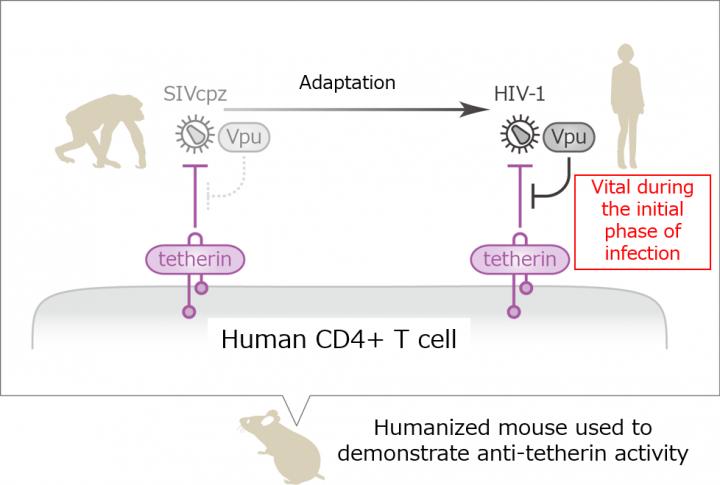
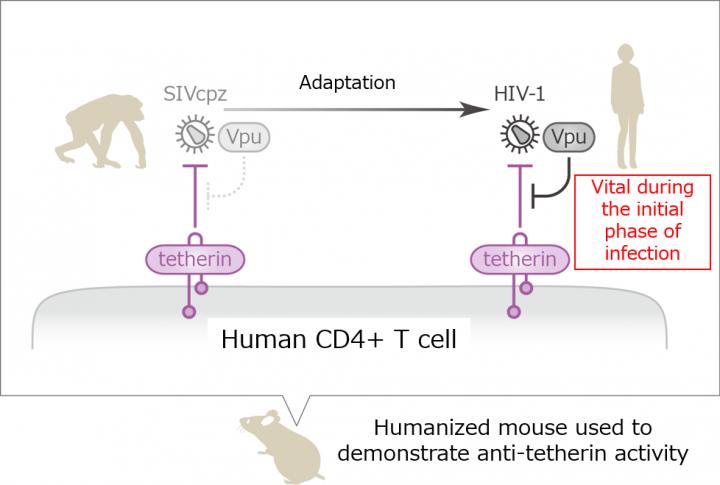
Human immunodeficiency virus — HIV — is believed to have evolved from a simian immunodeficiency virus, or SIV, that originated in chimpanzees. How SIV made the species jump has remained a mystery, since human bodies possess a defense mechanism that should prevent such infections. Tetherin, a crucial protein for this protection, acts as a sticky pad on the surface of infected cells, preventing them from releasing nascent virus particles.

In this evolutionary battle, viruses have developed their own arsenal of proteins as a countermeasure. For example, Vpu, an HIV accessory protein that targets tetherin, allows HIV to escape and spread.

An international team led by Kei Sato and Yoshio Koyanagi of Kyoto University set out to test whether the evolution of Vpu could have aided SIV in making the leap to humans. Their study, published in the journal Cell Host and Microbe, helps explain how HIV came into our world.

"We used an immunodeficient mouse model with a reconstituted human immune system, established through the transplantation of human blood-forming stem cells," explains Koyanagi. This design, he adds, allowed for both SIV and HIV infection to be studied in the mice.

Using reverse genetics to engineer several HIV strains with different Vpu mutants, the team investigated which Vpu function was key for successful virus infection.

"Vpu can inhibit immune signaling pathways in the cell and degrade tetherin," states Sato. "The Vpu variant responsible for downregulating tetherin was the most important property of Vpu for HIV."

They also found that returning tetherin to normal levels could suppress virus replication, suggesting that a minimal number of tetherin molecules can combat HIV.

Interestingly, SIV could not effectively infect human blood cells in the mouse model. But when SIV Vpu was endowed with properties resembling HIV Vpu — namely, anti-tetherin activity blood cell infection did occur.

"From an evolutionary standpoint, our study suggests that a gain-of-function ability in Vpu to overcome human tetherin allowed SIV to infect a new host: us," concludes Sato.

###

The paper "Human-Specific Adaptations in Vpu Conferring Anti-tetherin Activity Are Critical for Efficient Early HIV-1 Replication In Vivo" appeared 10 January 2018 in Cell Host & Microbe, with doi: 10.1016/j.chom.2017.12.009

Kyoto University is one of Japan and Asia's premier research institutions, founded in 1897 and responsible for producing numerous Nobel laureates and winners of other prestigious international prizes. A broad curriculum across the arts and sciences at both undergraduate and graduate levels is complemented by numerous research centers, as well as facilities and offices around Japan and the world. For more information please see: http://www.kyoto-u.ac.jp/en

Media Contact

Raymond Kunikane Terhune
[email protected]
81-757-535-728
@KyotoU_News

http://www.kyoto-u.ac.jp/en

Related Journal Article

http://dx.doi.org/10.1016/j.chom.2017.12.009
Share12Tweet8Share2ShareShareShare2

Related Posts

Florida Cane Toad: Complex Spread and Selective Evolution

Florida Cane Toad: Complex Spread and Selective Evolution

February 7, 2026
New Study Uncovers Mechanism Behind Burn Pit Particulate Matter–Induced Lung Inflammation

New Study Uncovers Mechanism Behind Burn Pit Particulate Matter–Induced Lung Inflammation

February 6, 2026

DeepBlastoid: Advancing Automated and Efficient Evaluation of Human Blastoids with Deep Learning

February 6, 2026

Navigating the Gut: The Role of Formic Acid in the Microbiome

February 6, 2026
Please login to join discussion

POPULAR NEWS

  • Robotic Ureteral Reconstruction: A Novel Approach

    Robotic Ureteral Reconstruction: A Novel Approach

    82 shares
    Share 33 Tweet 21
  • Digital Privacy: Health Data Control in Incarceration

    63 shares
    Share 25 Tweet 16
  • Study Reveals Lipid Accumulation in ME/CFS Cells

    57 shares
    Share 23 Tweet 14
  • Breakthrough in RNA Research Accelerates Medical Innovations Timeline

    53 shares
    Share 21 Tweet 13

About

We bring you the latest biotechnology news from best research centers and universities around the world. Check our website.

Follow us

Recent News

Phage-Antibiotic Combo Beats Resistant Peritoneal Infection

Boosting Remote Healthcare: Stepped-Wedge Trial Insights

Barriers and Boosters of Seniors’ Physical Activity in Karachi

Subscribe to Blog via Email

Enter your email address to subscribe to this blog and receive notifications of new posts by email.

Join 73 other subscribers
  • Contact Us

Bioengineer.org © Copyright 2023 All Rights Reserved.

Welcome Back!

Login to your account below

Forgotten Password?

Retrieve your password

Please enter your username or email address to reset your password.

Log In
No Result
View All Result
  • Homepages
    • Home Page 1
    • Home Page 2
  • News
  • National
  • Business
  • Health
  • Lifestyle
  • Science

Bioengineer.org © Copyright 2023 All Rights Reserved.