• HOME
  • NEWS
  • EXPLORE
    • CAREER
      • Companies
      • Jobs
    • EVENTS
    • iGEM
      • News
      • Team
    • PHOTOS
    • VIDEO
    • WIKI
  • BLOG
  • COMMUNITY
    • FACEBOOK
    • INSTAGRAM
    • TWITTER
Saturday, February 7, 2026
BIOENGINEER.ORG
No Result
View All Result
  • Login
  • HOME
  • NEWS
  • EXPLORE
    • CAREER
      • Companies
      • Jobs
        • Lecturer
        • PhD Studentship
        • Postdoc
        • Research Assistant
    • EVENTS
    • iGEM
      • News
      • Team
    • PHOTOS
    • VIDEO
    • WIKI
  • BLOG
  • COMMUNITY
    • FACEBOOK
    • INSTAGRAM
    • TWITTER
  • HOME
  • NEWS
  • EXPLORE
    • CAREER
      • Companies
      • Jobs
        • Lecturer
        • PhD Studentship
        • Postdoc
        • Research Assistant
    • EVENTS
    • iGEM
      • News
      • Team
    • PHOTOS
    • VIDEO
    • WIKI
  • BLOG
  • COMMUNITY
    • FACEBOOK
    • INSTAGRAM
    • TWITTER
No Result
View All Result
Bioengineer.org
No Result
View All Result
Home NEWS Science News Biology

Ragweed casts shade on soy production

Bioengineer by Bioengineer
March 28, 2018
in Biology
Reading Time: 3 mins read
0
Share on FacebookShare on TwitterShare on LinkedinShare on RedditShare on Telegram
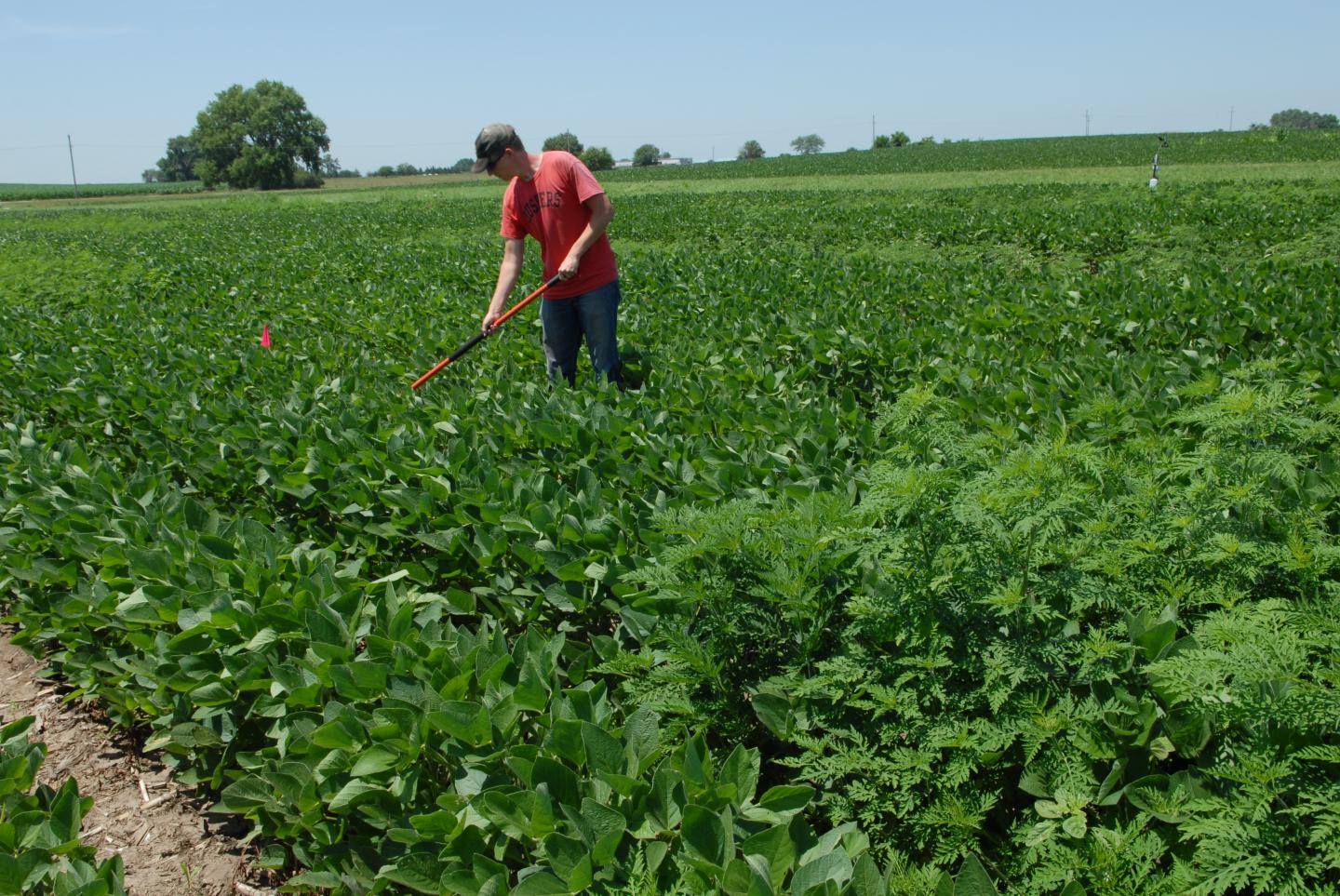
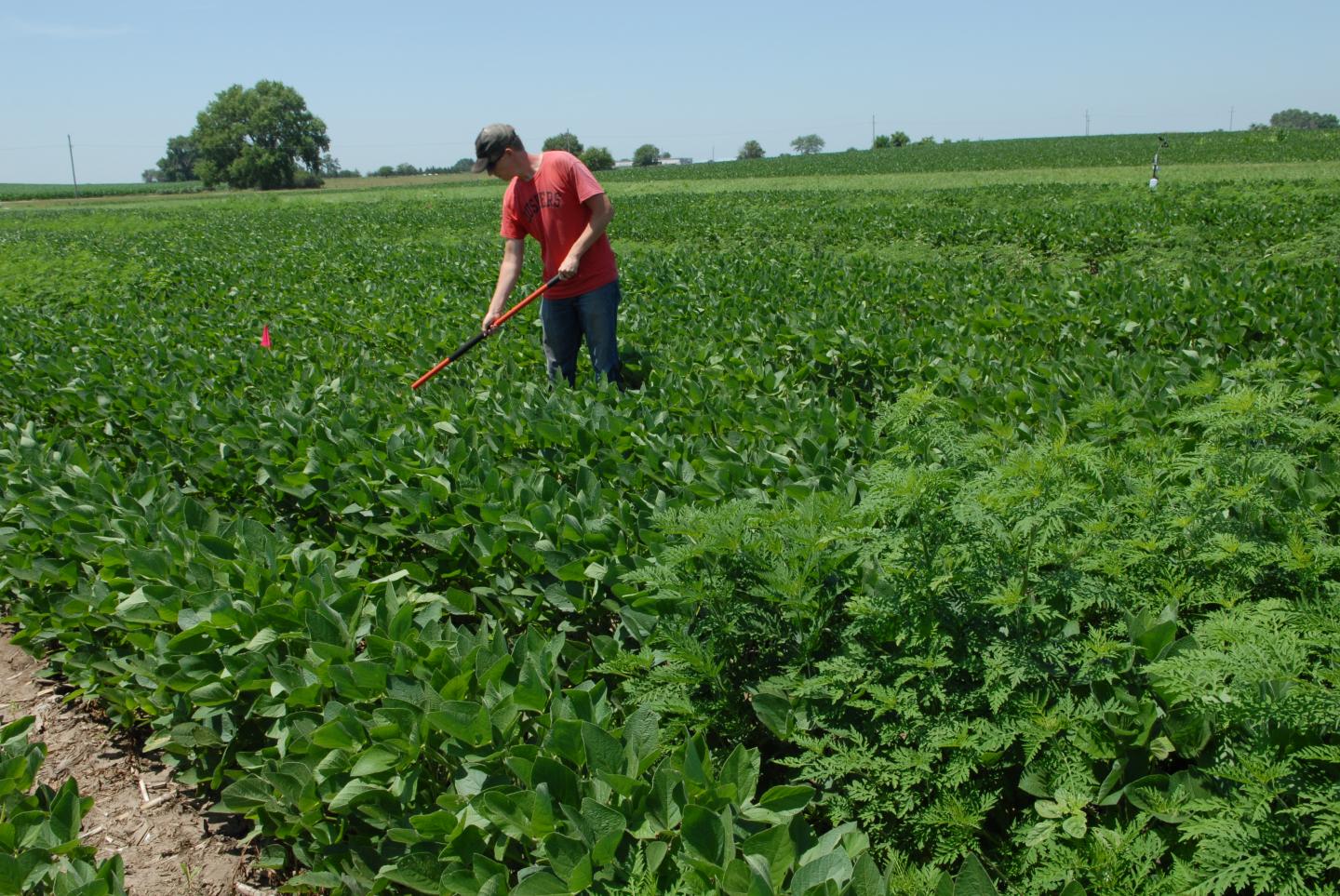
IMAGE

Credit: Amit Jhala

Ragweed, its pollen potent to allergy sufferers, might be more than a source of sneezes. In the Midwest, the plant may pose a threat to soybean production.

Scientists have found that ragweed can drastically reduce soybean yield.

"It wasn't really a weed we were worried about too much," says Ethann Barnes, a graduate research assistant in agronomy and horticulture at the University of Nebraska-Lincoln. "We didn't expect it to be this competitive."

Weeds compete with crops for light, water, and nutrients. Common ragweed, which is taller than soy, has historically been overlooked as a threat. And little is known about its impact on soy in the Midwest.

So, the scientists struck out to a soybean field near Mead, Nebraska. In 2015 and 2016, they planted soybean and ragweed in late spring. Within the experimental plots, ragweed density ranged from no plants (a weed-free control) to 12 plants per meter (about 39 inches) of the row.

The researchers had two goals: see if ragweed posed a serious threat to soybean, and see if there's a way to estimate the yield loss early in the growing season.

Barnes was surprised by how much the ragweed stifled the soybean in both years. The soybean crops did worse than in previous studies. One ragweed plant every 1.6 feet of soybean row decreased soybean yield by 76% in 2015, and by 40% in 2016. And soybean yield was reduced by 95% in 2015 and 80% in 2016 when common ragweed plants were grown only three inches apart in the soybean row.

During the experiment, there was plenty of water to go around for both plants. So, the scientists think ragweed mostly hurt soybean by starving it of sunlight.

"Whether I was presenting at conferences, or even just at my thesis defense, everyone was very surprised how big of a deal common ragweed could be," says Barnes.

What's more, it was very hard to predict early in the year how the soybean would fare. Barnes found that not until early August could he plug ragweed numbers into an equation and accurately predict what the soybean loss would be.

Now, Barnes and his team are sharing this information with growers in the area. "The ultimate goal of this area of science is for growers to count the number of weeds or make a measurement in their field three weeks into the season. From there they could see whether it's financially a viable option to control their weeds or just leave them in the field," says Barnes. By knowing how much damage the weeds might do, farmers can weigh that loss against the cost of killing the weeds.

More studies will be needed to hone in on the dynamics of ragweed-and other weed–growth. An end goal, he says, is to predict early in the season how weeds will impede crop yields, so farmers can make better decisions on how to manage them. Such estimates could help farmers know if, when, and how much pesticide to apply.

He hopes his study is a step toward that goal. "Hopefully it'll have an immediate impact for farmers, and advance the science of weed competition research."

###

The study was published in Agronomy Journal. The University of Nebraska Institute of Agriculture and Natural Resources funded the project.

Media Contact

Susan Fisk
[email protected]
608-335-6714
@ASA_CSSA_SSSA

http://www.agronomy.org

Related Journal Article

http://dx.doi.org/10.2134/agronj2017.09.0554

Share12Tweet8Share2ShareShareShare2

Related Posts

New Study Uncovers Mechanism Behind Burn Pit Particulate Matter–Induced Lung Inflammation

New Study Uncovers Mechanism Behind Burn Pit Particulate Matter–Induced Lung Inflammation

February 6, 2026

DeepBlastoid: Advancing Automated and Efficient Evaluation of Human Blastoids with Deep Learning

February 6, 2026

Navigating the Gut: The Role of Formic Acid in the Microbiome

February 6, 2026

AI-Enhanced Optical Coherence Photoacoustic Microscopy Revolutionizes 3D Cancer Model Imaging

February 6, 2026
Please login to join discussion

POPULAR NEWS

  • Robotic Ureteral Reconstruction: A Novel Approach

    Robotic Ureteral Reconstruction: A Novel Approach

    82 shares
    Share 33 Tweet 21
  • Digital Privacy: Health Data Control in Incarceration

    63 shares
    Share 25 Tweet 16
  • Study Reveals Lipid Accumulation in ME/CFS Cells

    57 shares
    Share 23 Tweet 14
  • Breakthrough in RNA Research Accelerates Medical Innovations Timeline

    53 shares
    Share 21 Tweet 13

About

We bring you the latest biotechnology news from best research centers and universities around the world. Check our website.

Follow us

Recent News

Succinate Receptor 1 Limits Blood Cell Formation, Leukemia

Palmitoylation of Tfr1 Drives Platelet Ferroptosis and Exacerbates Liver Damage in Heat Stroke

Oxygen-Enhanced Dual-Section Microneedle Patch Improves Drug Delivery and Boosts Photodynamic and Anti-Inflammatory Treatment for Psoriasis

Subscribe to Blog via Email

Enter your email address to subscribe to this blog and receive notifications of new posts by email.

Join 73 other subscribers
  • Contact Us

Bioengineer.org © Copyright 2023 All Rights Reserved.

Welcome Back!

Login to your account below

Forgotten Password?

Retrieve your password

Please enter your username or email address to reset your password.

Log In
No Result
View All Result
  • Homepages
    • Home Page 1
    • Home Page 2
  • News
  • National
  • Business
  • Health
  • Lifestyle
  • Science

Bioengineer.org © Copyright 2023 All Rights Reserved.