• HOME
  • NEWS
  • EXPLORE
    • CAREER
      • Companies
      • Jobs
    • EVENTS
    • iGEM
      • News
      • Team
    • PHOTOS
    • VIDEO
    • WIKI
  • BLOG
  • COMMUNITY
    • FACEBOOK
    • INSTAGRAM
    • TWITTER
Thursday, April 9, 2026
BIOENGINEER.ORG
No Result
View All Result
  • Login
  • HOME
  • NEWS
  • EXPLORE
    • CAREER
      • Companies
      • Jobs
        • Lecturer
        • PhD Studentship
        • Postdoc
        • Research Assistant
    • EVENTS
    • iGEM
      • News
      • Team
    • PHOTOS
    • VIDEO
    • WIKI
  • BLOG
  • COMMUNITY
    • FACEBOOK
    • INSTAGRAM
    • TWITTER
  • HOME
  • NEWS
  • EXPLORE
    • CAREER
      • Companies
      • Jobs
        • Lecturer
        • PhD Studentship
        • Postdoc
        • Research Assistant
    • EVENTS
    • iGEM
      • News
      • Team
    • PHOTOS
    • VIDEO
    • WIKI
  • BLOG
  • COMMUNITY
    • FACEBOOK
    • INSTAGRAM
    • TWITTER
No Result
View All Result
Bioengineer.org
No Result
View All Result
Home NEWS Science News Biology

‘AGameOfClones’: Identification of transgenic organisms

Bioengineer by Bioengineer
March 27, 2018
in Biology
Reading Time: 2 mins read
0
Share on FacebookShare on TwitterShare on LinkedinShare on RedditShare on Telegram
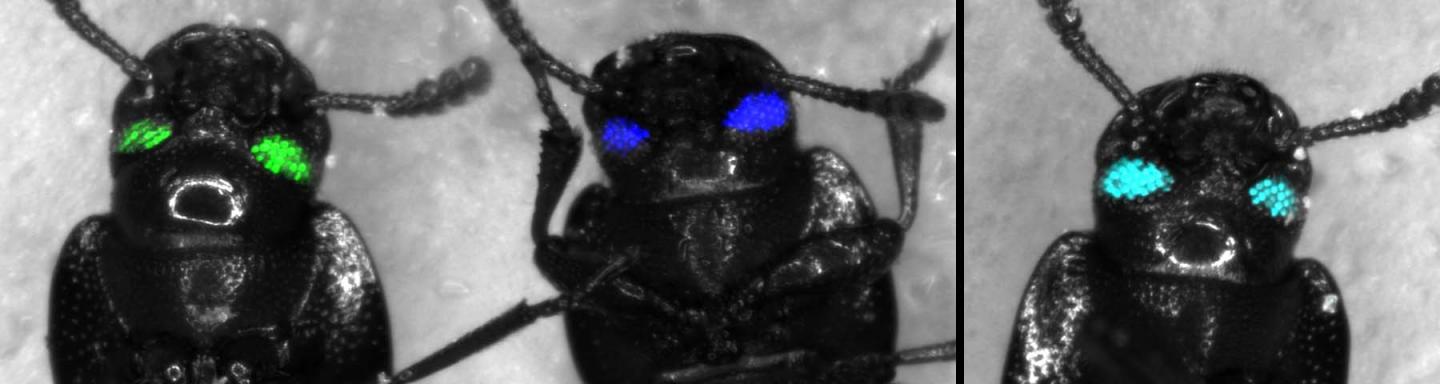
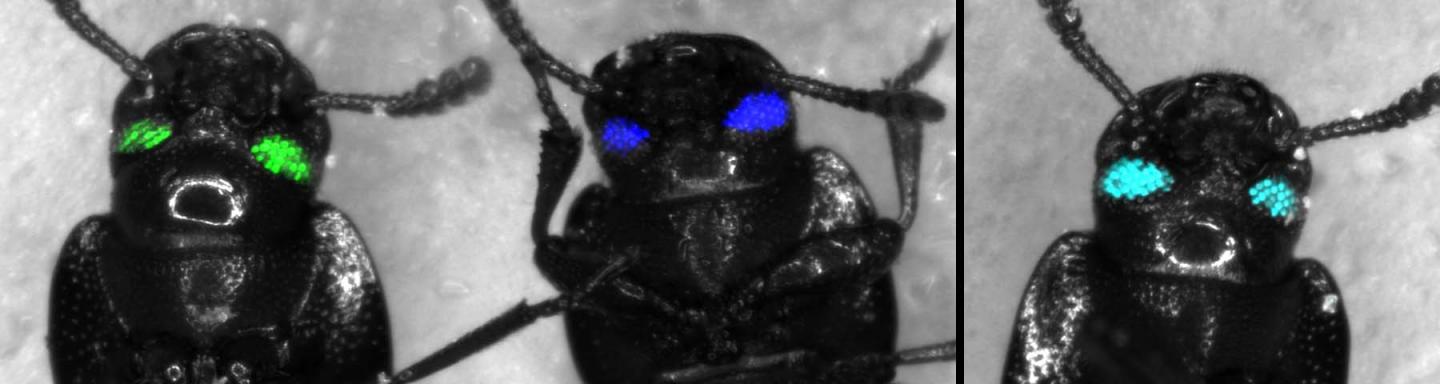
IMAGE

Credit: Strobl/Stelzer, Goethe University Frankfurt

To understand biological processes, researchers often use model organisms, such as mice, zebrafish and various species of insects, with the underlying idea that their discoveries can also be transferred to other species. A common technique is genetic manipulation, a process where a foreign gene (also known as a transgene) is inserted into one of the chromosomes of the target organism. Many model organisms have pairs of chromosomes – one inherited from each parent. In these pairs, the genes are arranged in the same order but are not necessarily identical.

Newly created transgenic organisms, however, carry the transgene on only one of the chromosomes. This can pose a problem for researchers because many experiments require individuals that carry the foreign gene on both. Unfortunately, only costly and error-prone methods can distinguish between these individuals. To overcome these drawbacks, Frederic Strobl from the research group led by Professor Ernst Stelzer at the Buchmann Institute for Molecular Life Sciences of Goethe University Frankfurt developed a genetic concept called "AGameOfClones" and applied it to the red flour beetle Tribolium castaneum.

In this approach, the foreign gene also contains sequences for two protein markers with different fluorescent colours. After several generations of breeding, two variants of the transgene emerge that each retain only one marker. This means that in the following generation, the descendants with both markers must be the progeny that carry the transgene on both chromosomes.

The "AGameOfClones" concept has several major advantages: Individuals with different markers can be easily identified and the procedure is cost-efficient, reliable and can be applied to almost all model organisms. This benefits especially animal welfare, since individuals that are unsuitable for use in experiments can be excluded as soon as the markers become detectable.

###

Publication (Open Access): Frederic Strobl, Anita Anderl, Ernst H.K. Stelzer: A universal vector concept for a direct genotyping of transgenic organisms and a systematic creation of homozygous lines.

Media Contact

Ernst Stelzer
[email protected]
49-798-42547
@goetheuni

http://www.uni-frankfurt.de

Original Source

http://www.muk.uni-frankfurt.de/70887301/058 http://dx.doi.org/10.7554/eLife.31677

Share12Tweet8Share2ShareShareShare2

Related Posts

Research Reveals Wildlife Trade Increases Risk of Disease Transmission to Humans

Research Reveals Wildlife Trade Increases Risk of Disease Transmission to Humans

April 9, 2026
Oxygen’s Role Uncovered: Key Factor in Limb Regeneration Revealed

Oxygen’s Role Uncovered: Key Factor in Limb Regeneration Revealed

April 9, 2026

Ancient Mammal Ancestor’s Secret Unveiled: First-Ever Egg Discovered

April 9, 2026

Seabass Genetics Reveal Temperature-Driven Sex Ratios

April 9, 2026
Please login to join discussion

POPULAR NEWS

  • blank

    Revolutionary AI Model Enhances Precision in Detecting Food Contamination

    98 shares
    Share 39 Tweet 25
  • Imagine a Social Media Feed That Challenges Your Views Instead of Reinforcing Them

    1012 shares
    Share 400 Tweet 250
  • Popular Anti-Aging Compound Linked to Damage in Corpus Callosum, Study Finds

    44 shares
    Share 18 Tweet 11
  • Boosting Breast Cancer Risk Prediction with Genetics

    43 shares
    Share 17 Tweet 11

About

We bring you the latest biotechnology news from best research centers and universities around the world. Check our website.

Follow us

Recent News

Always Active, Always Engaged: The Science Behind Lifelong Activity

AI-Powered Personal Trainer: Boosting Physical Activity in Older Adults with AI-Generated Motivation

Cutting-Edge CT Scan Analysis Enhances Detection of Various Sarcoidosis Forms

Subscribe to Blog via Email

Enter your email address to subscribe to this blog and receive notifications of new posts by email.

Join 78 other subscribers
  • Contact Us

Bioengineer.org © Copyright 2023 All Rights Reserved.

Welcome Back!

Login to your account below

Forgotten Password?

Retrieve your password

Please enter your username or email address to reset your password.

Log In
No Result
View All Result
  • Homepages
    • Home Page 1
    • Home Page 2
  • News
  • National
  • Business
  • Health
  • Lifestyle
  • Science

Bioengineer.org © Copyright 2023 All Rights Reserved.