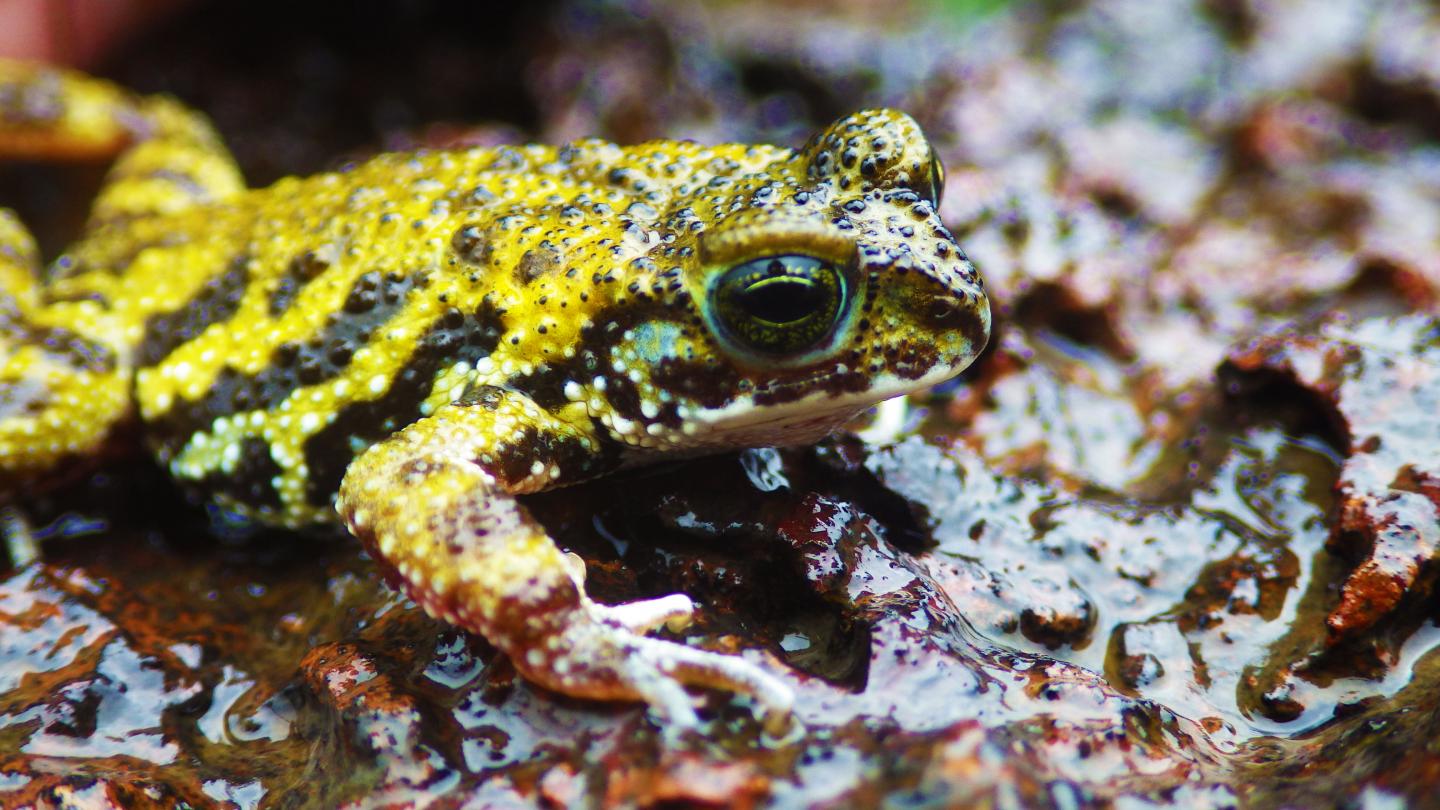
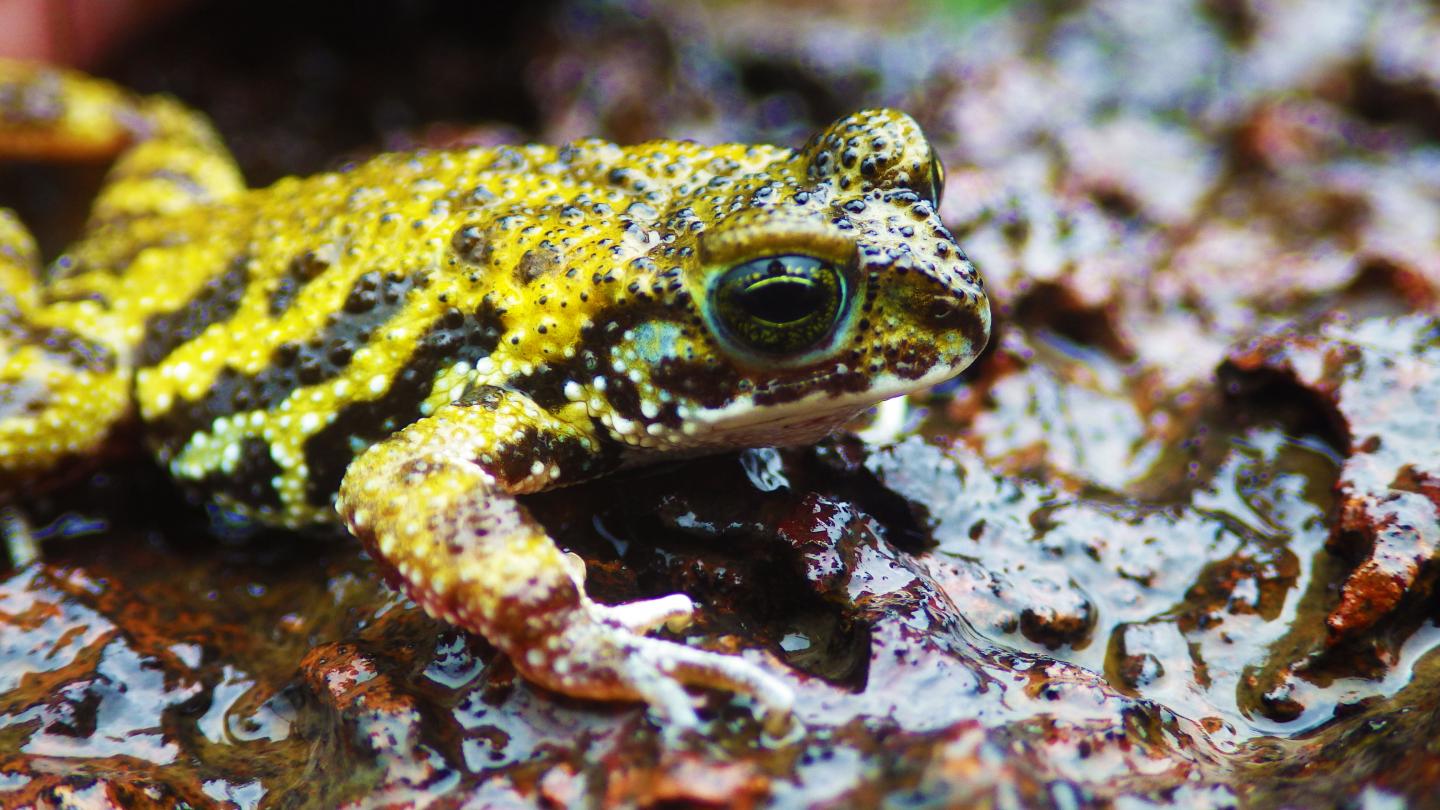
Credit: Lewis Davies/University of Plymouth
Rare amphibians living on rocky plateaux in western India are in desperate need of greater protection as their habitats are being eroded by expansions in population, industry and tourism, new research has shown.
An international team of scientists studied 21 species living in the northern section of the Western Ghats Biodiversity Hotspot, designated one of the eight most important global hotspots and one of the three most threatened by population growth.
They examined amphibian distribution and their essential habitats on rocky plateaux at a range of altitudes and found several areas where habitats were being destroyed by human activity such as mining, wind turbine installation and tourism. The amphibians in the region are also at risk from the spread of diseases including the potentially lethal chytrid fungus.
As a result, some species were already considered endangered with one, the Amboli Toad (Xanthophryne tigerina), labelled critically endangered on the International Union for Conservation of Nature's (IUCN) Red List. Others are listed as data deficient as researchers don't yet have enough information to say if their populations are at risk.
For many of the species the research, led by the University of Plymouth and published in the scientific journal PLOS ONE, represents the first statistically supported assessment of their habitat requirements.
It also calls for greater efforts to make people aware of the threats posed by development and industry, and for an increased focus on preserving the plateaux, their microhabitats and the species that live in them.
Christopher Thorpe, a Post Graduate Research Student in the University's School of Biological and Marine Sciences, said: "The rocky plateaux of the northern Western Ghats are a stressed habitat for amphibians, but those who live there have evolved to do so as it is a competition-free environment. They already face significant challenges but now the specific features they need to survive, such as large loose rocks and shallow pools created by monsoon rains, are being destroyed by human activity. Many of these highly important sites have low levels of statutory protection, greater efforts are needed to ensure these habitats – and the threatened species living within them – are protected for the future."
The Western Ghats is a chain of hills that runs north-south for around 1,600km along the southwestern coast of India, close to cities including Mumbai, Pune, Goa and Bangalore. Part has been declared a UNESCO World Heritage Site including one of the northern rocky plateaux.
This research focused on 14 sites within the area's northern section, which is considered geologically distinct and biologically isolated with many species endemic to the region and even to individual plateaux.
It showed that within the plateaux there were microhabitats such as rocks, pools, and woody plants which are all essential to the amphibians' chance of survival. However, in areas where these habitats had been eroded away, for example by the removal of rocks for development, some amphibians were less abundant. Some sites are being completely lost to open cast mining.
The researchers say that as the first statistically supported study looking at amphibian populations in the northern section of the Western Ghats, the work has added substantially to known microhabitat associations and shown that their preservation is clearly important for future conservation.
Dr Aparna Watve, from the Tata Institute of Social Sciences in Maharashtra, India, said: "Specialised ecosystems such as rocky plateaux are currently poorly understood and not accorded the same importance and protection as the forest habitats by the government. These ecosystems and their rich flora and faunal diversity are in danger of extinction and development practices, looking for short-term gains and neglecting the long-term effects of habitat destruction, are a real challenge to environmental conservation in India. There is a great need to understand the plateau ecology and ecosystem services to help plan local development without harming the biodiversity, and this paper provides valuable scientific evidence which will be useful for planning in-situ conservation and restoration of plateau biodiversity."
###
Media Contact
Alan Williams
[email protected]
175-258-8004
@PlymUni
http://www.plymouth.ac.uk
Original Source
https://www.plymouth.ac.uk/news/rocky-habitats-need-to-be-protected-for-endangered-amphibians-to-survive-study-show http://dx.doi.org/10.1371/journal.pone.0194810