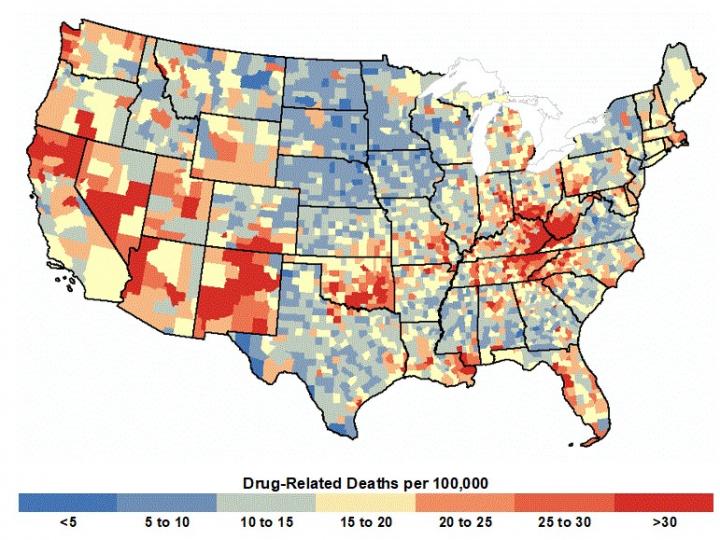
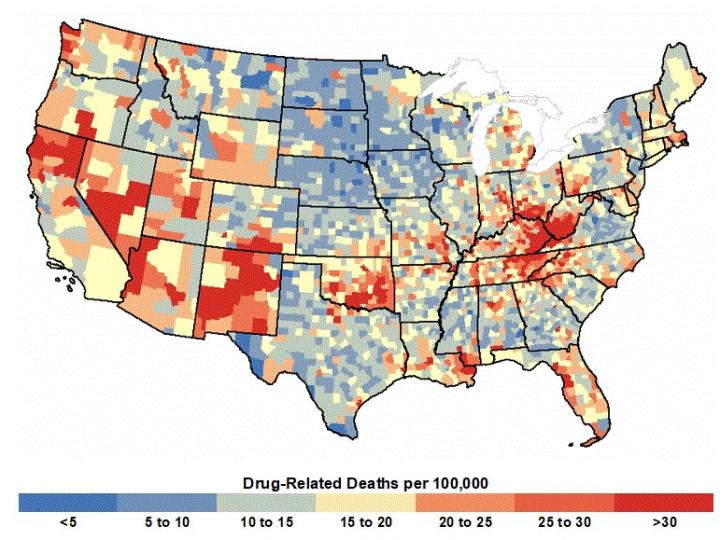
Credit: Shannon M. Monnat
Ann Arbor, March 26, 2018 – Drug-related deaths have grown to be a major US public health problem over the past two decades. Between 2006 and 2015 there were more than 515,000 deaths from drug overdoses and other drug-related causes. The economic, social, and emotional tolls of these deaths are substantial, but some parts of the US are bearing heavier burdens than others. Evidence from the first national study of county-level differences suggests that addressing economic and social conditions will be key to reversing the rising tide of drug deaths, reports the American Journal of Preventive Medicine.
"The drug epidemic is a pressing concern among policymakers," noted Shannon M. Monnat, PhD, Associate Professor of Sociology and Lerner Chair for Public Health Promotion, Maxwell School of Citizenship and Public Affairs, Syracuse University, Syracuse, New York, USA, who conducted the study. "The media portrayal of the drug overdose epidemic has largely been that it is a national crisis. However, drug deaths are not randomly distributed across the US. My analyses show that some places in the US have much higher drug mortality rates than others."
Using data from the US Centers for Disease Control and Prevention (CDC) Multiple-Cause of Death Files (2006-2015), US Census Bureau, US Department of Agriculture Economic Research Service, Agency for Healthcare Research and Quality, and Northeast Regional Center for Rural Development, the study modeled associations between county-level drug-related mortality rates and economic, social, and healthcare environments.
Analysis showed the average county-level age-adjusted drug-related mortality rate was 16.6 deaths per 100,000 population, but there were substantial geographic differences with drug-related deaths reaching over 100 per 100,000 in some counties. There was significant spatial variation in rates.
- High mortality rate clusters in Appalachia, Oklahoma, parts of the Southwest, and northern California
- Low mortality rate clusters in parts of the Northeast, the Black Belt, Texas, and the Great Plains
- Substantial within-state variation with West Virginia having the largest disparity between the highest and lowest rate counties
Average mortality rates were significantly higher in counties with greater economic and family distress and in counties economically dependent on mining. Counties at the highest level of family distress (divorce/separation and single parent families) had an average of more than eight more drug-related deaths per 100,000 population than counties at the lowest level.
Average mortality rates were significantly lower in counties with a larger presence of religious establishments, a greater percentage of recent immigrants, and counties with economies reliant on public (government) sector employment.
On average, there were no differences in mortality rates between rural and urban counties, but some rural counties, especially those in Appalachia, have the highest mortality rates in the country. Healthcare supply factors did not contribute to the differences between county mortality rates.
According to Dr. Monnat's findings, social and economic environments are important for prevention because they affect stress, healthcare investment, residents' knowledge about and access to services, self-efficacy, social support, and opportunities for social interaction.
"We need to get real with ourselves about the US drug problem," explained Dr Monnat. "We are not going to Narcan our way out of this. Opioids are a symptom of much larger social and economic problems. Just as other chronic diseases have underlying social determinants, addiction is also a social disease. 'Addiction does not discriminate' is a soundbite that ignores the reality that overdose rates are highest in economically distressed communities, particularly places that have experienced declines in job opportunities for people without a college degree. Addressing economic and social conditions will be key to reversing the rising tide of drug deaths."
###
Media Contact
Jillian B. Morgan
[email protected]
734-936-1590
@elseviernews
http://www.elsevier.com
Related Journal Article
http://dx.doi.org/10.1016/j.amepre.2018.01.040