Credit: © 2018 Zanoletti, Vassura, Venturini, Monai, Montini, Federici, Zacco, Treccani and Bontempi. Front. Chem. | doi: 10.3389/fchem.2018.00060
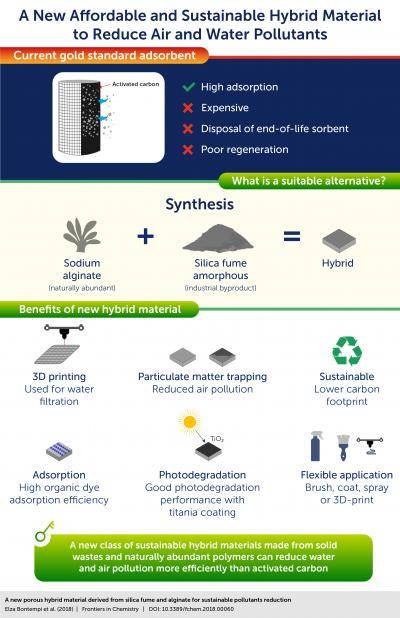
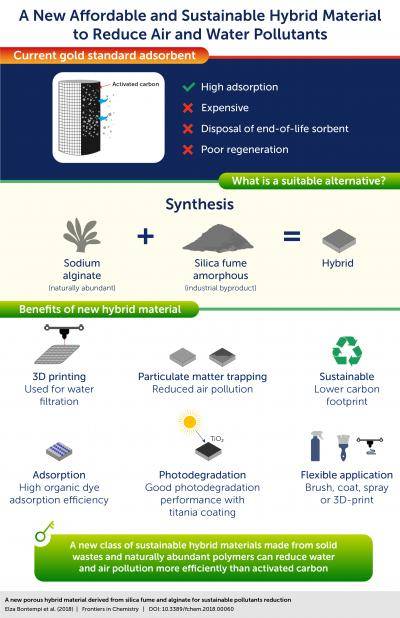
A new class of low-cost and sustainable hybrid materials could possibly displace activated carbon as the preferred choice for reducing wastewater and air pollution. The material, described in Frontiers in Chemistry, is synthesized inexpensively from solid wastes and a naturally abundant polymer — and can cut down pollutants in air and wastewater with more success than activated carbon, the current gold standard adsorbent.
"This paper shows the simple synthesis of a new porous hybrid material, obtained by using low cost and by-product materials," says the lead author, Dr. Elza Bontempi from the University of Brescia, Italy. "The material was designed on the basis of The European Commission's request to develop an affordable, sustainable and innovative design-driven material solution that can reduce the concentration of particulate matter in urban areas."
Particulate matter — solid particles and liquid droplets found in the air and emitted from power plants, industry, automobiles and fires — is ubiquitous in cities and even the countryside. Moreover, millions of tons of industrial effluents are released into the world's waters every year. Both particulate matter and organic dyes are highly toxic to ecosystems and to humanity.
Activated carbon is the most common adsorbent used to reduce both atmospheric and wastewater pollution — but is expensive to produce and regenerate. The challenge has been to find an economical alternative.
In the new study, researchers combined a naturally abundant raw material, sodium alginate (a polysaccharide that can be extracted from seaweed and algae) with a high-volume industrial by-product, silica fume (a by-product of ferrosilicon or silicon metal alloy processing) to produce a "green" adsorbent that is better than activated carbon.
"The article reports preliminary results about the new material's capability to capture particulate matter," says Dr. Bontempi. "It can also be used for wastewater remediation. In particular, its ability to replace activated carbon is demonstrated."
The synthesis method is simple and easy to scale up. Taking advantage of the gelling properties of alginate, the researchers combined it with the decomposition of food-grade sodium-bicarbonate (baking soda) to consolidate the material. Testing of wastewater pollution was performed using methylene blue dye as a model pollutant. The hybrid material adsorbed and removed the dye, even at high concentrations, with 94% efficiency.
Analyses revealed that, compared with activated carbon, production of the hybrid material consumed less energy ("embodied energy") while leaving a much lower carbon footprint. The material also demonstrated encouraging capabilities for trapping diesel exhaust fume particulate matter.
The material can be applied as a coating, used for spraying or brushing, and used for 3D-printing. This means it could be used to cover external building surfaces to remove particular matter, as well as to design water filtration units.
This versatility is an exciting new addition to humanity's toolkit for reducing air and water pollution.
###
This article is part of a special research collection: New Findings on the Use of Biosorbents and Technically-Based Sorbents to Control Soil and Water Pollution
Media Contact
Emma Duncan
[email protected]
@frontiersin
http://www.frontiersin.org
Related Journal Article
http://dx.doi.org/10.3389/fchem.2018.00060