

• HOME
  • NEWS
  • EXPLORE
    • CAREER
      • Companies
      • Jobs
    • EVENTS
    • iGEM
      • News
      • Team
    • PHOTOS
    • VIDEO
    • WIKI
  • BLOG
  • COMMUNITY
    • FACEBOOK
    • INSTAGRAM
    • TWITTER
Saturday, February 7, 2026
BIOENGINEER.ORG
No Result
View All Result
  • Login
  • HOME
  • NEWS
  • EXPLORE
    • CAREER
      • Companies
      • Jobs
        • Lecturer
        • PhD Studentship
        • Postdoc
        • Research Assistant
    • EVENTS
    • iGEM
      • News
      • Team
    • PHOTOS
    • VIDEO
    • WIKI
  • BLOG
  • COMMUNITY
    • FACEBOOK
    • INSTAGRAM
    • TWITTER
  • HOME
  • NEWS
  • EXPLORE
    • CAREER
      • Companies
      • Jobs
        • Lecturer
        • PhD Studentship
        • Postdoc
        • Research Assistant
    • EVENTS
    • iGEM
      • News
      • Team
    • PHOTOS
    • VIDEO
    • WIKI
  • BLOG
  • COMMUNITY
    • FACEBOOK
    • INSTAGRAM
    • TWITTER
No Result
View All Result
Bioengineer.org
No Result
View All Result
Home NEWS Science News Health

Scientists synthesized a new substance with considerable antitumoral properties

Bioengineer by Bioengineer
March 19, 2018
in Health
Reading Time: 2 mins read
0
Share on FacebookShare on TwitterShare on LinkedinShare on RedditShare on Telegram
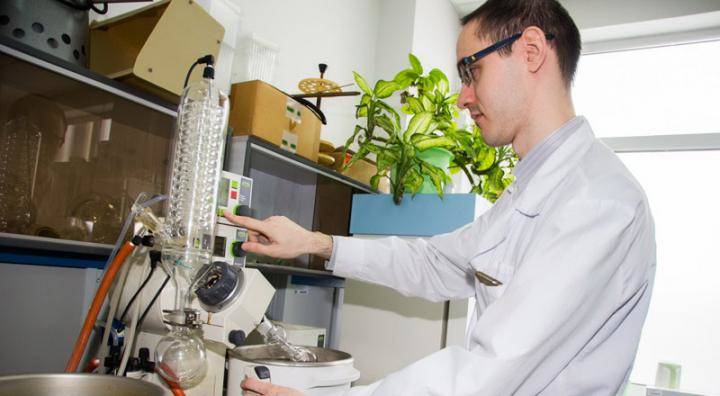
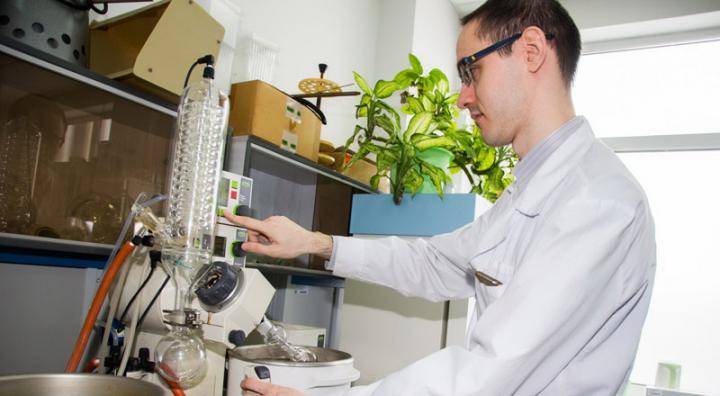
IMAGE

Credit: FEFU press-office

Scientists from Far Eastern Federal University developed a new synthetic derivative of fascaplysin – a biologically active substance with antitumoral properties obtained from sea sponges. Biological tests have shown that the compound is 2-3 times more active than fascaplysin. The results of the study were published in the well-known scientific journal Tetrahedron Letters.

The work has been carried out by the staff of the department of organic chemistry, School of Natural Sciences (SNS), FEFU at the laboratory for the synthesis of natural products. According to the assistant professor of the department Maksim Zhidkov, scientists from the university have been involved in the synthesis of biologically active substances for over 20 years. The results of recent studies are several new derivatives of fascaplysin that are promising for studying antitumoral properties in cell cultures.

"Fascaplysin is a unique compound. The wide range of its biological properties includes the ability to selectively inhibit cycle-dependent kinase 4 (CDK 4) that is responsible for quick and uncontrollable mitosis of cancer cells. We tested the new derivative on the cells of cervical cancer and monocytic leukemia, and the results showed 2-3 times higher activity than in the initial fascaplysin," explained Maksim Zhidkov.

According to the scientist, the study also included the development of another alkaloid that is relative to fascaplysin – 6-oxofascaplysin. This compound was obtained for the first time from the well-known dye – indigo.

"Currently we are working on a method for obtaining a wide range of fascaplysin derivatives of the new type using computer modeling and molecular docking. Our calculations have shown that such a range is likely to contain promising candidates with an expressed antitumoral and analgetic effects," added Maksim Zhidkov.

The research has been carried out with the support of a grand from FEFU Fund and in collaboration with other schools of the university, as well as the Far Eastern Department of the Russian Academy of Sciences. Namely, the laboratory for molecular and cellular neurobiology of the School of Biomedicine studies the influence of fascaplysin and its derivatives on the cells of glioblastoma (brain cancer). Among the participants of the research are associate professors of the department of organic chemistry, SNS, Maksim Zhidkov and Alexander Andin, as well as the postgraduate of the school Alexey Kantemirov.

###

Media Contact

Maria Lukina
[email protected]

http://https://www.dvfu.ru/en/

Original Source

https://www.sciencedirect.com/science/article/pii/S0040403918300315 http://dx.doi.org/10.1016/j.tetlet.2018.01.023


Share12Tweet8Share2ShareShareShare2

Related Posts

Decoding Prostate Cancer Origins via snFLARE-seq, mxFRIZNGRND

February 7, 2026

Digital Health Perspectives from Baltic Sea Experts

February 7, 2026

Exploring Decision-Making in Dementia Caregivers’ Mobility

February 7, 2026

Succinate Receptor 1 Limits Blood Cell Formation, Leukemia

February 7, 2026
Please login to join discussion

POPULAR NEWS

  • Robotic Ureteral Reconstruction: A Novel Approach

    Robotic Ureteral Reconstruction: A Novel Approach

    82 shares
    Share 33 Tweet 21
  • Digital Privacy: Health Data Control in Incarceration

    63 shares
    Share 25 Tweet 16
  • Study Reveals Lipid Accumulation in ME/CFS Cells

    57 shares
    Share 23 Tweet 14
  • Breakthrough in RNA Research Accelerates Medical Innovations Timeline

    53 shares
    Share 21 Tweet 13

About

We bring you the latest biotechnology news from best research centers and universities around the world. Check our website.

Follow us

Recent News

Decoding Prostate Cancer Origins via snFLARE-seq, mxFRIZNGRND

Digital Health Perspectives from Baltic Sea Experts

Florida Cane Toad: Complex Spread and Selective Evolution

Subscribe to Blog via Email

Enter your email address to subscribe to this blog and receive notifications of new posts by email.

Join 73 other subscribers
  • Contact Us

Bioengineer.org © Copyright 2023 All Rights Reserved.

Welcome Back!

Login to your account below

Forgotten Password?

Retrieve your password

Please enter your username or email address to reset your password.

Log In
No Result
View All Result
  • Homepages
    • Home Page 1
    • Home Page 2
  • News
  • National
  • Business
  • Health
  • Lifestyle
  • Science

Bioengineer.org © Copyright 2023 All Rights Reserved.