Credit: UPV/EHU
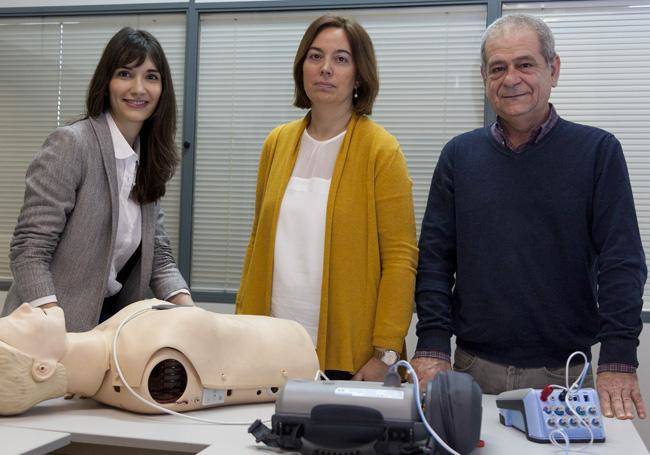
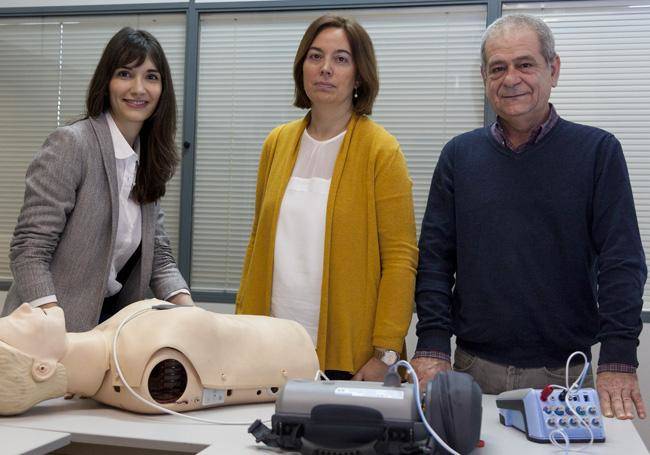
In the event of a cardiorespiratory arrest, two actions are crucial for the patient's survival: cardiopulmonary resuscitation (CPR) and defibrillation. CPR consists of rhythmically compressing the patient's chest to generate a minimum flow of blood in order to minimise the deterioration of vital organs (heart and brain). And defibrillation involves applying an electric shock to try to reverse the arrhythmia. "It is essential to perform CPR properly for the manoeuvre to be effective, and that is not easy even for highly trained personnel, since the chest has to be compressed at the appropriate frequency and depth (between 100-120 compressions per minute and between 5 and 6 cm)," explained Digna María González-Otero, author of the work.
The quality of the compressions is related to the patient's survival. That is why the resuscitation guidelines recommend the use of feedback systems to monitor the quality of CPR in real time. "These devices are usually placed between the patient's chest and the rescuer's hands and guide the rescuer to help him/her achieve the target depth and frequency of the compression," pointed out the UPV/EHU researcher. So, researchers in the UPV/EHU's Signal and Communications Group have developed an algorithm to calculate the depth and frequency of the compressions on the basis of chest acceleration. "In other words," said González-Otero, "just by placing an accelerometer on the patient's chest we can measure, in real time, the depth and frequency at which the compressions are being performed, and then correct the rescuer if necessary so that he/she performs quality CPR".
On sale shortly
The work published in the prestigious PLOS ONE journal validates the use of the new algorithm by demonstrating that it is very accurate in calculating the frequency and depth of the compressions when the acceleration signals measured in the chests of actual patients with cardiorespiratory arrest are analysed.
In view of the results obtained, the company Bexen Cardio, located in the Basque town of Ermua, is starting to market a device to assist the CPR used by this algorithm. It is a flexible, very thin device resembling a cushion. "The device functions when it is connected to the defibrillator and is the screen of the defibrillator which tells the rescuer whether he/she has to press harder, work faster, etc.," said Digna María González-Otero. "We could say that it is a straightforward, intuitive accessory of the defibrillator and which is geared, above all, towards the emergency services," she added. In fact, "some emergency services are already using it to validate its use in actual patients, to see whether it works as expected, whether it is convenient for the rescuer, whether it meets expectations, etc.", pointed out González-Otero. Bearing in mind the results being achieved, its mass marketing is expected to take place within a few months.
###
Additional information
This article has been published within the framework of the PhD thesis by Digna María González-Otero, entitled Feedback systems for the quality of chest compressions during cardiopulmonary resuscitation, and supervised by Jesús María Ruiz-Ojeda and Sofía Ruiz de Gauna-Gutiérrez in the UPV/EHU's Department of Communications Engineering.
Bibliographical reference
González-Otero DM, Ruiz JM, Ruiz de Gauna S, Gutiérrez JJ, Daya M, et al. (2018) Monitoring chest compression quality during cardiopulmonary resuscitation: Proof-of-concept of a single accelerometer-based feedback algorithm. PLOS ONE 13(2): e0192810. https://doi.org/10.1371/journal.pone.0192810
Media Contact
Matxalen Sotillo
[email protected]
34-688-673-770
@upvehu
http://www.ehu.es
Original Source
https://www.ehu.eus/en/-/algoritmo-berri-bat-garatu-dute-bihotz-biriketako-bizkortzea-eraginkorragoa-izan-dadin http://dx.doi.org/10.1371/journal.pone.0192810