

• HOME
  • NEWS
  • EXPLORE
    • CAREER
      • Companies
      • Jobs
    • EVENTS
    • iGEM
      • News
      • Team
    • PHOTOS
    • VIDEO
    • WIKI
  • BLOG
  • COMMUNITY
    • FACEBOOK
    • INSTAGRAM
    • TWITTER
Thursday, August 6, 2026
BIOENGINEER.ORG
No Result
View All Result
  • Login
  • HOME
  • NEWS
  • EXPLORE
    • CAREER
      • Companies
      • Jobs
        • Lecturer
        • PhD Studentship
        • Postdoc
        • Research Assistant
    • EVENTS
    • iGEM
      • News
      • Team
    • PHOTOS
    • VIDEO
    • WIKI
  • BLOG
  • COMMUNITY
    • FACEBOOK
    • INSTAGRAM
    • TWITTER
  • HOME
  • NEWS
  • EXPLORE
    • CAREER
      • Companies
      • Jobs
        • Lecturer
        • PhD Studentship
        • Postdoc
        • Research Assistant
    • EVENTS
    • iGEM
      • News
      • Team
    • PHOTOS
    • VIDEO
    • WIKI
  • BLOG
  • COMMUNITY
    • FACEBOOK
    • INSTAGRAM
    • TWITTER
No Result
View All Result
Bioengineer.org
No Result
View All Result
Home NEWS Science News Biology

Large-scale climatic warming could increase persistent haze in Beijing

Bioengineer by Bioengineer
March 15, 2018
in Biology
Reading Time: 2 mins read
0
Share on FacebookShare on TwitterShare on LinkedinShare on RedditShare on Telegram
IMAGE

Credit: LIN PEI

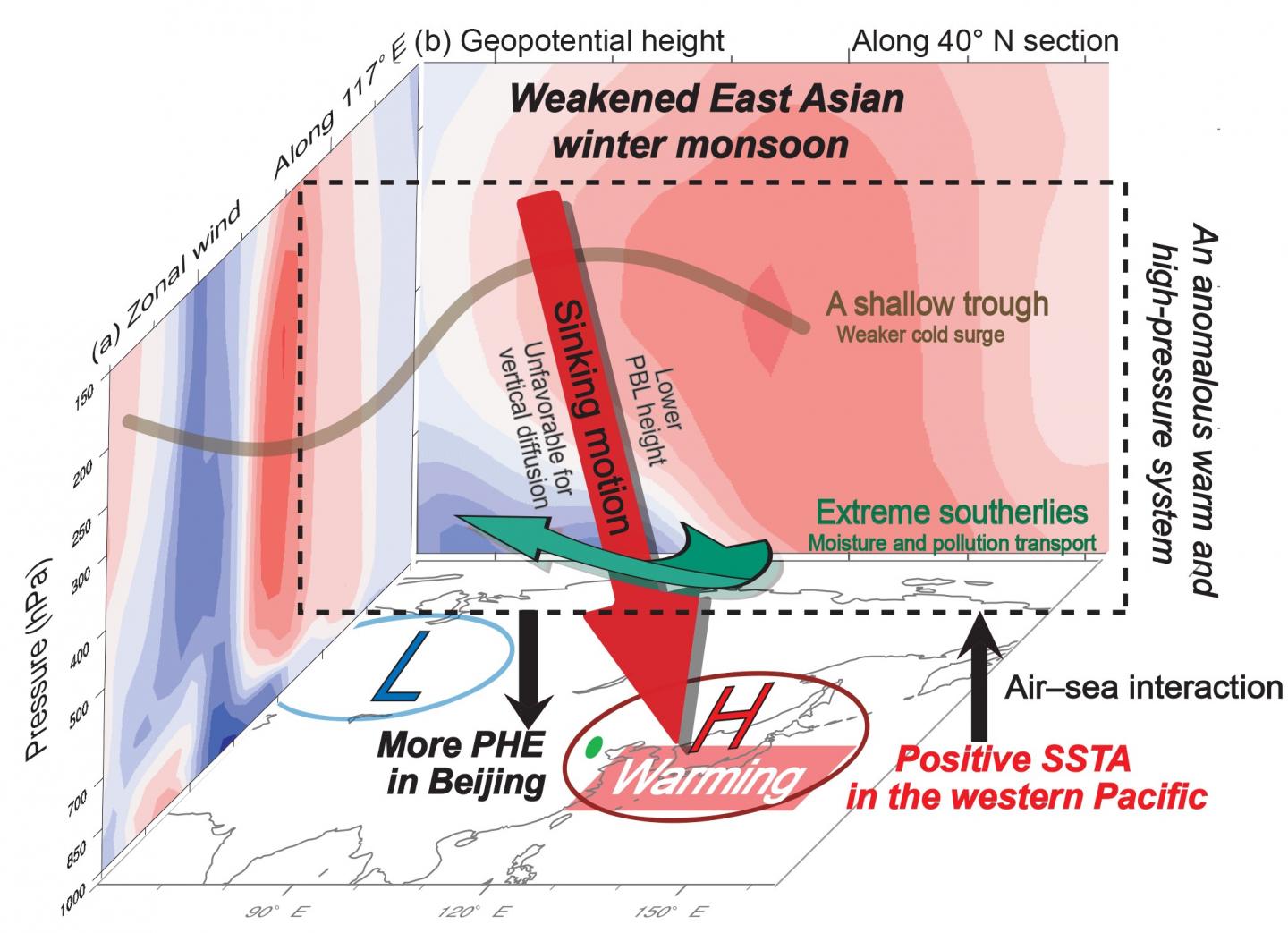
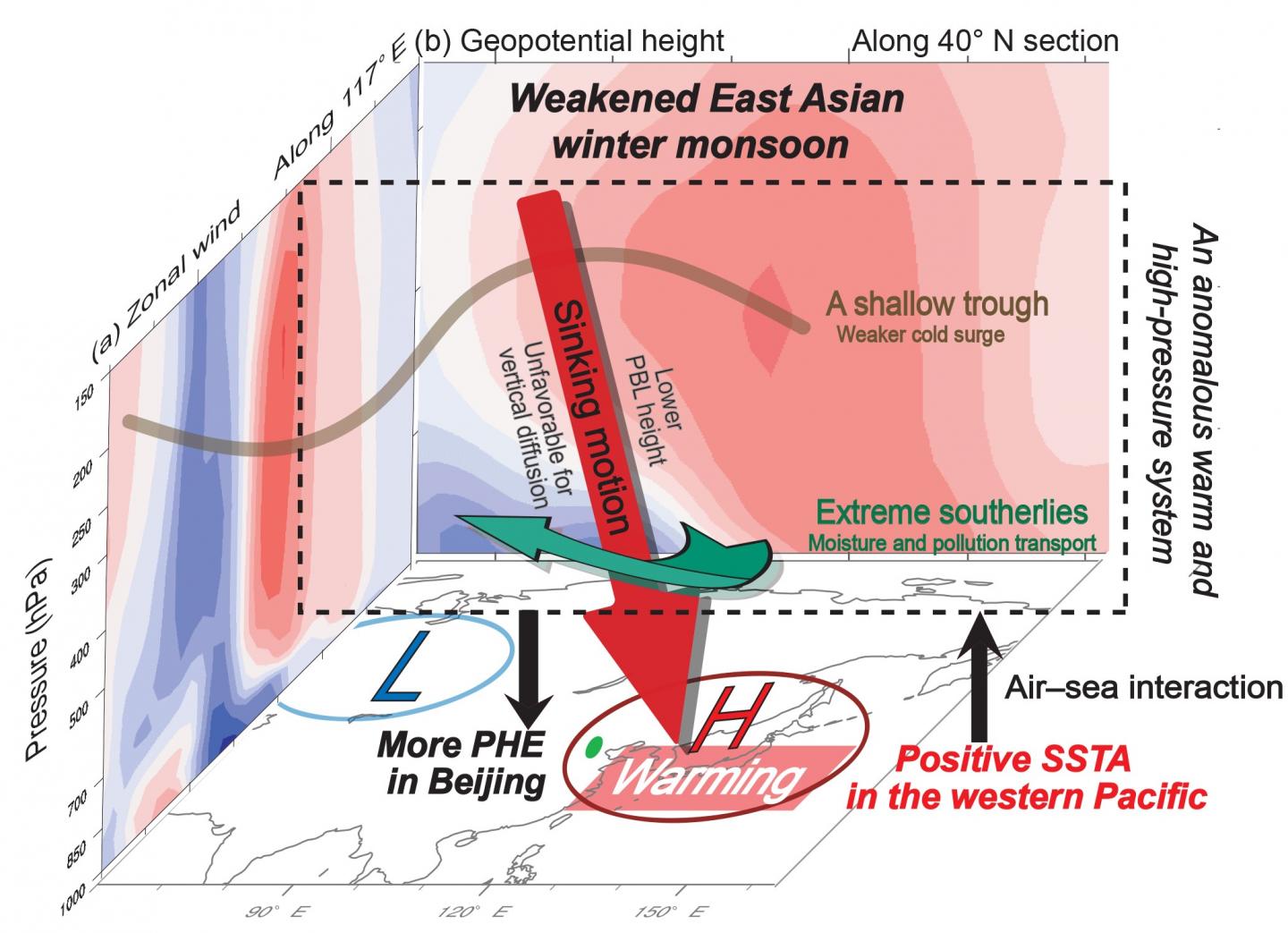
Over the past decades, Beijing, the capital city of China, has encountered increasingly frequent persistent haze events (PHEs). Severe PHEs not only lead to a sharp decrease in visibility, causing traffic hazards and disruptions, and, hence, affecting economic activities, but also induce serious health problems such as respiratory illnesses and heart disease. While the increased pollutant emissions serve as the most important reason, changes in regional atmospheric circulation associated with large-scale climate warming are found to play a role as well.

A recent study published in Atmospheric Chemistry & Physics by Dr. PEI Lin at the Beijing Urban Meteorological Institute and Prof. YAN Zhongwei at the Institute of Atmospheric Physics Chinese Academy of Sciences and their colleagues demonstrated a significant positive trend of PHEs in Beijing for the winters from 1980 to 2016 and its close relationship to an increasing frequency of extreme anomalous southerly episodes in North China, as a result of a weakened East Asian winter monsoon (EAWM) system. They further pointed out that over the period 1900-2016, the EAWM index was significantly correlated with the sea surface temperature anomalies (SSTA) over the northwestern Pacific, which exhibited a wavy positive trend, with an enhanced positive phase since the mid-1980s.

"This paper reveals a new point of view for understanding the increasing PHEs in Beijing", said YAN. In fact, the results allowed scientists to depict a mechanism to explain how large-scale climatic warming could increase PHEs in Beijing via changes in the typical regional atmospheric circulations.

"It is crucial to take into account the impact of long-term climatic change on the regional atmospheric conditions when making efforts in controlling local air pollution such as PHEs in Beijing." Suggested YAN.

###

Media Contact

Zheng Lin
[email protected]
86-108-299-5053
@aasjournal

http://english.iap.cas.cn/

Original Source

http://english.iap.cas.cn/RE/201803/t20180315_190733.html http://dx.doi.org/10.5194/acp-18-3173-2018


Share12Tweet8Share2ShareShareShare2

Related Posts

Pumas May Reduce Wildlife Collisions, Making Roads Safer for Drivers

Pumas May Reduce Wildlife Collisions, Making Roads Safer for Drivers

August 6, 2026
New study investigates whether tiny dinosaurs existed, challenging evolutionary assumptions

New study investigates whether tiny dinosaurs existed, challenging evolutionary assumptions

August 6, 2026

Human cancer models speed research and advance precision therapies

August 6, 2026

Study finds no clear IVF benefit from common embryo transfer techniques

August 6, 2026
Please login to join discussion

POPULAR NEWS

  • Heart attacks decline, cancer cases rise, while survival improves

    29 shares
    Share 12 Tweet 7
  • WS2-Templated Two-Step Anion Exchange Grows Metastable Quasi-1D W6Te6 on One-Inch Wafers

    29 shares
    Share 12 Tweet 7
  • Targeting sensory nerves after growth plate injuries could enhance healing

    29 shares
    Share 12 Tweet 7
  • Pumas May Reduce Wildlife Collisions, Making Roads Safer for Drivers

    29 shares
    Share 12 Tweet 7

About

We bring you the latest biotechnology news from best research centers and universities around the world. Check our website.

Follow us

Recent News

Heart attacks decline, cancer cases rise, while survival improves

WS2-Templated Two-Step Anion Exchange Grows Metastable Quasi-1D W6Te6 on One-Inch Wafers

Targeting sensory nerves after growth plate injuries could enhance healing

Subscribe to Blog via Email

Enter your email address to subscribe to this blog and receive notifications of new posts by email.

Join 86 other subscribers
  • Contact Us

Bioengineer.org © Copyright 2023 All Rights Reserved.

Welcome Back!

Login to your account below

Forgotten Password?

Retrieve your password

Please enter your username or email address to reset your password.

Log In
No Result
View All Result
  • Homepages
    • Home Page 1
    • Home Page 2
  • News
  • National
  • Business
  • Health
  • Lifestyle
  • Science

Bioengineer.org © Copyright 2023 All Rights Reserved.