• HOME
  • NEWS
  • EXPLORE
    • CAREER
      • Companies
      • Jobs
    • EVENTS
    • iGEM
      • News
      • Team
    • PHOTOS
    • VIDEO
    • WIKI
  • BLOG
  • COMMUNITY
    • FACEBOOK
    • INSTAGRAM
    • TWITTER
Saturday, February 7, 2026
BIOENGINEER.ORG
No Result
View All Result
  • Login
  • HOME
  • NEWS
  • EXPLORE
    • CAREER
      • Companies
      • Jobs
        • Lecturer
        • PhD Studentship
        • Postdoc
        • Research Assistant
    • EVENTS
    • iGEM
      • News
      • Team
    • PHOTOS
    • VIDEO
    • WIKI
  • BLOG
  • COMMUNITY
    • FACEBOOK
    • INSTAGRAM
    • TWITTER
  • HOME
  • NEWS
  • EXPLORE
    • CAREER
      • Companies
      • Jobs
        • Lecturer
        • PhD Studentship
        • Postdoc
        • Research Assistant
    • EVENTS
    • iGEM
      • News
      • Team
    • PHOTOS
    • VIDEO
    • WIKI
  • BLOG
  • COMMUNITY
    • FACEBOOK
    • INSTAGRAM
    • TWITTER
No Result
View All Result
Bioengineer.org
No Result
View All Result
Home NEWS Science News Biology

Metal-organic frameworks cut energy consumption of petrochemicals

Bioengineer by Bioengineer
March 15, 2018
in Biology
Reading Time: 2 mins read
0
Share on FacebookShare on TwitterShare on LinkedinShare on RedditShare on Telegram
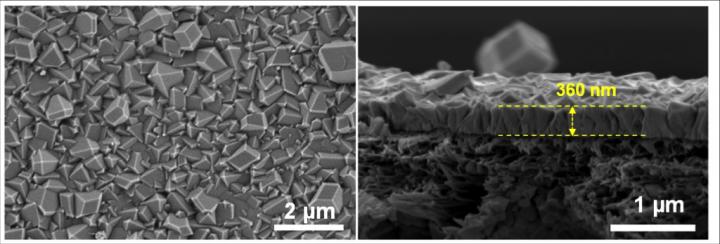
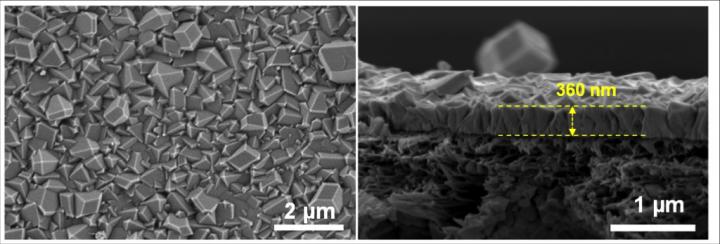
IMAGE

Credit: K.V. Agrawal/EPFL

In the chemical and the petrochemical industries, separating molecules in an energy-efficient way is one of the most important challenges. Overall, the separation processes account for around 40% of the energy consumed in the petrochemical industry, and reducing this can help addressing anthropogenic carbon emissions.

One of the most important products in the petrochemical industry is propylene, which is widely used in fibers, foams, plastics etc. Purifying propylene almost always requires separating it from propane. Currently this is done by cryogenic distillation, where the two gases are liquefied by being cooled to sub-zero temperatures. This gives the propylene-propane separation process a very large energy footprint.

A solution is to use "metal-organic frameworks" (MOF's). These are porous, crystalline polymers made of metal nodes that are linked together by organic ligands. The pores in their molecular structure allow MOFs to capture molecules so efficiently that they are now prime candidates in carbon-capture research.

In terms of separating molecules, MOF-based membranes are among the highest performers, and can carry out the propylene-propane separation at ambient temperature. One MOF called ZIF-8 (zeolitic imidazolium frameworks-8), allows propylene to diffuse through its pores 125 times more efficiently than propane at 30oC, offering high selectivity without the need for sub-zero temperatures.

"The main challenge with this approach is to synthesize high-quality, ultrathin, MOF films on commercial porous substrates without complicated substrate modifications," says Professor Kumar Varoon Agrawal at EPFL. "Such high-quality films have fewer defects and are necessary for obtaining the highest possible separation selectivity." His lab at EPFL Sion has now developed a straightforward MOF crystallization approach called "electrophoretic nuclei assembly for crystallization of highly-intergrown thin-films" (ENACT).

The ENACT method allows simple regulation of the heterogeneous nucleation on unmodified (as-obtained) porous and nonporous substrates. This in turn facilitates the synthesis of ultrathin, highly intergrown polycrystalline MOF films.

The lab used the ENACT method to synthesize 500-nm-thick MOF membranes. When they tested them, the membranes yielded one of the best separation performances in propylene/propane separation recorded to date. The ultrathin film yielded large propylene permeance (flux normalized with pressure difference), which will help reduce the membrane area needed for industrial applications.

The group concludes that the versatile, straightforward ENACT method can be extended to a wide-range of nanoporous crystals.

###

Funding

European Union (Horizon 2020)

Reference

G. He., M. Dakhchoune, J. Zhao, S. Huang, K. V. Agrawal. Electrophoretic Nuclei Assembly for Crystallization of High Performance Membranes on Unmodified Supports. Advanced Functional Materials, 2018. DOI: 10.1002/adfm.201707427

Media Contact

Nik Papageorgiou
[email protected]
41-216-932-105
@EPFL_en

http://www.epfl.ch/index.en.html

Related Journal Article

http://dx.doi.org/10.1002/adfm.201707427

Share12Tweet8Share2ShareShareShare2

Related Posts

Florida Cane Toad: Complex Spread and Selective Evolution

Florida Cane Toad: Complex Spread and Selective Evolution

February 7, 2026
New Study Uncovers Mechanism Behind Burn Pit Particulate Matter–Induced Lung Inflammation

New Study Uncovers Mechanism Behind Burn Pit Particulate Matter–Induced Lung Inflammation

February 6, 2026

DeepBlastoid: Advancing Automated and Efficient Evaluation of Human Blastoids with Deep Learning

February 6, 2026

Navigating the Gut: The Role of Formic Acid in the Microbiome

February 6, 2026
Please login to join discussion

POPULAR NEWS

  • Robotic Ureteral Reconstruction: A Novel Approach

    Robotic Ureteral Reconstruction: A Novel Approach

    82 shares
    Share 33 Tweet 21
  • Digital Privacy: Health Data Control in Incarceration

    63 shares
    Share 25 Tweet 16
  • Study Reveals Lipid Accumulation in ME/CFS Cells

    57 shares
    Share 23 Tweet 14
  • Breakthrough in RNA Research Accelerates Medical Innovations Timeline

    53 shares
    Share 21 Tweet 13

About

We bring you the latest biotechnology news from best research centers and universities around the world. Check our website.

Follow us

Recent News

Phage-Antibiotic Combo Beats Resistant Peritoneal Infection

Boosting Remote Healthcare: Stepped-Wedge Trial Insights

Barriers and Boosters of Seniors’ Physical Activity in Karachi

Subscribe to Blog via Email

Enter your email address to subscribe to this blog and receive notifications of new posts by email.

Join 73 other subscribers
  • Contact Us

Bioengineer.org © Copyright 2023 All Rights Reserved.

Welcome Back!

Login to your account below

Forgotten Password?

Retrieve your password

Please enter your username or email address to reset your password.

Log In
No Result
View All Result
  • Homepages
    • Home Page 1
    • Home Page 2
  • News
  • National
  • Business
  • Health
  • Lifestyle
  • Science

Bioengineer.org © Copyright 2023 All Rights Reserved.