• HOME
  • NEWS
  • EXPLORE
    • CAREER
      • Companies
      • Jobs
    • EVENTS
    • iGEM
      • News
      • Team
    • PHOTOS
    • VIDEO
    • WIKI
  • BLOG
  • COMMUNITY
    • FACEBOOK
    • INSTAGRAM
    • TWITTER
Sunday, February 8, 2026
BIOENGINEER.ORG
No Result
View All Result
  • Login
  • HOME
  • NEWS
  • EXPLORE
    • CAREER
      • Companies
      • Jobs
        • Lecturer
        • PhD Studentship
        • Postdoc
        • Research Assistant
    • EVENTS
    • iGEM
      • News
      • Team
    • PHOTOS
    • VIDEO
    • WIKI
  • BLOG
  • COMMUNITY
    • FACEBOOK
    • INSTAGRAM
    • TWITTER
  • HOME
  • NEWS
  • EXPLORE
    • CAREER
      • Companies
      • Jobs
        • Lecturer
        • PhD Studentship
        • Postdoc
        • Research Assistant
    • EVENTS
    • iGEM
      • News
      • Team
    • PHOTOS
    • VIDEO
    • WIKI
  • BLOG
  • COMMUNITY
    • FACEBOOK
    • INSTAGRAM
    • TWITTER
No Result
View All Result
Bioengineer.org
No Result
View All Result
Home NEWS Science News Health

UTHealth’s Shervin Assassi awarded $1.4 million to personalize scleroderma treatments

Bioengineer by Bioengineer
March 8, 2018
in Health
Reading Time: 2 mins read
2
Share on FacebookShare on TwitterShare on LinkedinShare on RedditShare on Telegram
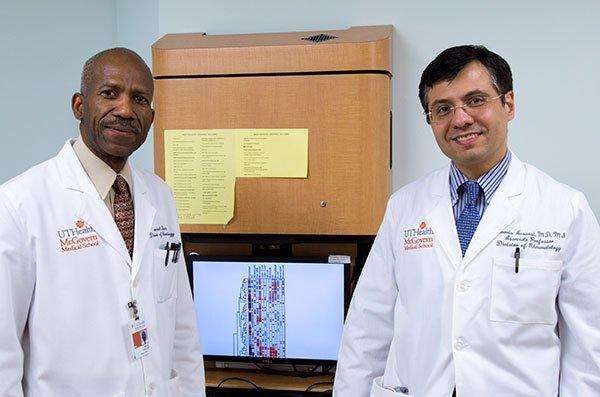
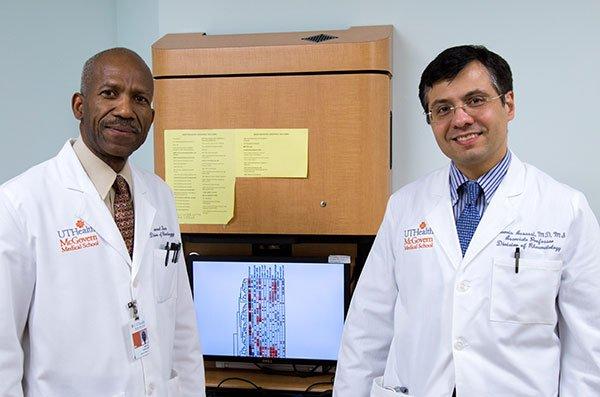
IMAGE

Credit: Maricruz Kwon, UTHealth

At The University of Texas Health Science Center at Houston (UTHealth), rheumatologist Shervin Assassi, M.D., is developing a blood test to determine which drugs work best for scleroderma patients with lung disease.

Assassi, whose work is supported with a $1.4 million Department of Defense medical research grant, is testing biomarkers that predict medication response in patients with scleroderma, an autoimmune disease affecting about 130,000 people in the United States.

Scleroderma patients often develop interstitial lung disease (also called pulmonary fibrosis) and have difficulty breathing and performing everyday tasks, said Assassi, an associate professor at McGovern Medical School at UTHealth.

"Medications that generally dampen the immune response such as cyclophosphamide or mycophenolate mofetil are used to treat scleroderma-related interstitial lung disease," he said. "However, patients respond very differently to these medications. Some show significant improvement in their lung function while others will continue to experience worsening disease, despite treatment."

Because these medications can have life-threatening side effects, doctors need to know ahead of time if they are going to work, Assassi said.

The research project capitalizes on the valuable biospecimens and clinical information collected in the recently completed Scleroderma Lung Study II, he said. This randomized controlled study showed that both cyclophosphamide and mycophenolate mofetil were modestly effective in the overall group.

However, the treatment effect was highly variable. The new project will link the molecular data generated in the biospecimens in the Scleroderma Lung Study II to lung outcomes to develop prediction models that identify patients who are likely to respond to immunosuppression.

"This can ultimately lead to more effective and safer treatment strategies for persons with scleroderma-related interstitial lung disease," he said.

Assassi's collaborators include David Elashoff, Ph.D., and Donald Tashkin, M.D., at the University of California, Los Angeles, and Jeffrey Browning, Ph.D., at Boston University.

###

Media Contact

Rob Cahill
[email protected]
713-500-3042

http://www.uthouston.edu

Original Source

https://www.uth.edu/media/story.htm?id=a7718eb0-225c-4676-a92a-6505fbe5b3b3
Share12Tweet8Share2ShareShareShare2

Related Posts

Evaluating a Self-Care App for Chest Trauma Patients

February 8, 2026

Anesthesia Method’s Impact on Elderly Hip Fracture Recovery

February 8, 2026

Menopause Care: Insights from Workforce Review and Consultation

February 7, 2026

LRRK2R1627P Mutation Boosts Gut Inflammation, α-Synuclein

February 7, 2026
Please login to join discussion

POPULAR NEWS

  • Robotic Ureteral Reconstruction: A Novel Approach

    Robotic Ureteral Reconstruction: A Novel Approach

    82 shares
    Share 33 Tweet 21
  • Digital Privacy: Health Data Control in Incarceration

    63 shares
    Share 25 Tweet 16
  • Breakthrough in RNA Research Accelerates Medical Innovations Timeline

    53 shares
    Share 21 Tweet 13
  • Mapping Tertiary Lymphoid Structures for Kidney Cancer Biomarkers

    50 shares
    Share 20 Tweet 13

About

We bring you the latest biotechnology news from best research centers and universities around the world. Check our website.

Follow us

Recent News

Evaluating a Self-Care App for Chest Trauma Patients

Anesthesia Method’s Impact on Elderly Hip Fracture Recovery

Menopause Care: Insights from Workforce Review and Consultation

Subscribe to Blog via Email

Enter your email address to subscribe to this blog and receive notifications of new posts by email.

Join 73 other subscribers
  • Contact Us

Bioengineer.org © Copyright 2023 All Rights Reserved.

Welcome Back!

Login to your account below

Forgotten Password?

Retrieve your password

Please enter your username or email address to reset your password.

Log In
No Result
View All Result
  • Homepages
    • Home Page 1
    • Home Page 2
  • News
  • National
  • Business
  • Health
  • Lifestyle
  • Science

Bioengineer.org © Copyright 2023 All Rights Reserved.