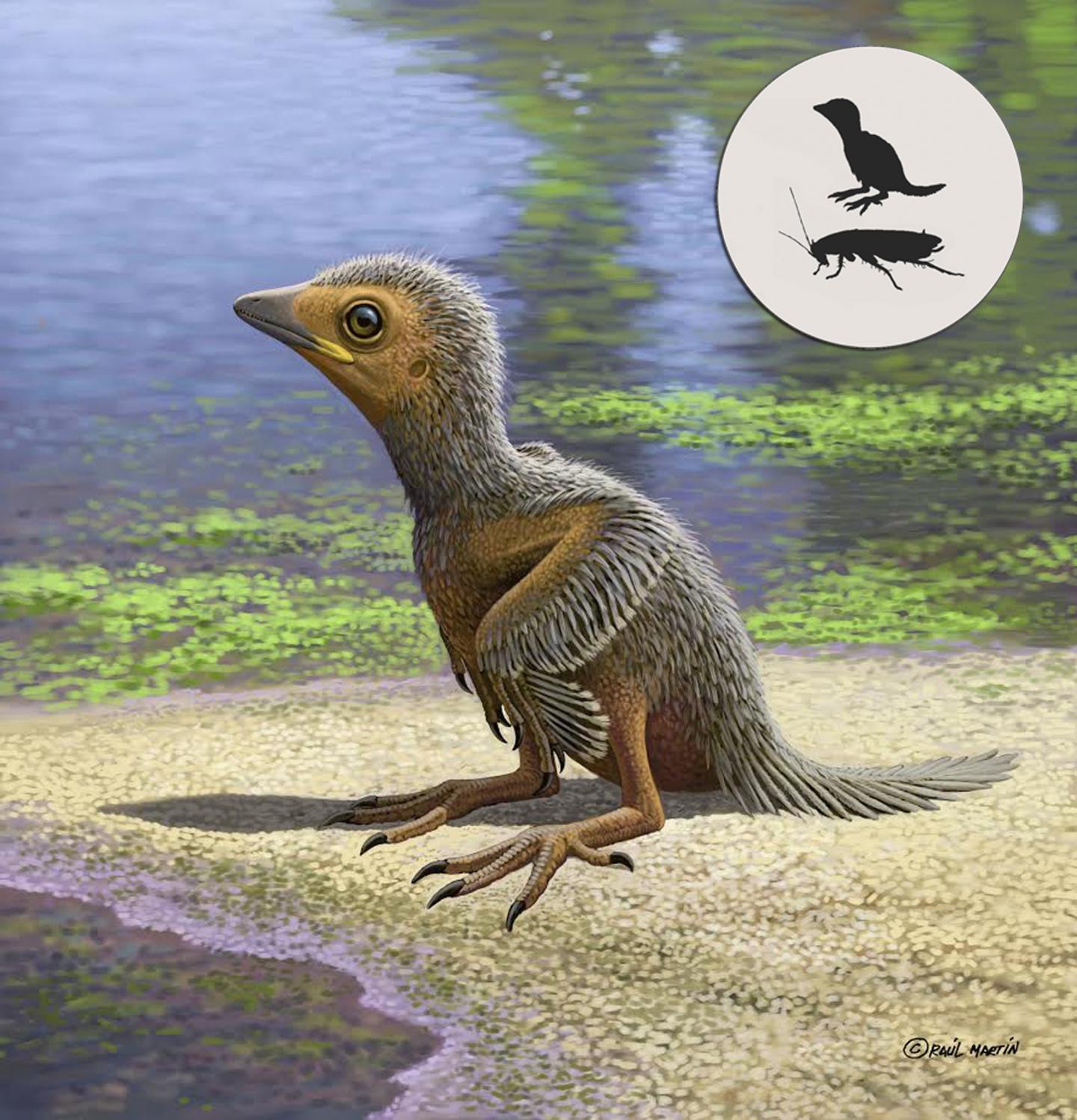
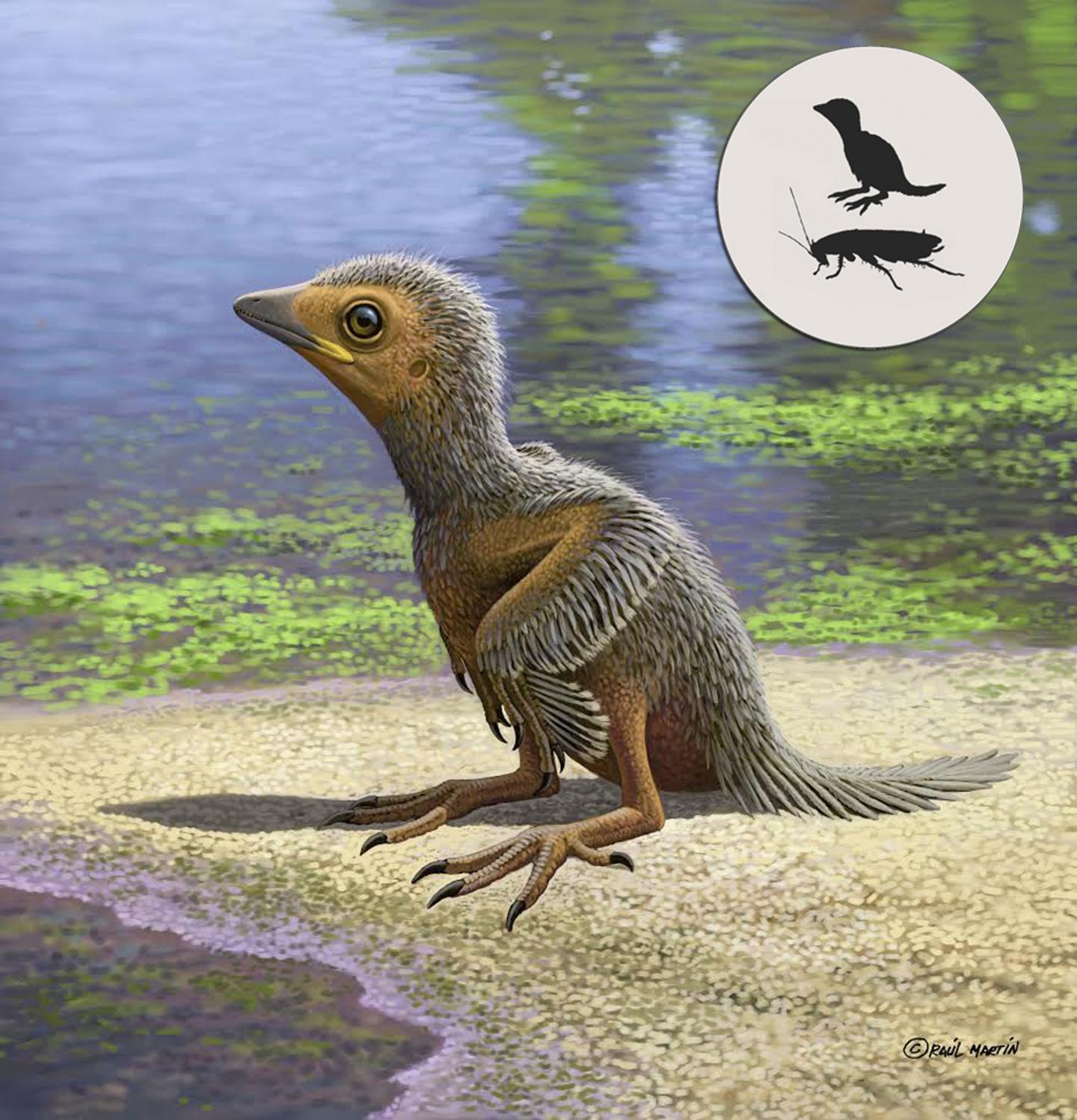
Credit: Raúl Martín
The tiny fossil of a prehistoric baby bird is helping scientists understand how early avians came into the world in the Age of Dinosaurs.
The fossil, which dates back to the Mesozoic Era (250-65 million years ago), is a chick from a group of prehistoric birds called, Enantiornithes. Made up of a nearly complete skeleton, the specimen is amongst the smallest known Mesozoic avian fossils ever discovered.
It measures less than five centimetres – smaller than the little finger on an average human hand – and would have weighed just three ounces when it was alive. What makes this fossil so important and unique is the fact it died not long after its birth. This is a critical stage in a bird's skeletal formation. That means this bird's extremely short life has given researchers a rare chance to analyse the species' bone structure and development.
Studying and analysing ossification – the process of bone development – can explain a lot about a young bird's life the researchers say. It can help them understand everything from whether it could fly or if it needed to stay with its parents after hatching or could survive on its own.
The lead author of the study, Fabien Knoll, from The University of Manchester's Interdisciplinary Centre for Ancient Life (ICAL), School of Earth and Environmental Sciences, and the ARAID–Dinopolis in Spain explains: 'The evolutionary diversification of birds has resulted in a wide range of hatchling developmental strategies and important differences in their growth rates. By analysing bone development we can look at a whole host of evolutionary traits.'
With the fossil being so small the team used synchrotron radiation to picture the tiny specimen at a 'submicron' level, observing the bones' microstructures in extreme detail.
Knoll said: 'New technologies are offering palaeontologists unprecedented capacities to investigate provocative fossils. Here we made the most of state-of-the-art facilities worldwide including three different synchrotrons in France, the UK and the United States.'
The researchers found the baby bird's sternum (breastplate bone) was still largely made of cartilage and had not yet developed into hard, solid bone when it died, meaning it wouldn't have been able to fly.
The patterns of ossification observed in this and the other few very young enantiornithine birds known to date also suggest that the developmental strategies of this particular group of ancient avians may have been more diverse than previously thought.
However, the team say that its lack of bone development doesn't necessarily mean the hatchling was over reliant on its parents for care and feeding, a trait known as being 'altricial'. Modern day species like love birds are highly dependent on their parents when born. Others, like chickens, are highly independent, which is known as 'precocial'. Although, this is not a black-and-white issue, but rather a spectrum, hence the difficulty in clarifying the developmental strategies of long gone bird species.
Luis Chiappe, from the LA Museum of Natural History and study's co-author added: 'This new discovery, together with others from around the world, allows us to peek into the world of ancient birds that lived during the age of dinosaurs. It is amazing to realise how many of the features we see among living birds had already been developed more than 100 million years ago.'
###
For media enquiries please contact Jordan Kenny on 0161 275 8257 and [email protected]
Reference: The paper 'A diminutive perinate European Enantiornithes reveals an asynchronous ossification pattern in early birds' is being published in Nature Communication DOI: 10.1038/s41467-018-03295-9 Fabien Knoll, Luis M. Chiappe, Sophie Sanchez, Russell J. Garwood, Nicholas P. Edwards, Roy A. Wogelius, William I. Sellers, Phillip L. Manning, Francisco Ortega, Francisco J. Serrano, Jesús Marugán-Lobón, Elena Cuesta, Fernando Escaso & Jose Luis Sanz
About The University of Manchester
The University of Manchester, a member of the prestigious Russell Group, is the UK's largest single-site university with more than 40,000 students – including more than 10,000 from overseas.It is consistently ranked among the world's elite for graduate employability.
The University is also one of the country's major research institutions, rated fifth in the UK in terms of 'research power' (REF 2014). World-class research is carried out across a diverse range of fields including cancer, advanced materials, addressing global inequalities, energy and industrial biotechnology.
No fewer than 25 Nobel laureates have either worked or studied here.
It is the only UK university to have social responsibility among its core strategic objectives, with staff and students alike dedicated to making a positive difference in communities around the world.
Manchester is ranked 38th in the world in the Academic Ranking of World Universities 2017 and 6th in the UK.
Visit http://www.manchester.ac.uk for further information.
Facts and figures: http://www.manchester.ac.uk/discover/facts-figures/
Research Beacons: http://www.manchester.ac.uk/research/beacons/
News and media contacts: http://www.manchester.ac.uk/discover/news/
Media Contact
Jordan Kenny
[email protected]
44-016-127-58257
@UoMNews
http://www.manchester.ac.uk
Related Journal Article
http://dx.doi.org/10.1038/s41467-018-03295-9