

• HOME
  • NEWS
  • EXPLORE
    • CAREER
      • Companies
      • Jobs
    • EVENTS
    • iGEM
      • News
      • Team
    • PHOTOS
    • VIDEO
    • WIKI
  • BLOG
  • COMMUNITY
    • FACEBOOK
    • INSTAGRAM
    • TWITTER
Saturday, February 7, 2026
BIOENGINEER.ORG
No Result
View All Result
  • Login
  • HOME
  • NEWS
  • EXPLORE
    • CAREER
      • Companies
      • Jobs
        • Lecturer
        • PhD Studentship
        • Postdoc
        • Research Assistant
    • EVENTS
    • iGEM
      • News
      • Team
    • PHOTOS
    • VIDEO
    • WIKI
  • BLOG
  • COMMUNITY
    • FACEBOOK
    • INSTAGRAM
    • TWITTER
  • HOME
  • NEWS
  • EXPLORE
    • CAREER
      • Companies
      • Jobs
        • Lecturer
        • PhD Studentship
        • Postdoc
        • Research Assistant
    • EVENTS
    • iGEM
      • News
      • Team
    • PHOTOS
    • VIDEO
    • WIKI
  • BLOG
  • COMMUNITY
    • FACEBOOK
    • INSTAGRAM
    • TWITTER
No Result
View All Result
Bioengineer.org
No Result
View All Result
Home NEWS Science News Biology

Vertical measurements of air pollutants in urban Beijing

Bioengineer by Bioengineer
March 4, 2018
in Biology
Reading Time: 2 mins read
0
Share on FacebookShare on TwitterShare on LinkedinShare on RedditShare on Telegram
IMAGE

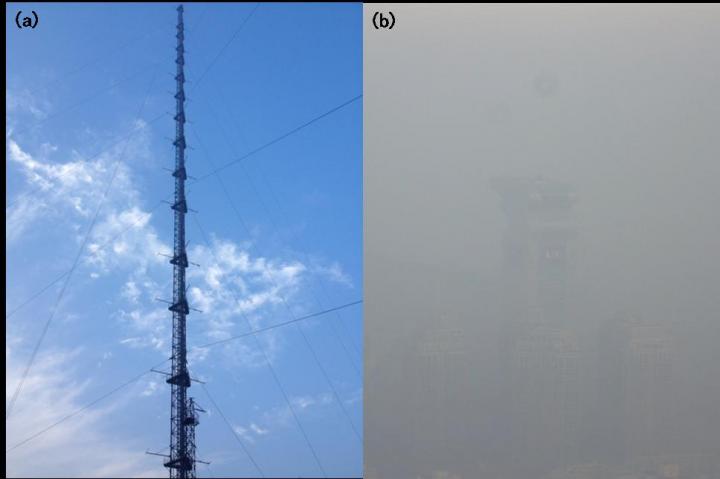
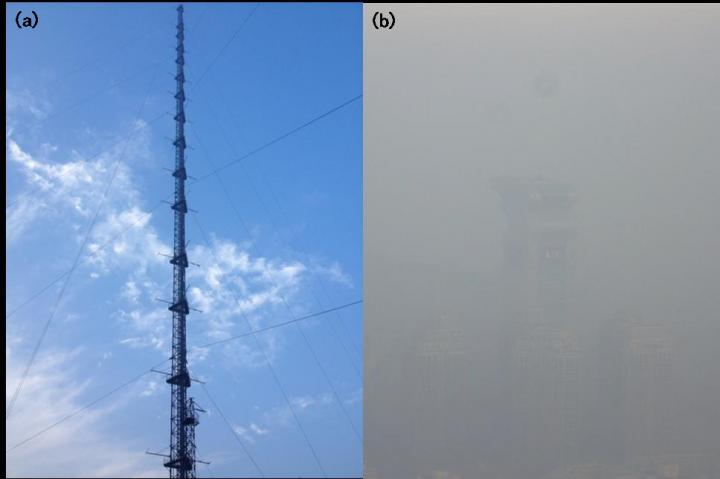
Credit: The photo on the left was taken by SUN Yele; The photo on the right was taken by the camera installed on the Tower.

Severe haze episodes with surprisingly high concentrations of fine particles (PM2.5) still occur in fall and winter seasons in Beijing, although the air quality has been improved in recent years. Air pollution often shows strong vertical differences in Beijing. For example, we can feel fresh air with a good visibility at the peak of a mountain on a hazy day, while the city is actually buried in a low visibility and severely polluted air. In the urban area, we also often observe the coexistence of haze and blue sky (Figure 1). To gain an in-depth understanding of the vertical evolution characteristics of air pollutants within urban boundary layer, a team of the State Key Laboratory of Atmospheric Boundary Layer Physics and Atmospheric Chemistry, Institute of Atmospheric Physics, CAS, used a container that can travel on the Beijing 325 m Meteorological Tower for the vertically resolved measurements of light extinction coefficient of dry fine particles, gaseous NO2, and black carbon (BC) (Figure 2) from ground surface to 260 m during daytime, and 200 m at nighttime. Simultaneously, non-refractory submicron aerosol (NR-PM1) species including organics, sulfate, nitrate, ammonium and chloride, were measured at ground level and 260 m on the tower with an Aerodyne High-Resolution Aerosol Mass Spectrometer (HR- AMS) and an Aerosol Chemical Speciation Monitor (ACSM), respectively. Four distinct types of vertical profiles were illustrated, and the vertical convection as indicated by mixing layer height, temperature inversion, and local emissions are three major factors affecting the changes in vertical profiles. The team found that the temperature inversion coupled by the interactions of different air masses elucidated the "blue sky – haze" co-existent phenomenon as shown in Figure 1. The tower-based vertically resolved measurements prove to be essential supplements to lidar measurements with a blind zone, typically below 200 m. The findings have recently been published in Atmospheric Chemistry & Physics).

###

Media Contact

Zheng Lin
[email protected]
86-108-299-5053
@aasjournal

http://english.iap.cas.cn/

Original Source

https://www.atmos-chem-phys.net/18/2495/2018/acp-18-2495-2018.html http://dx.doi.org/10.5194/acp-18-2495-2018


Share12Tweet7Share2ShareShareShare1

Related Posts

Florida Cane Toad: Complex Spread and Selective Evolution

Florida Cane Toad: Complex Spread and Selective Evolution

February 7, 2026
New Study Uncovers Mechanism Behind Burn Pit Particulate Matter–Induced Lung Inflammation

New Study Uncovers Mechanism Behind Burn Pit Particulate Matter–Induced Lung Inflammation

February 6, 2026

DeepBlastoid: Advancing Automated and Efficient Evaluation of Human Blastoids with Deep Learning

February 6, 2026

Navigating the Gut: The Role of Formic Acid in the Microbiome

February 6, 2026
Please login to join discussion

POPULAR NEWS

  • Robotic Ureteral Reconstruction: A Novel Approach

    Robotic Ureteral Reconstruction: A Novel Approach

    82 shares
    Share 33 Tweet 21
  • Digital Privacy: Health Data Control in Incarceration

    63 shares
    Share 25 Tweet 16
  • Study Reveals Lipid Accumulation in ME/CFS Cells

    57 shares
    Share 23 Tweet 14
  • Breakthrough in RNA Research Accelerates Medical Innovations Timeline

    53 shares
    Share 21 Tweet 13

About

We bring you the latest biotechnology news from best research centers and universities around the world. Check our website.

Follow us

Recent News

Evaluating Pediatric Emergency Care Quality in Ethiopia

TPMT Expression Predictions Linked to Azathioprine Side Effects

Improving Dementia Care with Enhanced Activity Kits

Subscribe to Blog via Email

Success! An email was just sent to confirm your subscription. Please find the email now and click 'Confirm' to start subscribing.

Join 73 other subscribers
  • Contact Us

Bioengineer.org © Copyright 2023 All Rights Reserved.

Welcome Back!

Login to your account below

Forgotten Password?

Retrieve your password

Please enter your username or email address to reset your password.

Log In
No Result
View All Result
  • Homepages
    • Home Page 1
    • Home Page 2
  • News
  • National
  • Business
  • Health
  • Lifestyle
  • Science

Bioengineer.org © Copyright 2023 All Rights Reserved.