Credit: Michigan State University
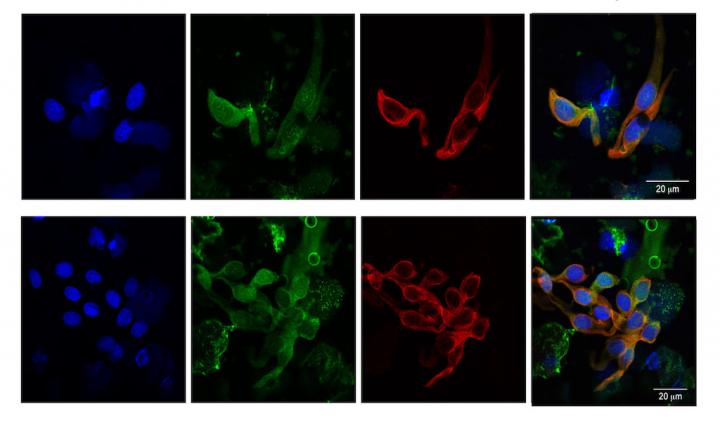
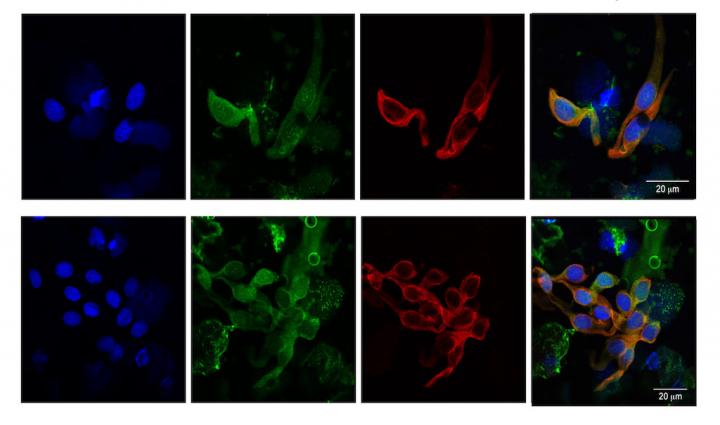
Michigan State University scientists are engineering a virus-like particle, known as Qβ, that will generate anti-cancer immune responses in the body and potentially be used as a new vaccine for the treatment of cancer.
The project, funded by a $2.4 million grant from the National Cancer Institute, will support the development of the vaccine to protect animals against cancerous cells that are currently untreatable, and could easily translate to vaccines for humans' use of spontaneously occurring cancers.
"This grant is unique as it focuses on the development of new anti-cancer immunotherapy based on collaborations between colleges of natural science, engineering and veterinary medicine," said Xuefei Huang, MSU Foundation Professor of chemistry in the College of Natural Science, and in biomedical engineering in the College of Engineering. "It aims to establish a novel method for cancer treatment, complementing the current chemo- and radio-therapy."
Huang is spearheading the research with two experts from the College of Veterinary Medicine, Vilma Yuzbasiyan-Gurkan, associate dean of research and graduate studies and a cancer researcher, and Paulo Vilar Saavedra, head of oncology.
The team will combine Qβ particles with tumor-associated carbohydrate antigens, or TACAs, which they believe will lead to complete antitumor cell immunity, reduce tumor growth and protect against tumor development. In addition, the researchers will use the Qβ's crystal structure to develop mutations that could reduce toxic antibodies and boost desired cells, which can also kill cancer cells.
This will be the first trial of its kind using TACA-based vaccine models.
"Comprehensive cancer research and treatment is a major area of research of our college, and this breakthrough research could be the response to many unanswered needs for cancer treatment in veterinary and human medicine," Yuzbasiyan-Gurkan said.
The most destructive cancers suppress the immune system by concealing proteins, which hinder signals that would normally trigger an immune response. To help combat this, the researchers are focusing on a special type of antigen that is present in various types of cancer cells, and often outlasts traditional chemotherapy treatments.
The vaccine will first be used to treat canine cancer patients and focus on osteosarcoma, a challenging bone tumor in dogs and humans.
"Our vaccine would reduce tumor growth and protect the patient against tumor development and redevelopment," Huang explained. "If we can further understand the connections between the structural features of Qβ-TACA formations and anti-tumor immunity, we can make a sustained impact on cancer vaccine design."
This research also reinforces the critical role veterinary medicine has in cancer research.
"Spontaneous cancers in dogs and cats provide a true test for the cancer vaccine approach," said Yuzbasiyan-Gurkan. "This is just one example of the many ways that veterinary and human medical research benefit each other."
###
Media Contact
Caroline Brooks
[email protected]
517-432-0920
@MSUnews
http://msutoday.msu.edu/journalists/
Original Source
https://msutoday.msu.edu/news/2018/virus-like-particle-could-lead-to-new-cancer-vaccine/