• HOME
  • NEWS
  • EXPLORE
    • CAREER
      • Companies
      • Jobs
    • EVENTS
    • iGEM
      • News
      • Team
    • PHOTOS
    • VIDEO
    • WIKI
  • BLOG
  • COMMUNITY
    • FACEBOOK
    • INSTAGRAM
    • TWITTER
Sunday, February 8, 2026
BIOENGINEER.ORG
No Result
View All Result
  • Login
  • HOME
  • NEWS
  • EXPLORE
    • CAREER
      • Companies
      • Jobs
        • Lecturer
        • PhD Studentship
        • Postdoc
        • Research Assistant
    • EVENTS
    • iGEM
      • News
      • Team
    • PHOTOS
    • VIDEO
    • WIKI
  • BLOG
  • COMMUNITY
    • FACEBOOK
    • INSTAGRAM
    • TWITTER
  • HOME
  • NEWS
  • EXPLORE
    • CAREER
      • Companies
      • Jobs
        • Lecturer
        • PhD Studentship
        • Postdoc
        • Research Assistant
    • EVENTS
    • iGEM
      • News
      • Team
    • PHOTOS
    • VIDEO
    • WIKI
  • BLOG
  • COMMUNITY
    • FACEBOOK
    • INSTAGRAM
    • TWITTER
No Result
View All Result
Bioengineer.org
No Result
View All Result
Home NEWS Science News Biology

Entomologist discovers millipede that comes in more color combinations…

Bioengineer by Bioengineer
February 13, 2018
in Biology
Reading Time: 2 mins read
0
Share on FacebookShare on TwitterShare on LinkedinShare on RedditShare on Telegram
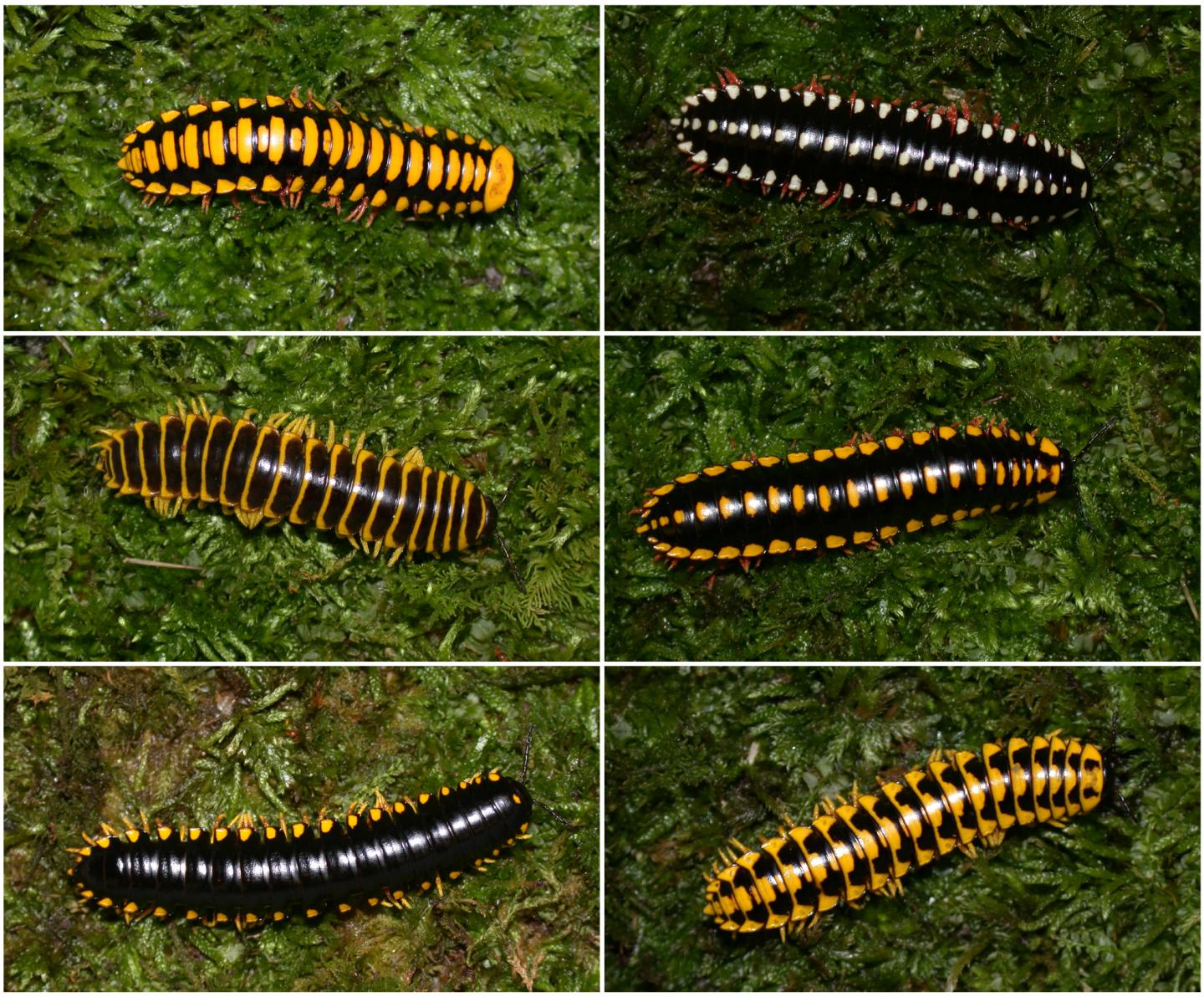
IMAGE

Credit: Virginia Tech

The new millipede that Paul Marek discovered is as pretty as it is dangerous.

The thumb-sized millipede that crawls around the forest floor of Southwest Virginia's Cumberland Mountains has more color combinations than any other millipede discovered.

Apheloria polychroma, as the millipede is known, also has an enviable trait in the animal world — it's covered in cyanide, ensuring any bird that snacks on the colorful but lethal invertebrate won't do it a second time. Lots of other millipedes that don't have as much toxic defense mimic Apheloria polychroma's coloring in hopes of avoiding becoming another link in the food chain.

This is the 10th species that Marek, an assistant professor in the Virginia Tech College of Agriculture and Life Sciences' Department of Entomology, has discovered and named in recent years. Apheloria polychroma was named for its rainbow of colors and was described by Marek; Jackson Means, a graduate student from Keswick, Virginia; and Derek Hennen, a graduate student from Little Hocking, Ohio. Marek runs the only millipede lab in the United States.

The team's findings were recently published in the journal Zootaxa.

While Marek's work is focused on small things, his research helps tell the larger story of the quickly changing natural world. By documenting the many living organisms of the planet, he is helping avoid anonymous extinction — a process in which a species goes extinct before its existence, role in the ecosystem, or potential benefit to humanity is known.

"It is imperative to describe and catalog these species so that we know what role they play in the ecosystem — and what impact we are having on them," said Marek. "This region is ripe with biodiversity and is an excellent living laboratory to do this work."

The millipedes that copy Apheloria polychroma use what is called Mullerian mimicry, where different species converge on a shared aposematic (warning signal) to defend themselves against a common predator. The more frequently predators encounter what appears to be the same brightly colored unpalatable millipede and memorize its warning colors, the better the collective advertisement of their noxiousness.

In addition to the millipede's colorful exoskeleton, it also serves an important role in the ecosystem as a decomposer by breaking down decaying leaves, wood, and other vegetation to unlock and recycle their nutrients for future generations of forest life.

In recent years, Marek also has had a tarantula named for him, explored the origins of bioluminescence, and discovered the leggiest creature on Earth.

###

Media Contact

Zeke Barlow
[email protected]
540-231-5417
@vtnews

http://www.vtnews.vt.edu

Original Source

https://vtnews.vt.edu/articles/2018/01/cals-millipede.html

Share13Tweet8Share2ShareShareShare2

Related Posts

Florida Cane Toad: Complex Spread and Selective Evolution

Florida Cane Toad: Complex Spread and Selective Evolution

February 7, 2026
New Study Uncovers Mechanism Behind Burn Pit Particulate Matter–Induced Lung Inflammation

New Study Uncovers Mechanism Behind Burn Pit Particulate Matter–Induced Lung Inflammation

February 6, 2026

DeepBlastoid: Advancing Automated and Efficient Evaluation of Human Blastoids with Deep Learning

February 6, 2026

Navigating the Gut: The Role of Formic Acid in the Microbiome

February 6, 2026
Please login to join discussion

POPULAR NEWS

  • Robotic Ureteral Reconstruction: A Novel Approach

    Robotic Ureteral Reconstruction: A Novel Approach

    82 shares
    Share 33 Tweet 21
  • Digital Privacy: Health Data Control in Incarceration

    63 shares
    Share 25 Tweet 16
  • Breakthrough in RNA Research Accelerates Medical Innovations Timeline

    53 shares
    Share 21 Tweet 13
  • Mapping Tertiary Lymphoid Structures for Kidney Cancer Biomarkers

    50 shares
    Share 20 Tweet 13

About

We bring you the latest biotechnology news from best research centers and universities around the world. Check our website.

Follow us

Recent News

Evaluating a Self-Care App for Chest Trauma Patients

Anesthesia Method’s Impact on Elderly Hip Fracture Recovery

Menopause Care: Insights from Workforce Review and Consultation

Subscribe to Blog via Email

Enter your email address to subscribe to this blog and receive notifications of new posts by email.

Join 73 other subscribers
  • Contact Us

Bioengineer.org © Copyright 2023 All Rights Reserved.

Welcome Back!

Login to your account below

Forgotten Password?

Retrieve your password

Please enter your username or email address to reset your password.

Log In
No Result
View All Result
  • Homepages
    • Home Page 1
    • Home Page 2
  • News
  • National
  • Business
  • Health
  • Lifestyle
  • Science

Bioengineer.org © Copyright 2023 All Rights Reserved.