• HOME
  • NEWS
  • EXPLORE
    • CAREER
      • Companies
      • Jobs
    • EVENTS
    • iGEM
      • News
      • Team
    • PHOTOS
    • VIDEO
    • WIKI
  • BLOG
  • COMMUNITY
    • FACEBOOK
    • INSTAGRAM
    • TWITTER
Sunday, May 17, 2026
BIOENGINEER.ORG
No Result
View All Result
  • Login
  • HOME
  • NEWS
  • EXPLORE
    • CAREER
      • Companies
      • Jobs
        • Lecturer
        • PhD Studentship
        • Postdoc
        • Research Assistant
    • EVENTS
    • iGEM
      • News
      • Team
    • PHOTOS
    • VIDEO
    • WIKI
  • BLOG
  • COMMUNITY
    • FACEBOOK
    • INSTAGRAM
    • TWITTER
  • HOME
  • NEWS
  • EXPLORE
    • CAREER
      • Companies
      • Jobs
        • Lecturer
        • PhD Studentship
        • Postdoc
        • Research Assistant
    • EVENTS
    • iGEM
      • News
      • Team
    • PHOTOS
    • VIDEO
    • WIKI
  • BLOG
  • COMMUNITY
    • FACEBOOK
    • INSTAGRAM
    • TWITTER
No Result
View All Result
Bioengineer.org
No Result
View All Result
Home NEWS Science News Health

Why air pollutants make some people vulnerable to atopic dermatitis

Bioengineer by Bioengineer
February 13, 2018
in Health
Reading Time: 2 mins read
0
Share on FacebookShare on TwitterShare on LinkedinShare on RedditShare on Telegram
IMAGE

Credit: Hidaka et al., 2016

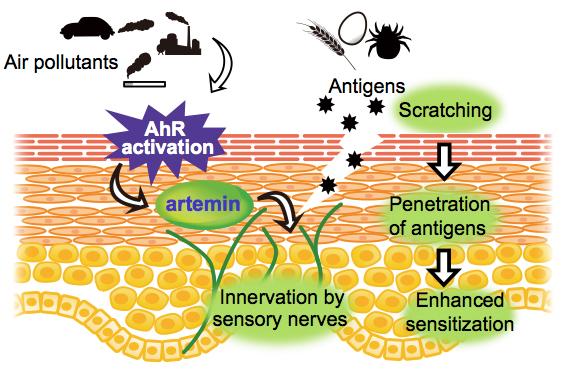
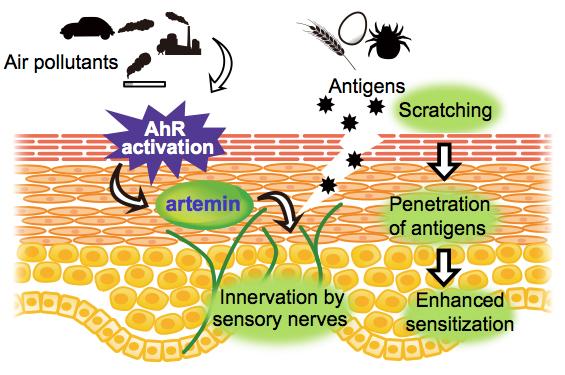
Tohoku University Graduate School of Medicine and Tohoku Medical Megabank Organization (ToMMo) are pleased to announce the published results of a study into why air pollutants cause some people to be more susceptible to atopic dermatitis, a kind of skin inflammation.

"We have discovered that AhR, a transcription factor activated by air pollutants, causes hypersensitivity to itch, through the expression of neurotrophic factor artemin," says Dr. Masayuki Yamamoto, who led the research team with Drs. Takanori Hidaka and Eri Kobayashi. "Scratching makes things worse because the skin barrier gets disrupted and sensitization to antigens is enhanced. That's why some people are predisposed to atopic dermatitis."

While the correlation between air pollution and the prevalence and severity of atopic dermatitis is well known, the underlying mechanism behind it was not widely understood, until now.

Itch causes scratching, which disrupts the skin barrier function, making it easy for antigens to penetrate. This results in the patients being sensitized to antigens and predisposed to allergic diseases such as asthma. This is known as "the allergic march," and is observed in patients with atopic dermatitis.

In human clinical samples, high levels of AhR activation and artemin expression are observed in atopic dermatitis patients but not in healthy individuals. This is also consistent with the findings in a similar study of mice, and further supports the notion that chronic activation of AhR is an important environmental factor causing atopic dermatitis.

Currently, steroid drugs are used as a symptomatic treatment for atopic dermatitis. However, in some cases, the itch remains. The research team believes that control of the itch is important and hopes that with the results of this study, new treatments using inhibitors of AhR and/or artemin can be found.

###

Contact:
Fuji Nagami
Tohoku University Tohoku Medical Megabank Organization
Tel: +81-22-717-7908
Fax: +81-22-717-7923
Email: [email protected]

Japan Agency for Medical Research and Development (AMED)
Tel: +81-3-6870-2224
Fax: +81-3-6870-2243
Email: [email protected]

Media Contact

Fuji Nagami
[email protected]
81-227-177-908
@TohokuUniPR

http://www.tohoku.ac.jp/en/

Share12Tweet8Share2ShareShareShare2

Related Posts

Age Discrimination Affects Healthcare Use in India

May 17, 2026

Advancements and Insights into Life Expectancy for Chronic Obstructive Pulmonary Disease Patients

May 17, 2026

Intrinsic Capacity, Resilience, Frailty in Stroke Recovery

May 17, 2026

Physical Resilience Linked to Aging Views in Chinese Elders

May 17, 2026
Please login to join discussion

POPULAR NEWS

  • Research Indicates Potential Connection Between Prenatal Medication Exposure and Elevated Autism Risk

    844 shares
    Share 338 Tweet 211
  • New Study Reveals Plants Can Detect the Sound of Rain

    730 shares
    Share 291 Tweet 182
  • Salmonella Haem Blocks Macrophages, Boosts Infection

    62 shares
    Share 25 Tweet 16
  • Breastmilk Balances E. coli and Beneficial Bacteria in Infant Gut Microbiomes

    58 shares
    Share 23 Tweet 15

About

We bring you the latest biotechnology news from best research centers and universities around the world. Check our website.

Follow us

Recent News

Age Discrimination Affects Healthcare Use in India

Lavandula-Zn(II) Hybrid Shields Steel from Corrosion

Targeted Radiotherapy Extends Control of Early-Stage Breast Cancer Spread

Subscribe to Blog via Email

Enter your email address to subscribe to this blog and receive notifications of new posts by email.

Join 82 other subscribers
  • Contact Us

Bioengineer.org © Copyright 2023 All Rights Reserved.

Welcome Back!

Login to your account below

Forgotten Password?

Retrieve your password

Please enter your username or email address to reset your password.

Log In
No Result
View All Result
  • Homepages
    • Home Page 1
    • Home Page 2
  • News
  • National
  • Business
  • Health
  • Lifestyle
  • Science

Bioengineer.org © Copyright 2023 All Rights Reserved.