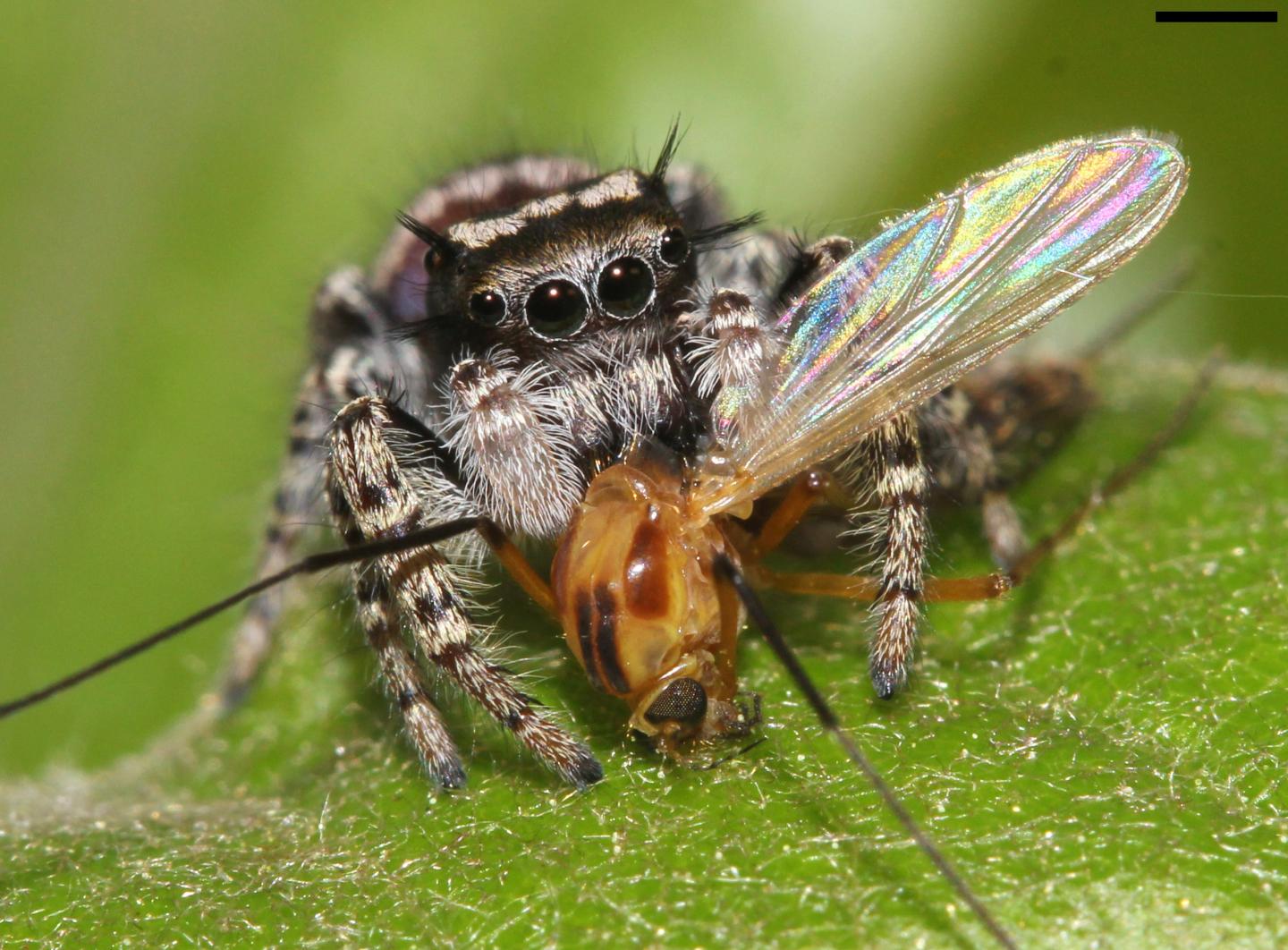
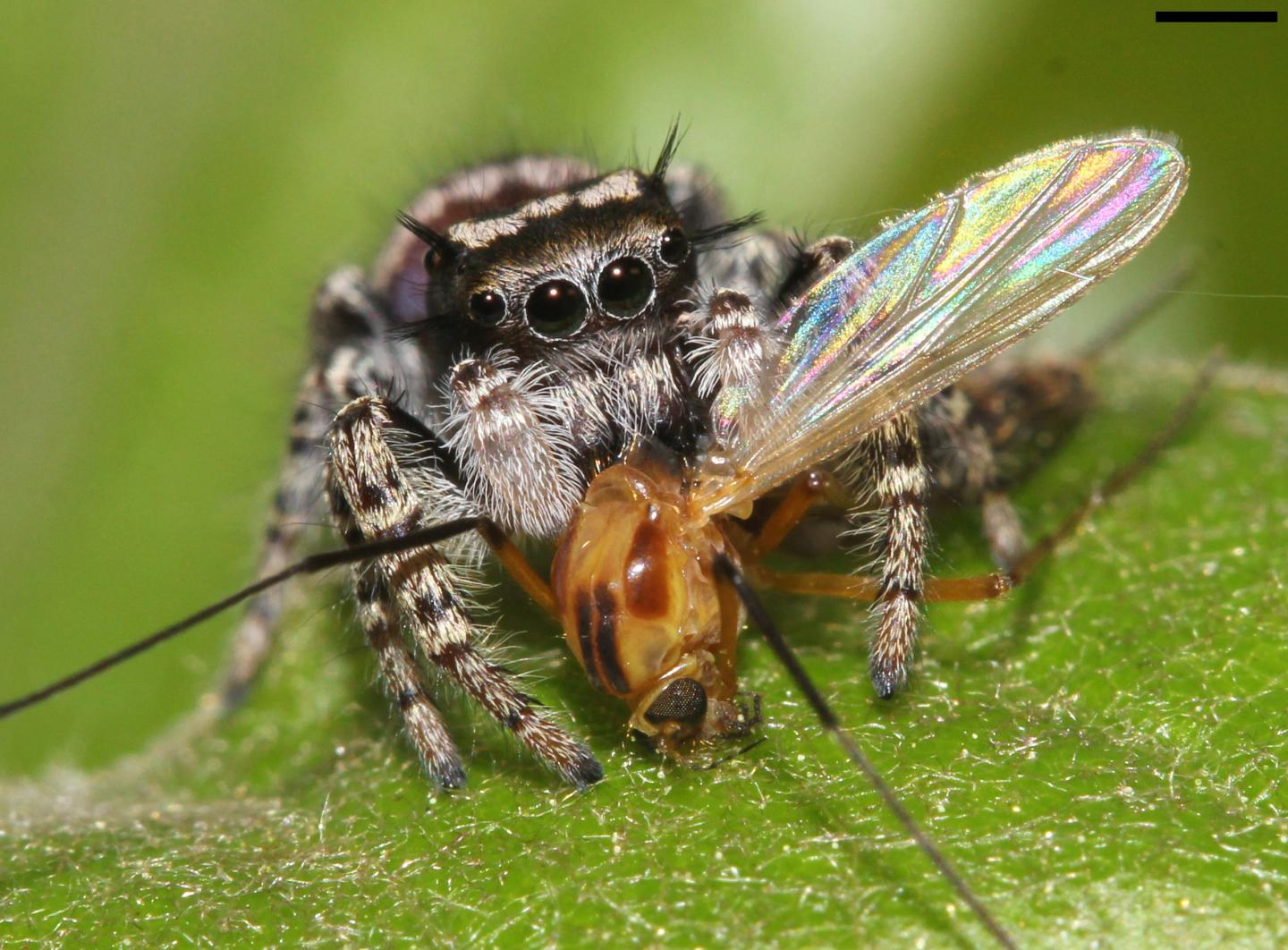
Credit: David E. Hill, Peckham Society, Simpsonville, South Carolina
It has long been suspected that spiders are one of the most important groups of predators of insects. Zoologists at the University of Basel and Lund University in Sweden have now shown just how true this is – spiders kill astronomical numbers of insects on a global scale. The scientific journal The Science of Nature has published the results.
With more than 45,000 species and a population density of up to 1,000 individuals per square meter, spiders are one of the world's most species-rich and widespread groups of predators. Due to their secretive lifestyle – many spiders are nocturnal or live well camouflaged in vegetation – it was previously difficult to demonstrate their ecological role, but zoologists at the University of Basel and Lund University (Sweden) have now used calculations to conclude that spiders indeed have an enormous ecological impact as natural enemies of insects.
Spiders kill vast numbers of insects
The researchers used two calculation methods based on different models, which consistently showed that the global spider population (with a weight of around 25 million tons) wipes out an estimated 400-800 million tons of prey every year. More than 90% of that prey is insects and springtails (Collembola). Furthermore, large tropical spiders occasionally prey on small vertebrates (frogs, lizards, snakes, fish, birds, and bats) or feed on plants. The large range of the global prey kill estimate is due to the fact that rates of prey kill can vary widely within specific ecosystems, and these variations must be taken into account for ecological projections.
Compare this to the fact that, according to the Food and Agriculture Organization of the United Nations (FAO), the worldwide human population consumes around 400 million tons of meat and fish every year. The spider's eating habits can even be compared to those of the whales (Cetacea) in the world's oceans, which eat an estimated 280-500 million tons of prey a year.
The particular importance of spiders in forests and grasslands
The zoologists also showed that spiders kill many times more insects in forests and grasslands than in other habitats. Spiders in these areas catch huge numbers of forest and grassland pests, whereas spiders in desert regions, in the Arctic tundra and in annual crops kill fewer insects in comparison. The spiders' impact is lower in agricultural areas because these are intensively managed areas that offer unfavorable living conditions for spiders.
"Our calculations let us quantify for the first time on a global scale that spiders are major natural enemies of insects. In concert with other insectivorous animals such as ants and birds, they help to reduce the population densities of insects significantly," says Martin Nyffeler from the University of Basel, lead author of the study. "Spiders thus make an essential contribution to maintaining the ecological balance of nature," he adds.
###
Original publication
Martin Nyffeler & Klaus Birkhofer
An estimated 400-800 million tons of prey are annually killed by the global spider community
The Science of Nature (2017), doi: 10.1007/s00114-017-1440-1
Media Contact
Olivia Poisson
[email protected]
@UniBasel_en
http://www.unibas.ch/