• HOME
  • NEWS
  • EXPLORE
    • CAREER
      • Companies
      • Jobs
    • EVENTS
    • iGEM
      • News
      • Team
    • PHOTOS
    • VIDEO
    • WIKI
  • BLOG
  • COMMUNITY
    • FACEBOOK
    • INSTAGRAM
    • TWITTER
Saturday, February 7, 2026
BIOENGINEER.ORG
No Result
View All Result
  • Login
  • HOME
  • NEWS
  • EXPLORE
    • CAREER
      • Companies
      • Jobs
        • Lecturer
        • PhD Studentship
        • Postdoc
        • Research Assistant
    • EVENTS
    • iGEM
      • News
      • Team
    • PHOTOS
    • VIDEO
    • WIKI
  • BLOG
  • COMMUNITY
    • FACEBOOK
    • INSTAGRAM
    • TWITTER
  • HOME
  • NEWS
  • EXPLORE
    • CAREER
      • Companies
      • Jobs
        • Lecturer
        • PhD Studentship
        • Postdoc
        • Research Assistant
    • EVENTS
    • iGEM
      • News
      • Team
    • PHOTOS
    • VIDEO
    • WIKI
  • BLOG
  • COMMUNITY
    • FACEBOOK
    • INSTAGRAM
    • TWITTER
No Result
View All Result
Bioengineer.org
No Result
View All Result
Home NEWS Science News Biology

Researchers raise a 170-million-year question over mysterious moss gene

Bioengineer by Bioengineer
February 12, 2018
in Biology
Reading Time: 2 mins read
0
Share on FacebookShare on TwitterShare on LinkedinShare on RedditShare on Telegram
IMAGE

Credit: Bezanilla et al. (2018) from the Journal of Cell Biology

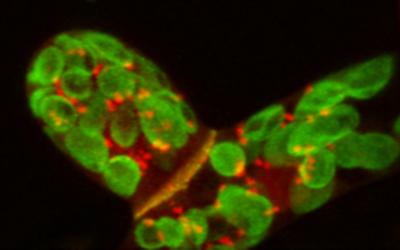
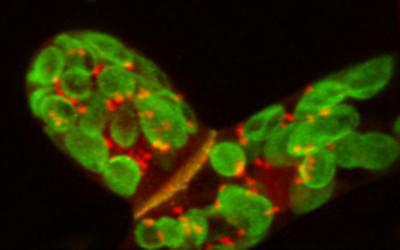
HANOVER, N.H. – February 12, 2018 – Researchers have identified a fused gene in moss that provides insight into how cells build their external walls. The same discovery raises questions about the one-of-a-kind gene that features two distinct proteins that participate in two distinct functions.

The research team identified the novel gene, known as For1F, while studying exocytosis. Exocytosis is the process by which cells secrete packets of protein and carbohydrates outside their membranes to support extracellular processes like the construction of cell walls.

The gene discovered in the research couples the exocytosis-regulating protein Sec10 with formin, a protein that regulates the remodeling of the actin cytoskeleton critical to forming cell shapes.

The new study also shows that the gene fusion occurred early in moss evolution and has been retained for more than 170 million years.

"We were surprised to find this fused gene in the moss genome," said Magdalena Bezanilla, the Ernest Everett Just 1907 Professor of Biology at Dartmouth College. "Through our research, we know that the analysis is correct, now it will be interesting to explore the advantage of this coupling of proteins."

Once For1F was observed, Bezanilla and her team set out to determine how unique this particular conjoined arrangement is. By consulting the database of the 1000 Genomes Project, the researchers found that the fused gene was evident in many diverse species of mosses, but not in other plants.

In all other plant and animal cells, Sec10 and formin are located independently. But, for some reason, the genes are fused in mosses. This unique combination of the genes demonstrates that there is a connection between exocytosis and the remodeling of the cell's internal skeleton, but what that connection is remains unclear.

Further complicating the research, the team also found that the genes did not have to be joined to do their jobs.

According to the paper: "Although not essential, the fusion may have had selective advantages and provides a unique opportunity to probe actin regulation of exocytosis."

"We know that this fusion occurred early in moss evolution and that it has been retained for millions of years," said Bezanilla. "All indications are that there should be some value to this arrangement, but why they are fused in mosses is a mystery."

Bezanilla's research focuses on how single cells and their neighbors work together in moss to construct cell walls over long periods of time. To do so, the team focuses on the molecules that drive the process.

"Moss is the perfect plant to study," said Bezanilla, "it's a great system with cells that are observable under the microscope and with a genome that we can manipulate."

###

Bezanilla led a team at Dartmouth and the University of Massachusetts Amherst to conduct the study. The research appears in the Journal of Cell Biology

Media Contact

David Hirsch
[email protected]
@dartmouth

http://www.dartmouth.edu

Related Journal Article

http://dx.doi.org/10.1083/jcb.201705084
Share13Tweet8Share2ShareShareShare2

Related Posts

Florida Cane Toad: Complex Spread and Selective Evolution

Florida Cane Toad: Complex Spread and Selective Evolution

February 7, 2026
New Study Uncovers Mechanism Behind Burn Pit Particulate Matter–Induced Lung Inflammation

New Study Uncovers Mechanism Behind Burn Pit Particulate Matter–Induced Lung Inflammation

February 6, 2026

DeepBlastoid: Advancing Automated and Efficient Evaluation of Human Blastoids with Deep Learning

February 6, 2026

Navigating the Gut: The Role of Formic Acid in the Microbiome

February 6, 2026
Please login to join discussion

POPULAR NEWS

  • Robotic Ureteral Reconstruction: A Novel Approach

    Robotic Ureteral Reconstruction: A Novel Approach

    82 shares
    Share 33 Tweet 21
  • Digital Privacy: Health Data Control in Incarceration

    63 shares
    Share 25 Tweet 16
  • Study Reveals Lipid Accumulation in ME/CFS Cells

    57 shares
    Share 23 Tweet 14
  • Breakthrough in RNA Research Accelerates Medical Innovations Timeline

    53 shares
    Share 21 Tweet 13

About

We bring you the latest biotechnology news from best research centers and universities around the world. Check our website.

Follow us

Recent News

Phage-Antibiotic Combo Beats Resistant Peritoneal Infection

Boosting Remote Healthcare: Stepped-Wedge Trial Insights

Barriers and Boosters of Seniors’ Physical Activity in Karachi

Subscribe to Blog via Email

Enter your email address to subscribe to this blog and receive notifications of new posts by email.

Join 73 other subscribers
  • Contact Us

Bioengineer.org © Copyright 2023 All Rights Reserved.

Welcome Back!

Login to your account below

Forgotten Password?

Retrieve your password

Please enter your username or email address to reset your password.

Log In
No Result
View All Result
  • Homepages
    • Home Page 1
    • Home Page 2
  • News
  • National
  • Business
  • Health
  • Lifestyle
  • Science

Bioengineer.org © Copyright 2023 All Rights Reserved.