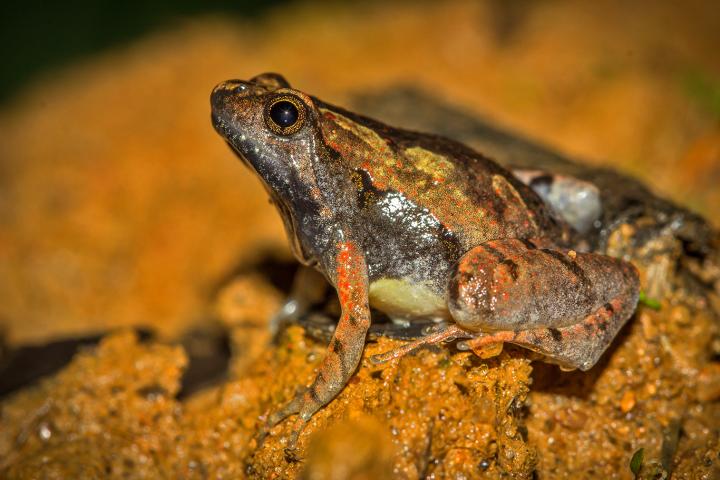
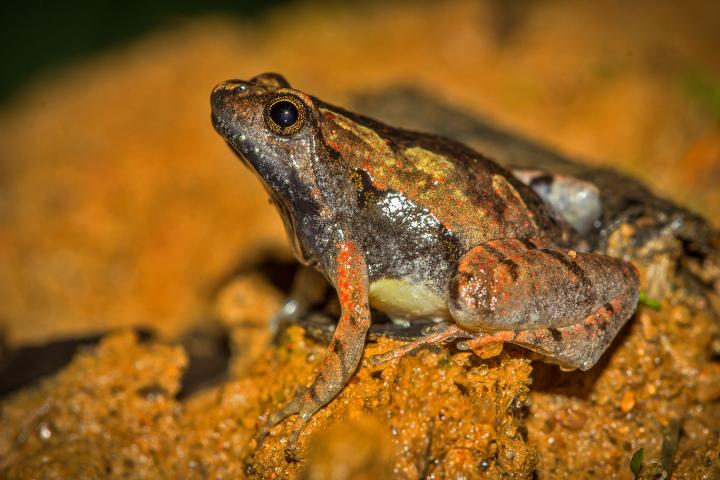
Credit: Ramit Singal
A team of researchers from India and the National University of Singapore (NUS) has discovered a new species of narrow-mouthed frog in the laterite rock formations of India's coastal plains. The frog, which is the size of a thumbnail, was named Microhyla laterite after its natural habitat.
The discovery by the research team, led by Mr Seshadri K S, a PhD student from the Department of Biological Sciences at the NUS Faculty of Science, was published in the prestigious journal PLOS ONE on 9 March 2016.
Tiny frog discovered in rocky wastelands
Laterite rock formations are prominent landscape features in the coastal plains of southwest India. They are broadly considered as rocky areas as they are usually devoid of trees and other vegetation, and are therefore classified as wastelands. These areas are often used for dumping activities and are heavily mined for construction materials in the form of bricks.
While conducting field surveys as a part of his citizen science initiative "My laterite, My habitat", independent researcher Mr Ramit Singal, who is one of the authors of the journal paper, spotted the frog in laterite habitats in and around the coastal town of Manipal, Udupi District, Karnataka State, India. He brought it to the attention of Mr Seshadri and his collaborators, who worked together to describe the frog.
The frog, which measures around 1.6 centimetres, is pale brown with prominent black markings on its dorsum, hands, feet and flanks. It has a call that can be easily mistaken for that of a cricket.
The newly discovered species was named Microhyla laterite (M. laterite) after the habitat it resides in. The research team suggested Laterite narrow-mouthed frog to be its common name, as frogs in the Microhyla genus have a smaller mouth compared to other frogs.
Mr Seshadri, who is the lead author of the journal paper, said, "By naming the frog after its habitat, we hope to draw attention to the endangered rock formations that are of ecological importance. M. laterite can potentially be used as a mascot to change peoples' perception about laterite areas."
To ensure the validity of the frog as a new species, Mr Seshadri and his team members studied the genes, body structure, colouration and vocalisations of four individual frogs. They also compared the results with data of closely related species.
"One could easily confuse this frog with other species like Microhyla ornata which is thought to occur all over India. However, it was evident from analysing the genes that M. laterite is a distinct species, and is closely related to M. sholigari, which is found only in the Western Ghats," said Mrs Priti Hebbar, one of the authors of the paper who is studying the effects of forest fragmentation on frogs in India for her PhD. "All three species are small and similar in appearance and only a critical examination would reveal the differences," she added.
Further studies and conservation efforts
Based on preliminary assessments, the research team suggested M. laterite to be classified as Endangered under the guidelines of the Red List by International Union for Conservation of Nature (IUCN), as the geographic range of the frog is narrow, within an area of 150 square kilometres in southwest India.
"In spite of its geological heritage, laterite areas in India receive very little protection from any legislation. Given the threats these fragile habitats are facing, there is a strong imperative to conserve them," said Mr Ramit.
Since M. laterite appears to be restricted to laterite rock formations along the west coast, the researchers intend to conduct further research to determine the evolutionary ecology of the frog, and to test for an association with laterite formations.
"How amphibians persist outside protected areas is not known. This critically endangered frog can be used as a basis for declaring its native laterite habitats as "Conservation Reserves" or "Biological Heritage Areas" under existing legislations in India, allowing us to further our knowledge and understanding of amphibians," said Mr Seshadri.
###
Media Contact
Carolyn Fong
[email protected]
65-651-65399
@NUSingapore
http://www.nus.edu.sg/