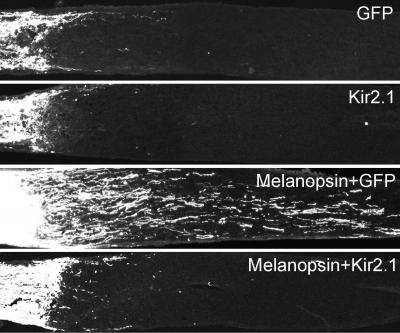
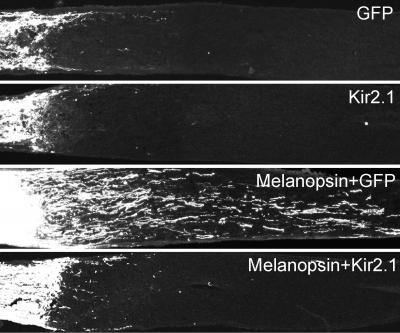
IMAGE: Enhancing neuronal firing activity by melanopsin overexpression in the retina promotes axon regeneration after the optic nerve injury comparing with GFP overexpression. Silencing neurons by using Kir2.1 blocks the induced…
Credit: Division of Life Science, HKUST
Damage to axons in the central nervous system (CNS) typically results in permanent functional deficits. Boosting intrinsic growth programs can dramatically augment the axon regeneration of injured neurons. If injured neurons can regenerate sufficient number of axons, the CNS may recover and overcome such functional deficits.
In a recent research, scientists from the Hong Kong University of Science and Technology (HKUST) demonstrated that axon regenerative capacity can be boosted with the right stimulants on neuronal activity through either an optogenetic or a chemogenetic approach. They found that overexpression of a photopigment, melanopsin, in retinas could enhance neuronal firing of retinal ganglion cells (RGCs) and promote axonal regeneration after optic nerve crush by activating mammalian target of rapamycin (mTOR) signaling. Axon regeneration can also be promoted by activating Gq signaling in RGCs through Designer Receptor Exclusively Activated by Designer Drugs (DREADD), wildly adopted as a tool to increase neuronal activity.
The findings were published in the Feb. 1, 2016 early online edition of the journal PNAS (doi: 10.1073/pnas.1523645113).
Led by Kai Liu, the study's senior author and assistant professor in life sciences at HKUST, the research team started the investigation on mice by overexpressing melanopsin in RGCs using adeno-associated virus (AAV) to determine whether melanopsin could promote axonal regeneration. Axonal regeneration was evident after two weeks, and the effect was found to be stimulated by light and neuronal firing, which enhanced and maintained mTOR signaling.
To mimic the downstream pathway of melanopsin and also stimulate neuronal activity through a different method, the researchers took a chemogenetic approach by injecting AAVs expressing DREADD-Gq into the eyes of the mice. A significant increase in axonal growth was detected as well after daily administration of a synthetic agonist clozapine-n-oxide.
"Our results show that melanopsin boosts axon regeneration by enhancing mTORC1 in a neuronal activity-dependent manner," Liu said. "Melanopsin activates Gq/11 signaling that subsequently increases neuronal activity and calcium influx to a degree that may be necessary to sustain long-term mTOR activation in RGCs"
In his previous work, Liu had found that inhibition of the PTEN gene would activate mTOR and promote corticospinal tract regeneration after spinal cord injury. " Neuronal activity has previously been shown to play important roles in axonal sprouting and synaptic plasticity in adult mammals. This study suggests another role and a mechanism of neuronal activity in axon regeneration, and potentially provides a simple strategy to facilitate neural repair," Liu said.
###
This project is supported by the Hong Kong Research Grants Council and the Hong Kong Spinal Cord Injury Foundation.
Media Contact
Sherry No
[email protected]
852-235-86302
http://www.ust.hk