Credit: Courtesy of Mick West.
Washington, DC– Well-understood physical and chemical processes can easily explain the alleged evidence of a secret, large-scale atmospheric spraying program, commonly referred to as "chemtrails" or "covert geoengineering," concludes a new study from Carnegie Science, University of California Irvine, and the nonprofit organization Near Zero.
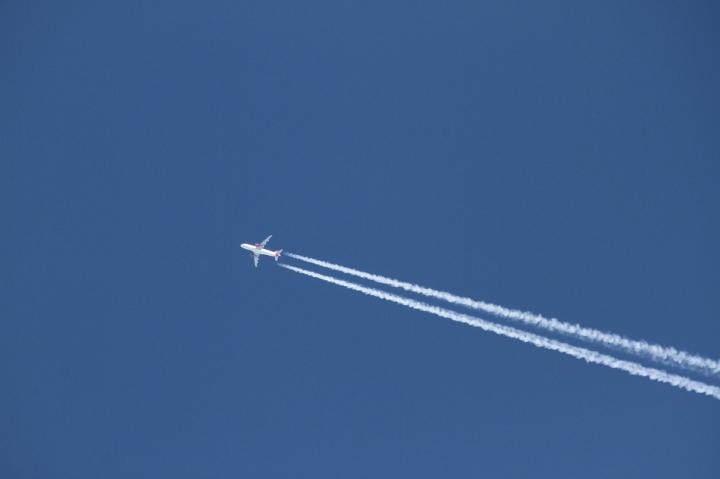
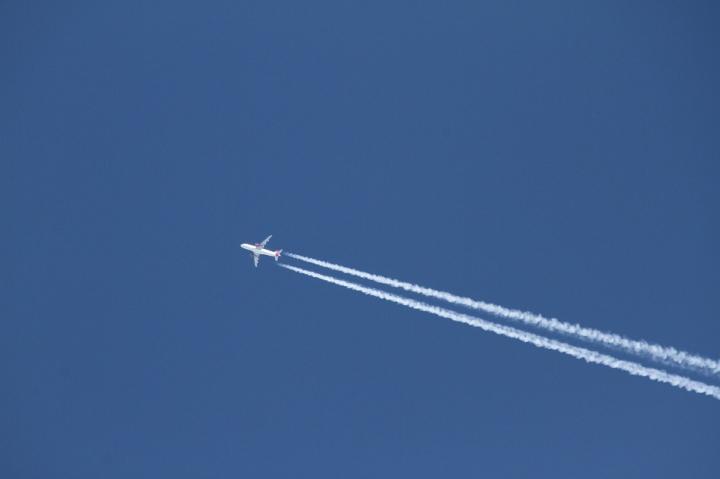
Some groups and individuals erroneously believe that the long-lasting condensation trails, or contrails, left behind aircraft are evidence of a secret large-scale spraying program. They call these imagined features "chemtrails." Adherents of this conspiracy theory sometimes attribute this alleged spraying to the government and sometimes to industry.
The authors of this study, including Carnegie's Ken Caldeira, conducted a survey of the world's leading atmospheric scientists, who categorically rejected the existence of a secret spraying program. The team's findings, published by Environmental Research Letters, are based on a survey of two groups of experts: atmospheric chemists who specialize in condensation trails and geochemists working on atmospheric deposition of dust and pollution.
The survey results show that 76 of the 77 participating scientists said they had not encountered evidence of a secret spraying program, and agree that the alleged evidence cited by the individuals who believe that atmospheric spraying is occurring could be explained through other factors, such as typical airplane contrail formation and poor data sampling.
The research team undertook their study in response to the large number of people who claim to believe in a secret spraying program. In a 2011 international survey, nearly 17 percent of respondents said they believed the existence of a secret large-scale atmospheric spraying program to be true or partly true. And in recent years a number of websites have arisen claiming to show evidence of widespread secret chemical spraying, which they say is linked to negative impacts on human health and the environment.
"We wanted to establish a scientific record on the topic of secret atmospheric spraying programs for the benefit of those in the public who haven't made up their minds," said Davis. "The experts we surveyed resoundingly rejected contrail photographs and test results as evidence of a large-scale atmospheric conspiracy."
The research team says they do not hope to sway those already convinced that there is a secret spraying program–as these individuals usually only reject counter-evidence as further proof of their theories–but rather to establish a source of objective science that can inform public discourse.
"Despite the persistence of erroneous theories about atmospheric chemical spraying programs, until now there were no peer-reviewed academic studies showing that what some people think are 'chemtrails' are just ordinary contrails, which are becoming more abundant as air travel expands. Also, it is possible that climate change is causing contrails to persist for longer periods than they used to." Caldeira said. "I felt it was important to definitively show what real experts in contrails and aerosols think. We might not convince die-hard believers that their beloved secret spraying program is just a paranoid fantasy, but hopefully their friends will accept the facts."
###
The Carnegie Institution for Science (carnegiescience.edu) is a private, nonprofit organization headquartered in Washington, D.C., with six research departments throughout the U.S. Since its founding in 1902, the Carnegie Institution has been a pioneering force in basic scientific research. Carnegie scientists are leaders in plant biology, developmental biology, astronomy, materials science, global ecology, and Earth and planetary science.
Media Contact
Ken Caldeira
[email protected]
650-704-7212
@carnegiescience
https://carnegiescience.edu/