• HOME
  • NEWS
  • EXPLORE
    • CAREER
      • Companies
      • Jobs
    • EVENTS
    • iGEM
      • News
      • Team
    • PHOTOS
    • VIDEO
    • WIKI
  • BLOG
  • COMMUNITY
    • FACEBOOK
    • INSTAGRAM
    • TWITTER
Saturday, February 7, 2026
BIOENGINEER.ORG
No Result
View All Result
  • Login
  • HOME
  • NEWS
  • EXPLORE
    • CAREER
      • Companies
      • Jobs
        • Lecturer
        • PhD Studentship
        • Postdoc
        • Research Assistant
    • EVENTS
    • iGEM
      • News
      • Team
    • PHOTOS
    • VIDEO
    • WIKI
  • BLOG
  • COMMUNITY
    • FACEBOOK
    • INSTAGRAM
    • TWITTER
  • HOME
  • NEWS
  • EXPLORE
    • CAREER
      • Companies
      • Jobs
        • Lecturer
        • PhD Studentship
        • Postdoc
        • Research Assistant
    • EVENTS
    • iGEM
      • News
      • Team
    • PHOTOS
    • VIDEO
    • WIKI
  • BLOG
  • COMMUNITY
    • FACEBOOK
    • INSTAGRAM
    • TWITTER
No Result
View All Result
Bioengineer.org
No Result
View All Result
Home NEWS Science News Biology

Previously unknown global ecological disaster discovered

Bioengineer by Bioengineer
February 11, 2018
in Biology
Reading Time: 2 mins read
0
Share on FacebookShare on TwitterShare on LinkedinShare on RedditShare on Telegram
IMAGE

Credit: UZH

There have been several mass extinctions in the history of the earth. One of the largest known disasters occurred around 252 million years ago at the boundary between the Permian and the Triassic. Almost all sea-dwelling species and two thirds of all reptiles and amphibians died out. Although there were also brief declines in diversity in the plant world, they recovered in the space of a few thousand years, which meant that similar conditions to before prevailed again.

Change in flora within a millennia

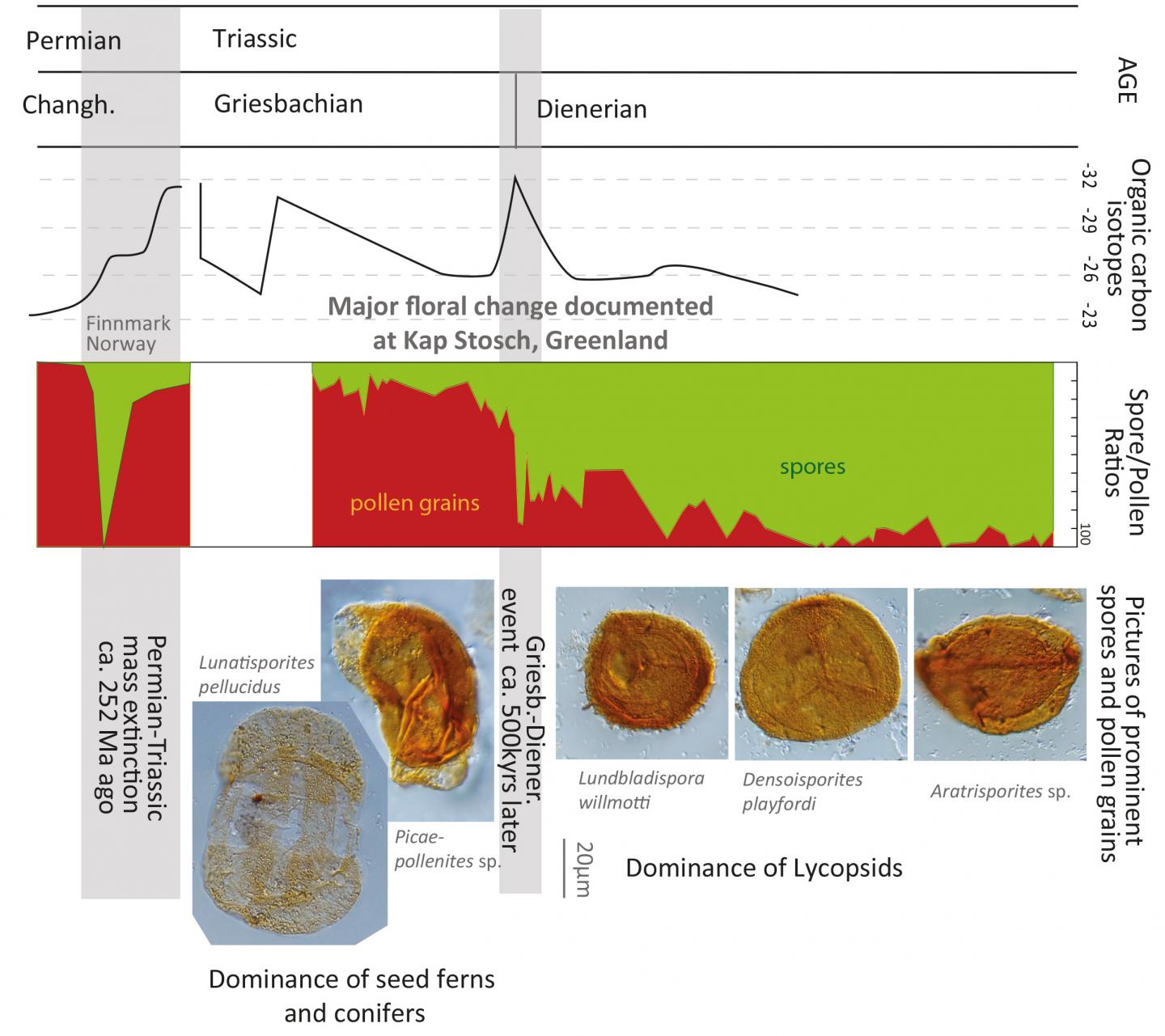
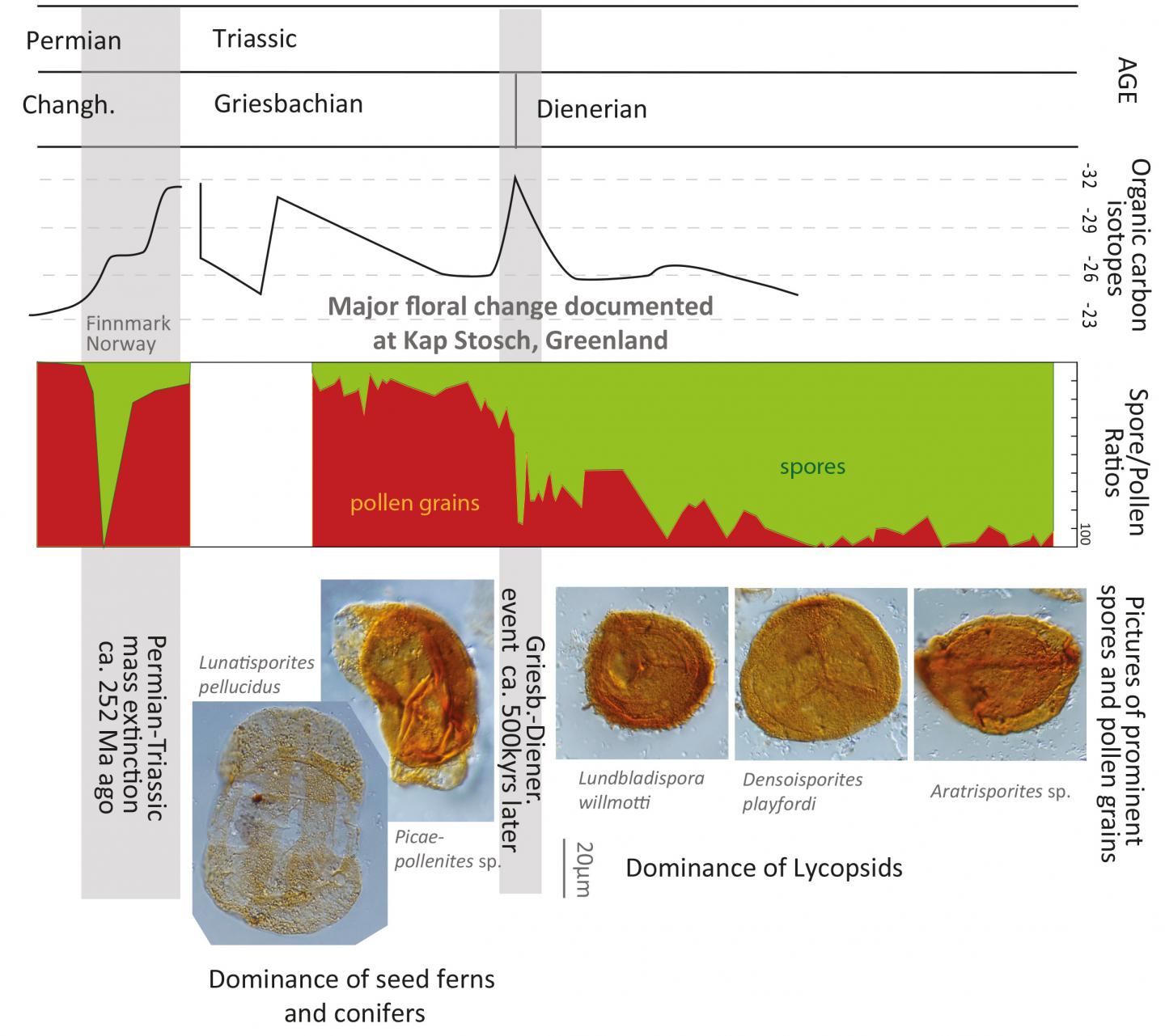
Researchers from the Institute and Museum of Paleontology at the University of Zurich have now discovered another previously unknown ecological crisis on a similar scale in the Lower Triassic. The team headed by Peter A. Hochuli and Hugo Bucher revealed that another event altered the vegetation fundamentally and for longer approximately 500,000 years after the major natural disaster at the boundary between the Permian and the Triassic.

The scientists studied sediments towering over 400 meters high from North-Eastern Greenland. Carbon isotope curves suggest that the prevalent seed ferns and conifers were replaced by spore plants in the space of a few millennia. To this day, certain spore plants like ferns are still famous for their ability to survive hostile conditions better than more highly developed plants.

Catastrophic ecological upheaval changes plant world

Until now, it was assumed that the environment gradually recovered during the Lower Triassic 252.4 to 247.8 million years ago. "The drastic, simultaneous changes in flora and the composition of the carbon isotopes indicate that the actual upheaval in the vegetation didn't take place until the Lower Triassic, i.e. around 500,000 years later than previously assumed," explains Hochuli.

The researchers didn't just observe the mass death of vegetation in Greenland; they already discovered the first indications of this floral shift a few years ago in sediment samples from Pakistan. Moreover, the latest datings of volcanic ash by Australian scientists show that the most significant change in the plant world did not happen until a few millennia after the Permian/Triassic boundary. During this period, the indigenous glossopteris seed plant group died out, an event that had previously been dated back to the Permian. Thanks to these findings, the sediment sequences of the supercontinent Gondwana in the southern hemisphere now need to be reinterpreted.

Crisis probably triggered by volcanic eruptions

What caused this newly described natural disaster remains unclear. "However, we see a link between this previously unknown global event and the enormous volcanic eruptions we know from the Lower Triassic in what's now Siberia," explains Bucher, Director of UZH's Institute and Museum of Paleontology.

###

Literature:

Peter A. Hochuli, Anna Sanson-Barrera, Elke Schneebeli-Hermann & Hugo Bucher. Severest crisis overlooked – Worst disruption of terrestrial environments postdates the Permian-Triassic mass extinction. Nature Scientific Reports. June 24, 2016. Doi: 10.1038/srep28372

Media Contact

Prof. Dr. Peter A. Hochuli
[email protected].ch
41-793-971-460
@uzh_news

http://www.uzh.ch

Share12Tweet8Share2ShareShareShare2

Related Posts

New Study Uncovers Mechanism Behind Burn Pit Particulate Matter–Induced Lung Inflammation

New Study Uncovers Mechanism Behind Burn Pit Particulate Matter–Induced Lung Inflammation

February 6, 2026

DeepBlastoid: Advancing Automated and Efficient Evaluation of Human Blastoids with Deep Learning

February 6, 2026

Navigating the Gut: The Role of Formic Acid in the Microbiome

February 6, 2026

AI-Enhanced Optical Coherence Photoacoustic Microscopy Revolutionizes 3D Cancer Model Imaging

February 6, 2026
Please login to join discussion

POPULAR NEWS

  • Robotic Ureteral Reconstruction: A Novel Approach

    Robotic Ureteral Reconstruction: A Novel Approach

    82 shares
    Share 33 Tweet 21
  • Digital Privacy: Health Data Control in Incarceration

    63 shares
    Share 25 Tweet 16
  • Study Reveals Lipid Accumulation in ME/CFS Cells

    57 shares
    Share 23 Tweet 14
  • Breakthrough in RNA Research Accelerates Medical Innovations Timeline

    53 shares
    Share 21 Tweet 13

About

We bring you the latest biotechnology news from best research centers and universities around the world. Check our website.

Follow us

Recent News

Scientists Identify SARS-CoV-2 PLpro and RIPK1 Inhibitors Showing Potent Synergistic Antiviral Effects in Mouse COVID-19 Model

Neg-Entropy: The Key Therapeutic Target for Chronic Diseases

Multidisciplinary Evidence-Based Guidelines for Therapeutic Drug Monitoring of Biologics in Inflammatory Bowel Disease

Subscribe to Blog via Email

Enter your email address to subscribe to this blog and receive notifications of new posts by email.

Join 73 other subscribers
  • Contact Us

Bioengineer.org © Copyright 2023 All Rights Reserved.

Welcome Back!

Login to your account below

Forgotten Password?

Retrieve your password

Please enter your username or email address to reset your password.

Log In
No Result
View All Result
  • Homepages
    • Home Page 1
    • Home Page 2
  • News
  • National
  • Business
  • Health
  • Lifestyle
  • Science

Bioengineer.org © Copyright 2023 All Rights Reserved.