Credit: DGIST
A DGIST research team led by Professor Su-Il In, who developed acupuncture needles combined with nanotechnology, was recognized as the world's first application of this technology. This development is expected to open new directions in the oriental medicine research field.
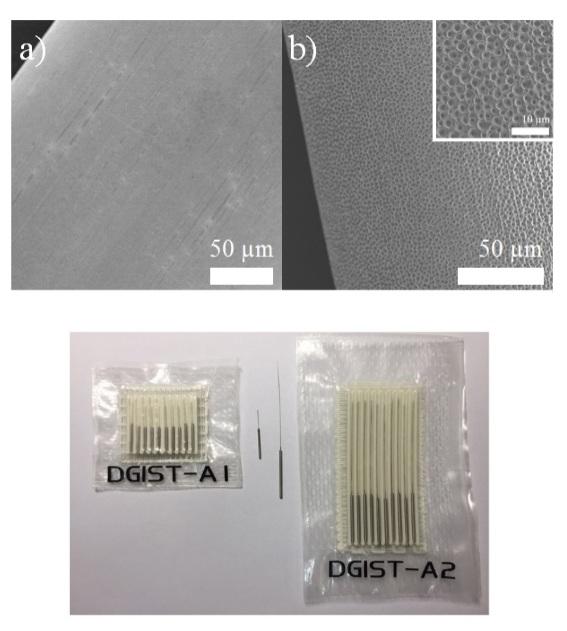
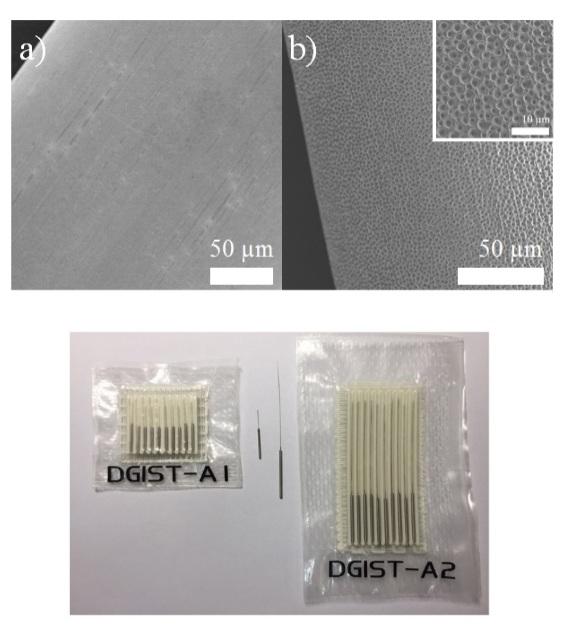
Professor Su-Il In's research team from the Department of Energy Systems Engineering succeeded in developing porous acupuncture needles (hereafter PANs) that offer enhanced therapeutic properties by applying nanotechnology on the acupuncture needles for the first time in the world.
The findings of this experiment, which was conducted in collaboration with DGIST's research team and the Addiction Control Research Center at Daegu Haany University, have attracted the attention of the relevant academic field in light of the fact that the experiment combined nanotechnology with acupuncture needles.
Professor In's research team developed PANs with fine pores ranging in sizes from nanometers (nm= one billionth of a meter) to micrometers (? = one millionth of a meter) on the surface of the needles using a nano-electrochemical method.
PANs are formed by anodization, and are characterized by a widened surface of the needles through the following process: anion (F-) contained in the electrolyte bored into the surface of the metal needles (positive) and created fine and uniform pores.
PANs are expected to be as effective as conventional large and long needles by minimizing the sense of pain during acupuncture treatment while expanding the surface area of the needle 20 times greater than conventional acupuncture ones.
Through electrophysiological experiments with rats, In's research team proved that PANs excel in transferring signals from a spinal dorsal horn by the in vivo stimulation of Shenmen (HT7) points, and in particular, demonstrated that the efficacy of PANs is superior to conventional acupuncture needles in treating alcohol and cocaine addiction in animal experiments.
Applications for international patents for the fabrication technology of PANs developed by DGIST have already been submitted in countries such as the US, China, and Europe. In addition, in the domestic oriental medicine field, the fact that the efficacy of acupuncture needles has been improved through their structural transformation by applying nanotechnology has been recognized and evaluated as the first such instance in the thousand-year history of eastern medicine.
Professor Su-Il In from DGIST's Department of Energy Systems Engineering said, "The development of nanotechnology has taken science and technology to the next level in various fields such as solar cells, quantum computers, display development, and the like. Based on this experiment's achievement of combining nanotechnology and oriental medicine, I will continue to conduct research in order to be at the forefront of the scientific population of oriental medicine."
Director Jae-ha Yang from Daegu Haany University said, "In western medicine, nanotechnology is widely used from diagnosis to treatment; but in eastern medicine, particularly in acupuncture therapy, it is rare to utilize nano science. The findings of this study are expected to open new directions in the field of eastern medicine where nano science is rarely explored and utilized."
Professor In's research findings were published on October 7, 2016 in the online edition of Scientific Reports.
###
Journal Reference
Su-ll In, Young S. Gwak, et. al., "Hierarchical Micro/Nano-Porous Acupuncture Needles Offering
Enhanced Therapeutic Properties", Scientific Reports 2016.
http://www.nature.com/articles/srep34061
Media Contact
Dahye Kim
[email protected]
82-537-851-163
http://www.dgist.ac.kr