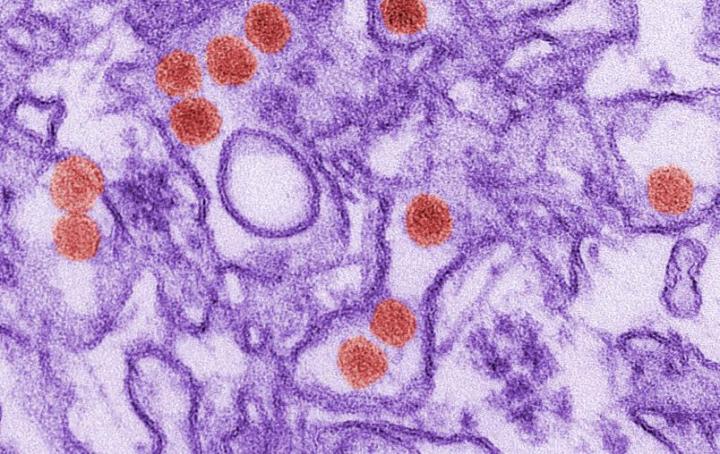
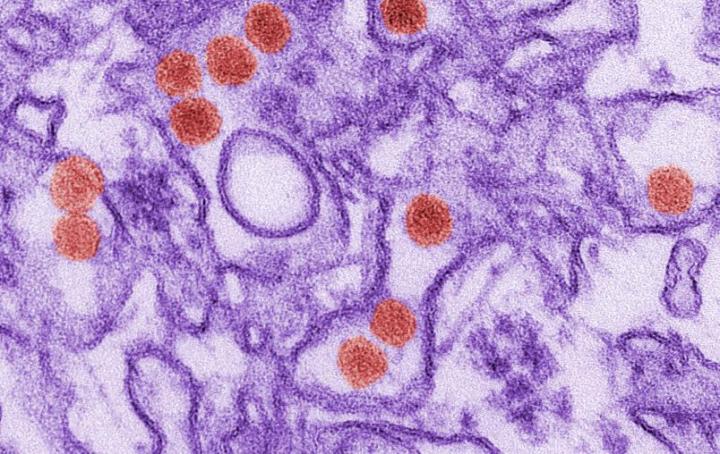
Credit: cdc/Cynthia Goldsmith
DZIF scientists from the University of Bonn have shown that not all conventional Zika virus molecular diagnostic tests for are sufficiently reliable. They developed optimised assays and a control for quantifying viruses in blood and urine.
Diagnosing Zika viruses reliably is of major importance–for both patients and fur-ther research on the spread of the virus. The Zika virus is currently spreading in Central and South America; over one million people have become infected since spring 2015. Currently, acute infections are predominantly confirmed by determin-ing the virus's genetic information in blood and urine. Six tests developed prior to the outbreak are currently being used in Central and South America. The problem is their reliability: can they also detect viral RNA in very low viral concentrations? How sensitive are they to different Zika virus strains and are their results compa-rable to each other? To date, these questions have not been fully clarified. Scien-tists therefore have concerns that numerous infections with the virus are going undetected.
The reliability problem
"It is particularly important for pregnant women to reliably know whether they have Zika viruses in their blood or not," explains Prof Felix Drexler who, together with Prof Christian Drosten and his team from the University of Bonn, has now carefully examined the existing tests. Over the last months, it has been confirmed that a Zika virus infection during pregnancy can cause foetal brain malformations.
A comparison of all PCR tests
In order to eliminate diagnostic uncertainties, the DZIF scientists initially tested the commonly used tests for sensitivity at the partner site Bonn-Cologne. All tests investigate viral RNA (ribonucleic acid), i.e. the hereditary information of the pathogen. The tests use the so-called polymerase chain reaction (PCR), a conven-tional method for detecting nucleic acid. The tests especially differ in that they examine different regions of the viral gene. PCR tests are suitable for early virus detection in the first weeks after the onset of symptoms. Serological tests, which determine the antibodies produced by the infected person, are recommended for use after the eighth day.
Results confirm concerns
The Zika assay comparison results confirm the researchers' concerns: some of the testing systems were not sensitive enough to detect low amounts of viruses. Ad-ditionally, not all virus strains are detected uniformly across the testing systems. Comparability between the assays is limited. The researchers assume that de-pending on the testing system, 20 to 80 percent of the patients may get an incor-rect diagnosis, if serological testing methods are not used for further diagnosis.
New testing systems for everyone
The researchers from Bonn consequently developed two new optimised PCR tests. Besides this, they have developed and made available a control which not only validates each test, but also quantifies the viral RNA in the blood and urine. The so-called "calibrator" used for this purpose is synthetically constructed RNA which contains all the different viral RNA target zones used in the different con-ventional tests. The test protocols and the calibrator can be ordered worldwide free of charge.
"With our study, we especially wanted to call attention to the fact that a negative PCR test is not necessarily reliable," Drexler explains. The researchers have al-ready made their results freely available prior to publication on the World Health Organisation (WHO) server. In an outbreak situation like this, all parties involved should exchange data as early as possible and have access to the best diagnostic tools.
The Bonn group led by Drexler and Drosten developed the globally used, stand-ardised test for the MERS pathogen. At the DZIF, they are well-equipped for de-tecting newly emerging viruses. The Zika diagnostics project was supported by the DZIF and the European Union.
###
Publication
Corman VM, Rasche A, Baronti C, Aldabbagh S, Cadar D, Reusken CBEM et al.: Clinical comparison, standardization and optimization of Zika virus molecular de-tection [Submitted]. Bull World Health Organ E-pub: 19 Apr 2016. Doi: http://dx.doi.orgn/10.2471/BLT.16.175950
Contact
Prof Jan Felix Drexler
DZIF field "Emerging Infections"
University of Bonn
T +49-228-287-11697
E-mail: [email protected]
Prof Christian Drosten
DZIF field „Emerging Infections"
University of Bonn
T +49 228 287 11055
E-Mail: [email protected]
DZIF Press Office
Janna Schmidt and Karola Neubert
E-Mail: [email protected]
Media Contact
Jan Felix Drexler
[email protected]
49-228-287-11697
http://www.dzif.de/en/