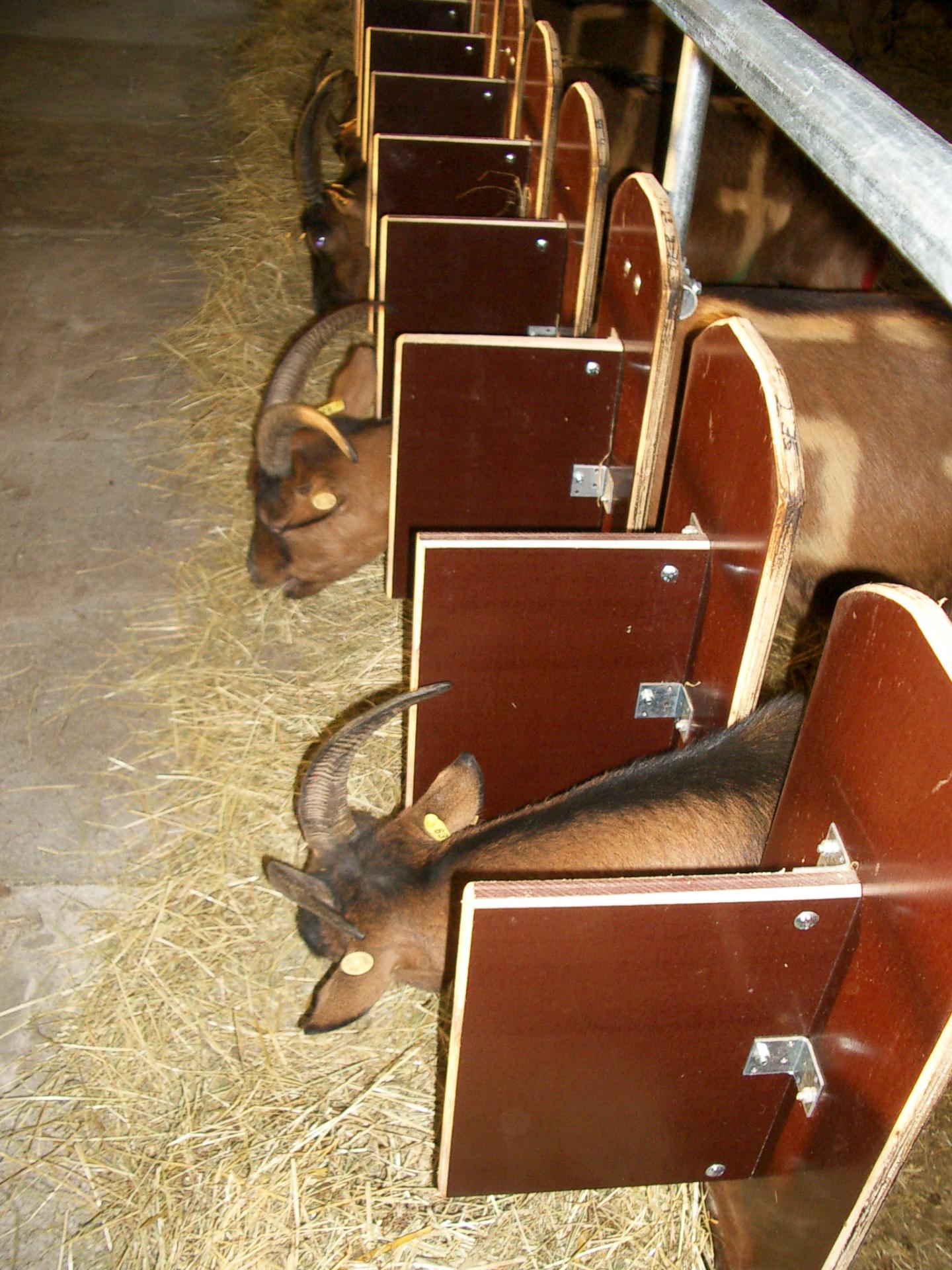
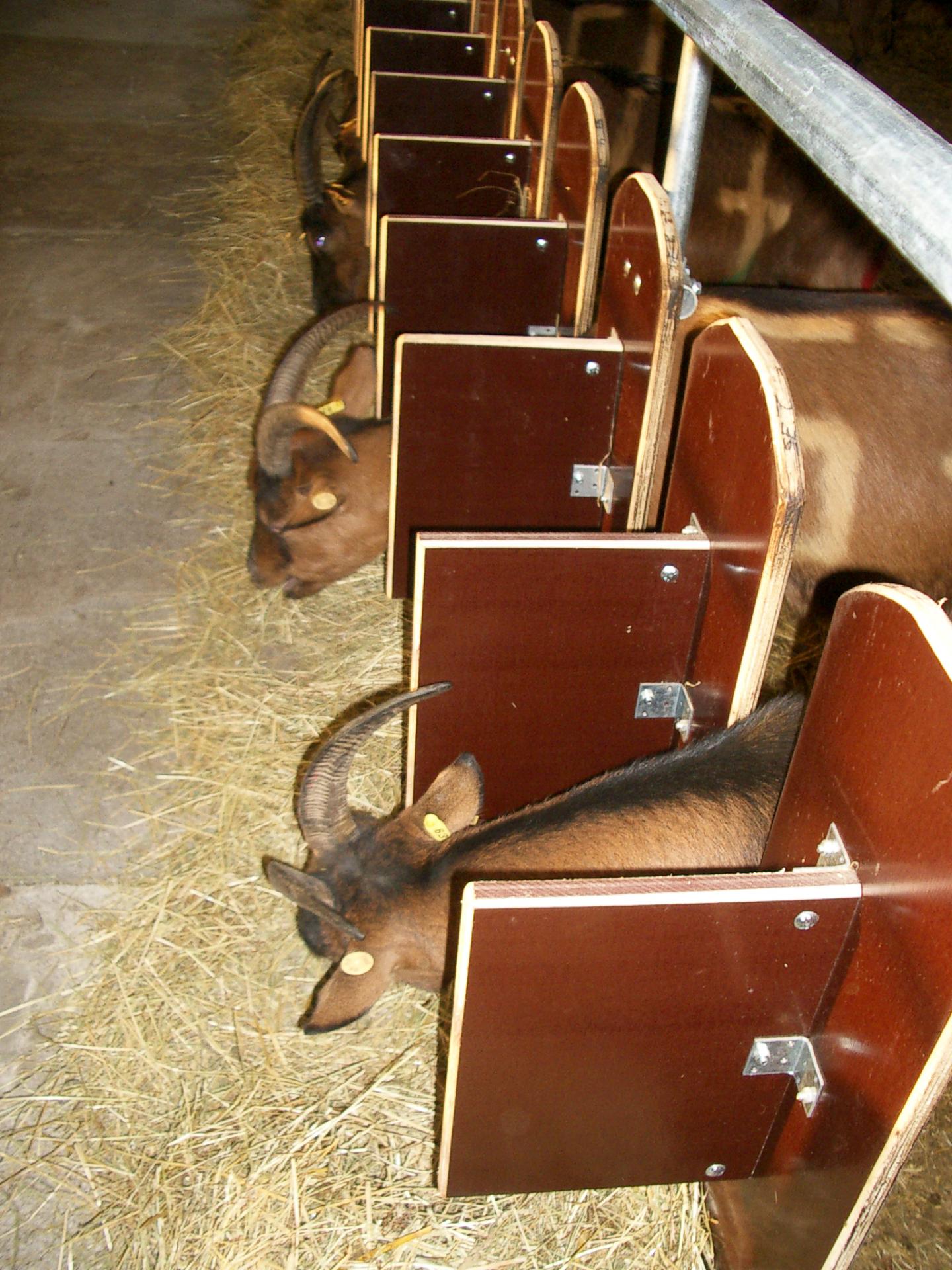
Competition in the goat pen is especially high during feeding time. Social tension rises and there is an increased frequency of agonistic interactions. A significant influence here is the available space. Goats prefer to maintain a minimum distance, termed "individual distance", to other goats. But this amount of feeding space is only rarely available. "To get to their food, the animals 'involuntarily' come into closer proximity than they would like. This can lead to injuries, stress and reduced milk yield," says project leader Susanne Waiblinger of the Institute of Animal Husbandry and Welfare at Vetmeduni Vienna.
Well-designed feed barriers have positive effects
Structural aids such as feeding racks can improve the situation. They can create a barrier between the neighbouring feeding places, as the animals have to put their head through the individual openings in order to feed. But feeding racks do not prevent animals from being disturbed during feeding. The goats constantly observe which animals are standing next to them or if higher-ranking animals are approaching. "They interrupt their feeding because they want to displace other animals when they come too close or because they have to avoid dominant animals," explains Waiblinger. It is known from other animal species that non-transparent head partitions between the animals can, in a manner of speaking, reduce the individual distance. "Animals don't feel disturbed when they can't see each other," says Waiblinger. The question therefore was whether head partitions can also reduce tensions at the feeding area of a goat herd. The team around first author Eva Nordmann therefore attached additional head partitions to the feeding racks. They then observed the social behaviour in two groups, each kept for two weeks with the head partitions and two weeks without, and assessed the nutritional status of the goats. They also noted how many feeding places were occupied simultaneously and analysed stress indicators in faecal samples. A positive effect of the head partitions was observed especially in terms of social behaviour and feeding place use.
Out of sight, out of mind
High-ranking goats were calmer during feeding because the head partitions prevented them from seeing the neighbouring feeding places and they did not feel compelled to chase away competitors. As a result, other goats are less frequently driven away from their feeding places. Feeding times were more relaxed in terms of less frequent disturbances during feeding. More feeding places were used at one time and the goats more often stood directly next to each other without leaving a feeding place unoccupied. The researchers even observed an increased nutritional status (musculature and fat) measured at the lumbar spine among the high-ranking animals. The fewer disturbances by neighbouring animals therefore appeared to increase food intake among high-ranking animals.
Head partitions support sense of well-being
The head partitions significantly reduced the agonistic interactions between the animals in the feeding area. The feeding time was more relaxed for all members of the herd. "Head partitions can therefore be recommended as supportive measures in the feeding area," concludes Waiblinger. "Together with metal palisades, they form a very good structure for the feeding area in the goat pen and contribute to the well-being of the animals. That can also improve the health and milk yield of the goats in the long term."
###
Service
The article "Head partitions at the feed barrier affect behaviour of goats" by Eva Nordmanna, Kerstin Barth, Andreas Futschik, Rupert Palme and Susanne Waiblinger was published in the journal Applied Animal Behaviour Science. http://www.sciencedirect.com/science/article/pii/S0168159115000970
About the University of Veterinary Medicine, Vienna
The University of Veterinary Medicine, Vienna in Austria is one of the leading academic and research institutions in the field of Veterinary Sciences in Europe. About 1,300 employees and 2,300 students work on the campus in the north of Vienna which also houses five university clinics and various research sites. Outside of Vienna the university operates Teaching and Research Farms. http://www.vetmeduni.ac.at
Scientific Contact:
Susanne Waiblinger
Institute of Animal Husbandry and Animal Welfare
University of Veterinary Medicine Vienna (Vetmeduni Vienna)
T 43-1-25077-4905
[email protected]
Released by:
Georg Mair
Science Communication / Corporate Communications
University of Veterinary Medicine Vienna (Vetmeduni Vienna)
T 43-1-25077-1165
[email protected]
Media Contact
Susanne Waiblinger
[email protected]
43-125-077-4905
http://www.vetmeduni.ac.at