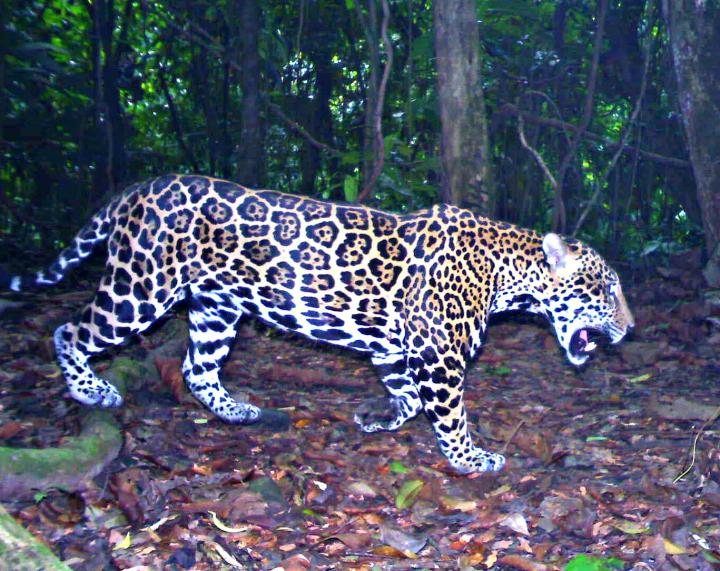
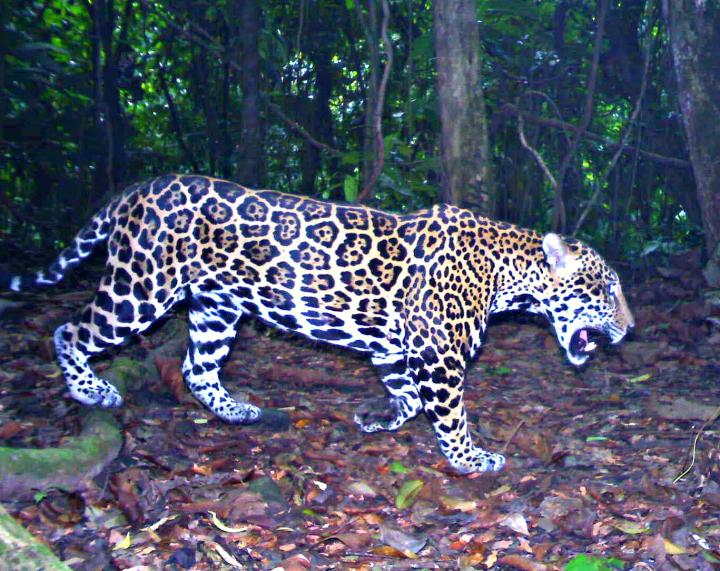
Credit: © Panthera-ICF
A research group led by the American Museum of Natural History and global wild cat conservation organization Panthera has published the largest gene-based survey of its kind on wild jaguar populations in Mesoamerica. The analysis, published today in the journal PLOS ONE, is based on nearly 450 jaguar scat samples collected in Belize, Costa Rica, Guatemala, Honduras, and Mexico. This work identifies areas of conservation concern for Mesoamerican jaguars and underscores the importance of large-scale genetic monitoring efforts when prioritizing conservation and management efforts for this near-threatened, and elusive, carnivore species.
"Mesoamerica has one of the highest deforestation rates worldwide, potentially limiting movement and genetic connectivity in forest-dependent jaguars across this fragmented landscape. Large-scale conservation genetics studies on wild jaguars spanning across several range countries assessing these threats are rare and suffer from low sample sizes for this region," said Claudia Wultsch, the lead author of the paper, a scientist in the Museum's Sackler Institute for Comparative Genomics, and a conservation research fellow at Panthera. "Over the last 100 years, jaguars in Mesoamerica have been pushed out from more than 77 percent of their historic range."
To get a better idea of the genetic health and connectivity of jaguar populations in this area and the effectiveness of the existing wildlife corridors (i.e., stretches of habitat that facilitate movement between local populations), the researchers turned to DNA obtained from field-collected jaguar scat.
This non-invasive technique lets researchers gather large DNA sample sizes of difficult-to-study wildlife species, such as big cats, without physically capturing, handling, or disturbing the animals. Since these samples quickly degrade in the warm and humid conditions of the tropical countries, however, a great deal of laboratory work has to be done to successfully analyze the DNA.
"We believe that these jaguars were once continuously distributed over the whole landscape of Mesoamerica, but human activity has resulted in smaller populations that are isolated from other groups," said George Amato, director of the Museum's Sackler Institute for Comparative Genomics and the paper's senior author. "We want to know whether this fragmentation is resulting in reduced gene flow or inbreeding or other things that might be detrimental to the animals. But most importantly, we want to figure out ways to reconnect these populations or, even if they're not completely isolated, to engage in activities that allow jaguars to move more freely across the landscape. One of the only ways to do this is through genetic analysis."
The researchers analyzed DNA from 115 individual jaguars spread across five Mesoamerican countries. Overall, they found moderate levels of genetic variation in the jaguars, with the lowest diversity in Mexico, followed by Honduras. Low levels of genetic diversity could decrease reproductive fitness and resistance to disease, and generally lower animals' potential to adapt to a changing environment.
When assessing genetic connectivity in Mesoamerican jaguars, the scientists found low levels of gene flow between jaguars in the Selva Maya — the largest contiguous tropical forest north of the Amazon, spreading over northern Guatemala, central Belize, and southern Mexico — and those in Honduras. This suggests that there is limited jaguar movement between these two areas, which is somewhat surprising since they are so geographically close. Although more data are needed to fill gaps in the study, the authors say that the region connecting these sites faces rapid land-cover changes, which have severely increased over the last two decades, putting remaining stepping-stone habitats for jaguars at further risk. This region represents a conservation priority and the authors recommend continued management and maintenance of jaguar corridors and mitigation of jaguars' main threats (e.g., human-wildlife conflict).
"Large-scale conservation strategies such as Panthera's Jaguar Corridor Initiative, which are instrumental to protect broadly distributed species such as jaguars, maintain their connectivity, and by doing so to ensure their long-term survival, need to incorporate genetic monitoring of wild populations to fully understand how these species respond to environmental changes and increasing levels of human impacts," Wultsch said.
###
Other authors on the study include Anthony Caragiulo and Salisa Rabinowitz, American Museum of Natural History; Isabela Dias-Freedman, Rutgers University; and Howard Quigley, Panthera.
PLOS ONE paper: http://journals.plos.org/plosone/article?id=10.1371/journal.pone.0162377
AMERICAN MUSEUM OF NATURAL HISTORY (AMNH.ORG)
The American Museum of Natural History, founded in 1869, is one of the world's preeminent scientific, educational, and cultural institutions. The Museum encompasses 45 permanent exhibition halls, including the Rose Center for Earth and Space and the Hayden Planetarium, as well as galleries for temporary exhibitions. It is home to the Theodore Roosevelt Memorial, New York State's official memorial to its 33rd governor and the nation's 26th president, and a tribute to Roosevelt's enduring legacy of conservation. The Museum's five active research divisions and three cross-disciplinary centers support approximately 200 scientists, whose work draws on a world-class permanent collection of more than 33 million specimens and artifacts, as well as specialized collections for frozen tissue and genomic and astrophysical data, and one of the largest natural history libraries in the world. Through its Richard Gilder Graduate School, it is the only American museum authorized to grant the Ph.D. degree and the Master of Arts in Teaching degree. Annual attendance has grown to approximately 5 million, and the Museum's exhibitions and Space Shows can be seen in venues on five continents. The Museum's website and collection of apps for mobile devices extend its collections, exhibitions, and educational programs to millions more beyond its walls. Visit amnh.org for more information.
Follow
Become a fan of the Museum on Facebook at facebook.com/naturalhistory, and follow us on Instagram at @AMNH, Tumblr at amnhnyc, or Twitter at twitter.com/AMNH.
Media Contact
Kendra Snyder
[email protected]
212-496-3419
@amnh
http://www.amnh.org