• HOME
  • NEWS
  • EXPLORE
    • CAREER
      • Companies
      • Jobs
    • EVENTS
    • iGEM
      • News
      • Team
    • PHOTOS
    • VIDEO
    • WIKI
  • BLOG
  • COMMUNITY
    • FACEBOOK
    • INSTAGRAM
    • TWITTER
Sunday, November 29, 2026
BIOENGINEER.ORG
No Result
View All Result
  • Login
  • HOME
  • NEWS
  • EXPLORE
    • CAREER
      • Companies
      • Jobs
        • Lecturer
        • PhD Studentship
        • Postdoc
        • Research Assistant
    • EVENTS
    • iGEM
      • News
      • Team
    • PHOTOS
    • VIDEO
    • WIKI
  • BLOG
  • COMMUNITY
    • FACEBOOK
    • INSTAGRAM
    • TWITTER
No Result
View All Result
Bioengineer.org
No Result
View All Result
Home NEWS Science News Technology

Dynamic Replenishment Cuts Robot Delivery Fleet Size by 63 Percent

by
November 29, 2026
in Technology
Reading Time: 2 mins read
0
Dynamic Replenishment Cuts Robot Delivery Fleet Size by 63 Percent

Dynamic Replenishment Cuts Robot Delivery Fleet Size by 63 Percent

Share on FacebookShare on TwitterShare on LinkedinShare on RedditShare on Telegram

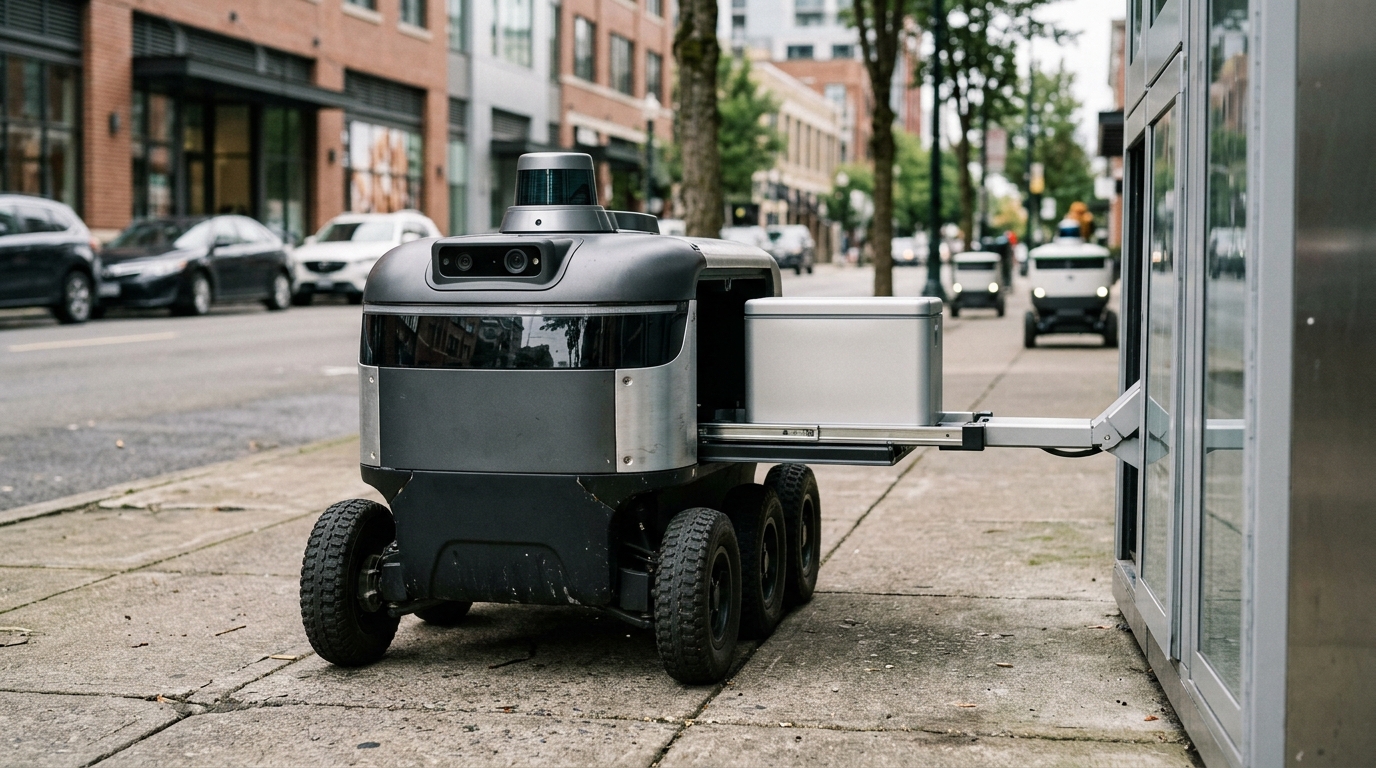
A collaborative optimization framework for community delivery stations and logistics robots significantly reduced operational infrastructure requirements and vehicle fleet sizes in simulation experiments, according to a recent study. The research developed a two-tier strategy that jointly optimizes the spatial location of delivery stations and the dynamic multi-trip routing of automated delivery robots navigating residential environments.

The study addressed the operational bottlenecks caused by expanding e-commerce delivery volumes, particularly the persistent last-mile challenges found at the final delivery stage within residential communities. Logistics robots deployed in these environments typically face operational restrictions because of limited onboard carrying capacities and restricted battery endurance, which constrain their single-trip service performance.

This study introduces a virtual node strategy to fission the physical site. Based on this structural framework, the team formulated a mixed integer programming model incorporating practical operational considerations, including soft time windows, obstacle avoidance, vehicle load limits, and battery electricity constraints.

To solve the resulting combinatorial model, the researchers implemented a two-layer hybrid heuristic algorithm. The upper-level main problem utilizes an improved genetic algorithm equipped with adaptive crossover and mutation operators, which enhance global search optimization capabilities when selecting optimal distribution station locations.

The lower-level sub-problem employs an improved ant colony algorithm dedicated to multi-trip path planning. This component adds a resource prediction mechanism to the state transfer rules to automatically trigger dynamic replenishment logic.

Simulation evaluations demonstrated significant performance gains over traditional step-by-step optimization strategies. The collaborative framework decreased the number of active distribution stations by 33.33 percent and lowered total system costs by 33.32 percent, while reducing default penalties associated with delivery time windows by 73.76 percent.

Evaluating the dynamic replenishment mechanism against a non-replenishment baseline showed substantial fleet and operational savings. Incorporating dynamic replenishment lowered the required robot fleet size by 63.16 percent and decreased overall delivery operating costs by 46.20 percent, confirming the economic feasibility of trading delivery mileage for reduced fleet quantity under physical resource constraints.

The study provides a scientific theoretical basis and decision support for building community smart logistics networks that achieve high efficiency and low cost.

Subject of Research: Community logistics robot location-routing collaborative optimization

Article Title: Location-routing collaborative optimization of community logistics robot delivery stations considering spatiotemporal constraints and dynamic replenishment

Article References: Luo, L., Li, L., & Yu, M. (2026). Location-routing collaborative optimization of community logistics robot delivery stations considering spatiotemporal constraints and dynamic replenishment. Discover Applied Sciences. https://doi.org/10.1007/s42452-026-09937-8

Image Credits: AI Generated

DOI: 10.1007/s42452-026-09937-8

Keywords: last-mile delivery, logistics robots, location-routing problem, mixed integer programming, dynamic replenishment, genetic algorithm, ant colony algorithm, virtual node strategy, soft time windows, obstacle avoidance, fleet size optimization, smart logistics, autonomous delivery, multi-trip routing, resource constraints, heuristic optimization

News Source: Denise Maddox. (November 29, 2026). Dynamic Replenishment Cuts Robot Delivery Fleet Size by 63 Percent. Scienmag.


Tags: ant colony algorithmautonomous deliverydynamic replenishmentfleet size optimizationgenetic algorithmHeuristic Optimizationlast-mile deliverylocation-routing problemlogistics robotsmixed-integer programmingmulti-trip routingobstacle avoidanceresource constraintssmart logisticssoft time windowsvirtual node strategy
Share12Tweet7Share2ShareShareShare1

Related Posts

Classroom Operative Temperature Drives Student Comfort Across Fifteen Clothing Ensembles

Classroom Operative Temperature Drives Student Comfort Across Fifteen Clothing Ensembles

November 29, 2026
Computational Modeling Identifies Novel Triphenylamine Dye Q4-TPA for Efficient Solar Cells

Computational Modeling Identifies Novel Triphenylamine Dye Q4-TPA for Efficient Solar Cells

November 29, 2026

Natural Plant Fiber Composites Match Synthetic Performance in Multilayer Armor Systems

November 29, 2026

Graphene oxide thickness influences colloidal stability and cellular toxicity across models

November 29, 2026

POPULAR NEWS

  • Natural Plant Fiber Composites Match Synthetic Performance in Multilayer Armor Systems

    Natural Plant Fiber Composites Match Synthetic Performance in Multilayer Armor Systems

    29 shares
    Share 12 Tweet 7
  • Plant Compound Alpha-Mangostin Inhibits Mycobacterium Tuberculosis Gyrase B in Laboratory Tests

    29 shares
    Share 12 Tweet 7
  • Suspected Pediatric Transverse Myelitis Case Managed Without Advanced Imaging in Gaza

    29 shares
    Share 12 Tweet 7
  • Head Nurse Mentorship Pilot Tracks Feasibility and Preliminary Management Competency Gains

    29 shares
    Share 12 Tweet 7

About

We bring you the latest biotechnology news from best research centers and universities around the world. Check our website.

Follow us

Recent News

Rare DMD Exon Duplication Linked to Mild Muscular Weakness Without Heart Symptoms

Roasting Alters Grains Distinctly in Multi-Omics Study of Popular Tea Substitutes

Classroom Operative Temperature Drives Student Comfort Across Fifteen Clothing Ensembles

Subscribe to Blog via Email

Enter your email address to subscribe to this blog and receive notifications of new posts by email.

Join 90 other subscribers
  • Contact Us

Bioengineer.org © Copyright 2023 All Rights Reserved.

Welcome Back!

Login to your account below

Forgotten Password?

Retrieve your password

Please enter your username or email address to reset your password.

Log In
No Result
View All Result
  • Homepages
    • Home Page 1
    • Home Page 2
  • News
  • National
  • Business
  • Health
  • Lifestyle
  • Science

Bioengineer.org © Copyright 2023 All Rights Reserved.