Robotics researchers have introduced an integrated vision-guided adaptive neuro-fuzzy calibration framework unified with a hybrid multi-objective optimizer to enhance the kinematic precision of industrial manipulators under complex operating conditions. Evaluated on a six-degree-of-freedom industrial robotic arm, the system combines stereo-vision three-dimensional pose acquisition, adaptive neuro-fuzzy modeling of optical distortions, and a dual-objective optimization engine that pairs the Multi-Objective Grey Wolf Optimizer with the Modified Gorilla Troops Optimizer. In experimental validation against uncalibrated baselines and standalone meta-heuristic algorithms, the proposed hybrid methodology achieved a positioning root mean square error of 0.131 and a mean absolute error of 0.098 while reducing objective function values to 0.41 and 0.36. The optimization procedure achieved stable convergence within 48 iterations, outperforming individual optimizer baselines that required 64 and 72 iterations. Concurrently, optical lens corrections achieved over a sixty-five percent reduction in radial and tangential distortions while lowering camera reprojection error from 1.92 pixels to 0.64 pixels, demonstrating a viable strategy for high-precision robotic automation.
Industrial robotic manipulators play an indispensable role across modern manufacturing processes, where operations such as precision machining, drilling, riveting, and component fabrication demand repeatable, sub-millimetric accuracy. Despite rigid mechanical constructions, the operational accuracy of articulated manipulators is continually degraded by geometric imperfections, joint compliance, structural elasticity, thermal variations, and sensor noise. To attain the strict tolerances required by advanced aerospace and automotive assembly lines, geometric calibration serves as an essential prerequisite. Classical calibration routines conventionally rely on analytical kinematic formulations, such as the Denavit-Hartenberg parametric framework, combined with standard gradient-based searches or traditional meta-heuristic algorithms. However, these conventional frameworks struggle to accommodate tightly coupled nonlinear kinematic parameter interactions, spatial distortions inherent in optical metrology systems, and the multi-objective trade-offs present during physical deployments, which frequently causes premature algorithm stagnation and sensitivity to noisy measurement datasets.
The integration of optical metrology into robotic environments has gained considerable traction due to the capacity of stereo-vision systems to provide non-contact, high-resolution three-dimensional pose feedback across the workspace. Nevertheless, optical pose acquisition introduces its own severe calibration obstacles, notably radial, tangential, and reprojection distortions caused by camera lenses and perspective perspective-n-point transformations. Conventional calibration strategies treat camera distortion correction and kinematic parameter estimation as decoupled, independent phases, which inevitably allows residual vision errors to propagate directly into the kinematic parameter estimates. Furthermore, existing evolutionary and swarm optimization techniques, including particle swarm optimization, differential evolution, non-dominated sorting genetic algorithms, and multi-objective particle swarm optimizers, frequently demonstrate slow global convergence, weak local search refinement, or erratic distribution along the Pareto front when attempting to minimize end-effector positioning errors and kinematic parameter deviations simultaneously.
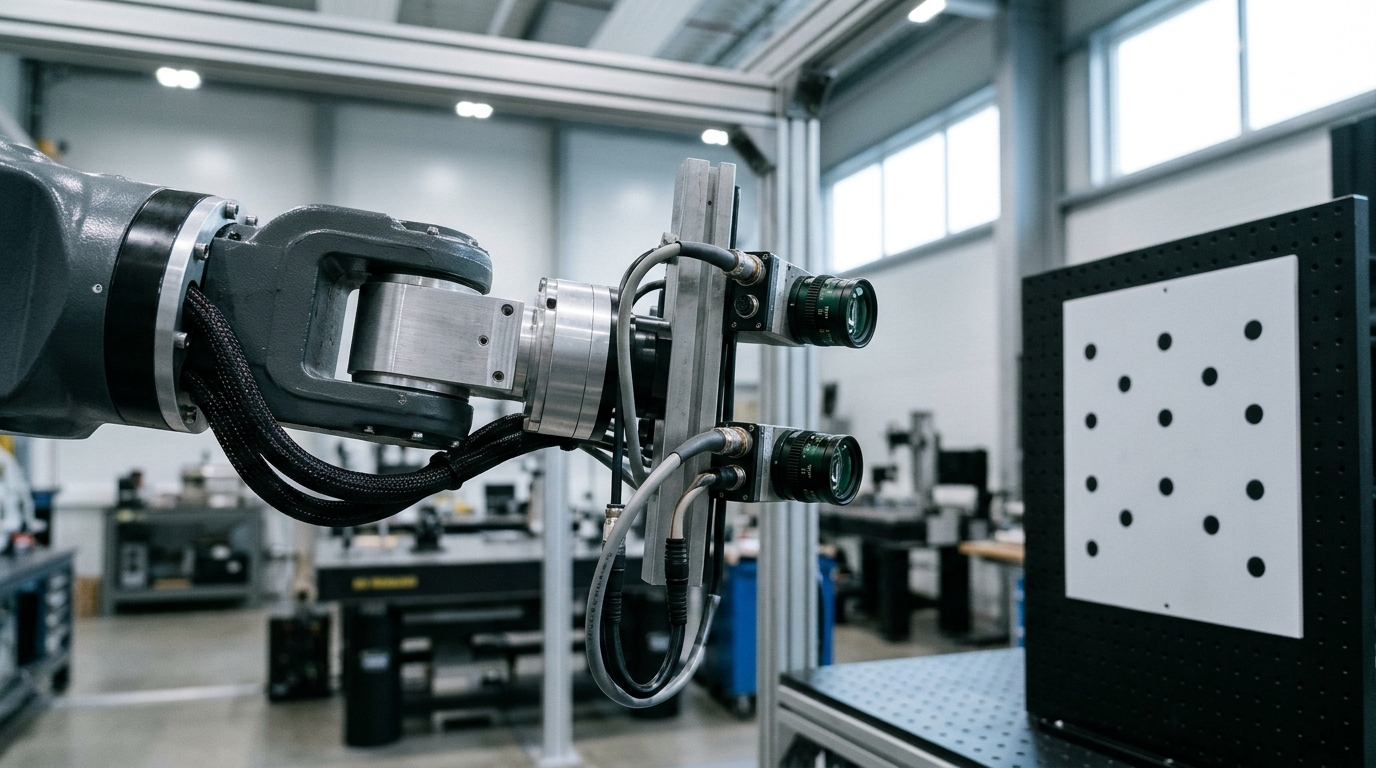
To overcome these systemic limitations, the vision-guided adaptive neuro-fuzzy calibration framework establishes an integrated, sequential pipeline designed to mitigate error propagation between vision metrology and robot kinematics. The workflow begins by attaching physical feature markers to the end-effector of a six-degree-of-freedom manipulator within a controlled workspace observed by a calibrated stereo-camera pair. High-resolution left and right video frames record pixel correspondences to triangulate spatial coordinates, while a perspective-n-point solver calculates the three-dimensional orientation of the tool center point. Rather than feeding these raw optical coordinates directly into an optimization engine, the framework routes the measured spatial poses into a dedicated Adaptive Neuro-Fuzzy Inference System. This neuro-fuzzy layer acts as an intermediate learning stage that dynamically maps non-linear spatial deviations relative to nominal reference poses, producing distortion-corrected pose datasets that serve as high-fidelity inputs for kinematic parameter refinement.
The optical acquisition phase relies on rigorous geometric triangulation across a rectified stereo camera pair characterized by intrinsic focal length matrices, principal optical centers, and a fixed baseline distance. Disparity calculations between horizontal image coordinates yield the depth coordinate along the optical axis, from which spatial horizontal and vertical positions are derived in the camera coordinate frame. Combining these translated points with orientation matrices generated through the perspective-n-point algorithm produces a homogeneous transformation matrix representing the measured vision-derived pose for each sample configuration. Because raw stereo measurements contain lens imperfections and perspective distortion, reference poses derived from nominal kinematic calculations or independent high-precision measurement systems are incorporated to isolate measurement noise from genuine mechanical deviations, thereby establishing a structured numerical foundation for subsequent neuro-fuzzy training.
The adaptive neuro-fuzzy distortion modeling module harnesses the linguistic interpretability of fuzzy logic systems alongside the adaptive learning capabilities of artificial neural networks to rectify complex nonlinear spatial errors that evade analytical representation. Structured around multi-input fuzzy inference rules, the network receives three-dimensional Cartesian coordinates as input variables and targets the spatial deviation between measured poses and reference poses. The model dynamically tunes antecedent fuzzy membership functions and consequent linear parameter vectors by minimizing the mean squared error across all sampled configurations. Unlike deep neural networks that require massive training corpora or static regression techniques that fail to generalize across non-homogeneous workspaces, the neuro-fuzzy system trains effectively on compact calibration datasets. It dynamically compensates for radial, tangential, and reprojection errors, passing fully corrected three-dimensional coordinates into the downstream kinematic optimizer.
Kinematic parameter refinement is orchestrated by a hybrid optimization engine combining the Multi-Objective Grey Wolf Optimizer and the Modified Gorilla Troops Optimizer to balance broad global exploration with aggressive local exploitation. The Multi-Objective Grey Wolf Optimizer emulates natural predatory encircling behaviors, utilizing non-dominated sorting and crowding distance mechanisms to maintain an external archive of Pareto-optimal solutions guided by designated alpha, beta, and delta leader wolves. Meanwhile, the Modified Gorilla Troops Optimizer enhances traditional gorilla group dynamics through adaptive step control, migration mechanisms, and local perturbation operators that prevent candidate solutions from trapping in local minima. A dynamic weighted fusion coefficient blends candidate solution vectors generated by both algorithms at each iteration, simultaneously minimizing end-effector positioning root mean square error and the mean absolute deviation of Denavit-Hartenberg parameters within strictly bounded parameter constraints.
The comprehensive calibration pipeline is governed by a three-phase operational lifecycle encompassing initial calibration, dynamic model updating, and rigorous unseen validation. During calibration, the hybrid optimizer identifies optimal parameter sets that align simulated kinematic outputs with experimental reference measurements. The update phase utilizes adaptive formulation rules to adjust internal membership functions and kinematic correction terms whenever operational shifts, thermal drift, or updated sensory readings emerge during extended automated shifts. Finally, the validation phase subjects the updated kinematic parameters to an independent testing dataset representing ten percent of the collected samples, evaluating generalizability via root mean square error, mean absolute error, correlation coefficients, and goodness-of-fit metrics. A calibrated system is accepted for industrial deployment only when the validation error remains beneath a predetermined threshold while the correlation coefficient approaches unity.
Experimental evaluation was executed on a standardized workstation equipped with an Intel Core i7 processor, an NVIDIA RTX-series graphics processing unit, and 32 gigabytes of random-access memory running a Robot Operating System central controller. Testing evaluated a physical six-degree-of-freedom manipulator observed by high-resolution cameras under uniform illumination and fixed surface reflectance conditions, partitioning the gathered dataset into eighty percent calibration, ten percent training, and ten percent validation subsets. Statistical comparisons against baseline optimizers demonstrated marked superiority across all evaluated metrics. For the primary positioning cost function, the hybrid model reduced minimum error to 0.0051 millimeters, maximum error to 0.42 millimeters, and standard deviation to 0.085 millimeters, compared to baseline maximum errors reaching 19.0 millimeters under NSGA-II. For the second objective function, the hybrid scheme achieved a mean error of 58.55 micrometers and a standard deviation of 3.10 micrometers, outperforming MOPSO and MOEAD.
Analysis of Pareto front quality further substantiated the optimization efficiency of the hybrid approach, yielding a hypervolume metric of 0.81, a spacing metric of 0.033, and a spread of 0.91, indicating a tightly clustered, well-distributed frontier that consistently dominated standalone MOGWO and MGTO frontiers. Visual reconstructions exhibited enhanced edge alignment and structural consistency, achieving a structural similarity index measure of 0.921. While the experimental findings confirm robust calibration performance under controlled laboratory conditions, the authors noted that external operational variability, such as ambient lighting fluctuations, intense industrial sensor noise, and diverse physical workspace boundaries, could influence distortion modeling stability. Consequently, ongoing operational deployment across high-mix manufacturing lines will require continuous validation across diverse mechanical configurations, varied environmental disturbance levels, and varied industrial tooling setups.
Subject of Research: Vision-guided robotic calibration using adaptive neuro-fuzzy modeling and hybrid multi-objective optimization
Article Title: Vision-guided adaptive neuro-fuzzy calibration using hybrid multi-objective optimizer for industrial robots application
Article References: B, P., Selvakumar Arockia Doss, A., & Srivastava, S. (2026). Vision-guided adaptive neuro-fuzzy calibration using hybrid multi-objective optimizer for industrial robots application. Results in Engineering, 32, Article 114333. https://doi.org/10.1016/j.rineng.2026.114333
Image Credits: AI Generated
DOI: 10.1016/j.rineng.2026.114333
Keywords: industrial robotics, robot calibration, kinematic calibration, Denavit-Hartenberg parameters, stereo vision metrology, adaptive neuro-fuzzy inference system, ANFIS, multi-objective optimization, grey wolf optimizer, gorilla troops optimizer, MOGWO, MGTO, reprojection error, spatial distortion correction, 6-DOF manipulator, Pareto dominance
News Source: Denise Maddox. (November 29, 2026). Hybrid Multi-Objective Optimizer Calibrates Industrial Robots Using Adaptive Stereo Vision. Scienmag.