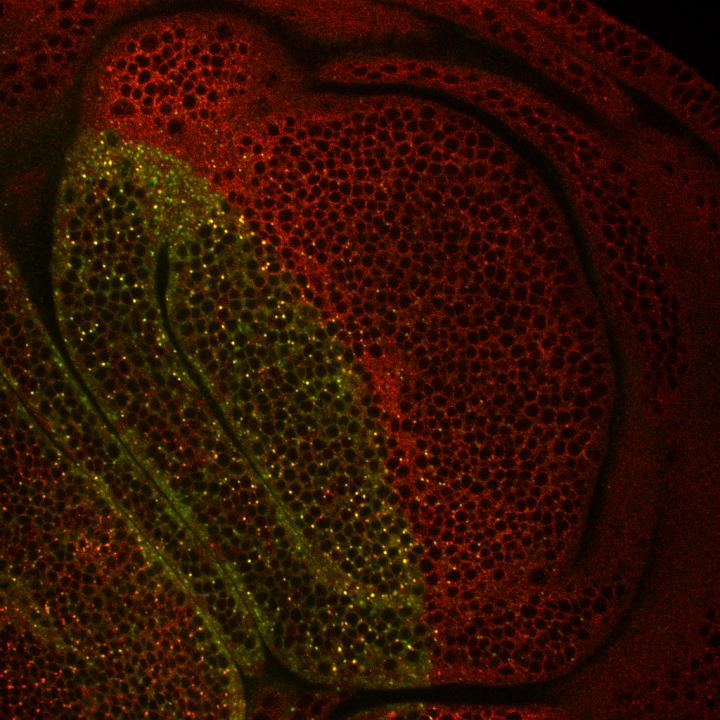
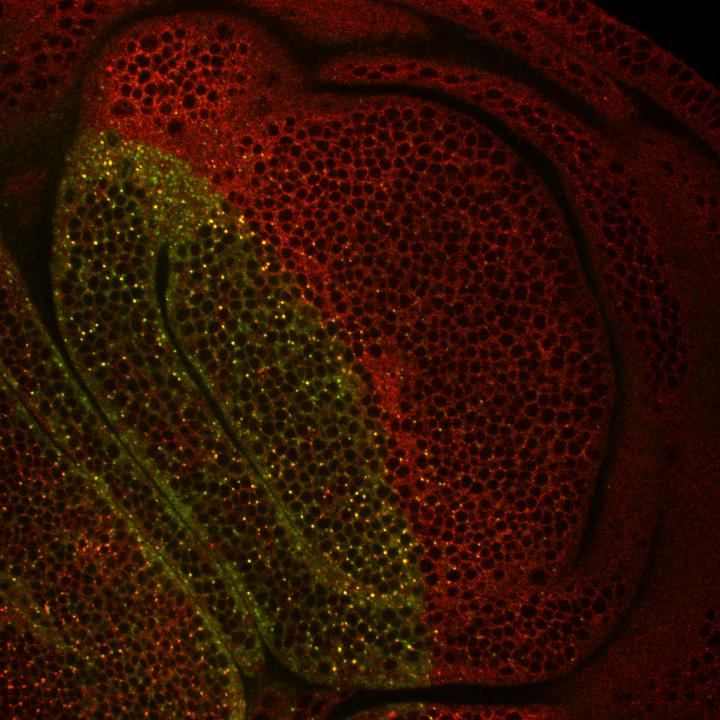
How do the cells in a human embryo know where they are located in the body and how they should develop? Why do certain cells form a finger while others do not? Freiburg biologists have explained the mechanisms that control these steps by showing why veins form at particular points in the wing of a fruit fly. The protein Pentagone spreads a particular signal in the wing that tells the cells how to behave. "The proteins Dpp and Pentagone, which are crucial for this developmental step in the organism Drosophila melanogaster, are also present in a similar form in humans," says the Freiburg biologist Dr. Giorgos Pyrowolakis. "The fundamental principles elucidated in this study are also active in humans, where they might control things like where cells form fingers." Pyrowolakis and a team including Jennifer Gawlik, Dr. Mark Norman, Alexander Springhorn, and Robin Vuilleumier published their findings in the journal eLife. In the future, the results could contribute to our understanding of the origin of developmental disorders.
The protein Dpp is located in a cellular field in various concentrations. The cells located in the middle of the future wing produce Dpp. The protein spreads to the rest of the cells in the tissue, becoming less concentrated in the process. In mathematical terms, this phenomenon is referred to as a concentration gradient. A cell activates different genes depending on where it is located in the gradient. Each cell develops as specified by the genes activated in it, and veins develop when certain thresholds have been reached. Hence, the gradient determines the distance between the veins of the fruit fly wing.
The cells located furthest from the Dpp source produce Pentagone. Without this protein, there would be no concentration gradient in the cell network and Dpp would stuck at the point of its production. If the gene for Pentagone is switched off in fruit flies, the wings of the insects are smaller and the external vein is missing. "Pentagone causes Dpp to keep spreading," explains Pyrowolakis, "thus extending the distribution-range of the protein."
The Freiburg biologists elucidated the molecular mechanisms behind these processes in their study. Dpp binds to receptors located on the surface of the cell in the future wing and initiates a signal cascade in the cell. The signal cascade activates different genes depending on how many receptors are bound by Dpp. Pentagone binds to a particular part of the receptors, the so-called co-receptors. They function like tentacles, "grabbing" proteins and passing them on to the receptor. Pentagone causes the co-receptors to be pushed into the cell to be broken down. This reduces the amount of co-receptors that can bind and pass on Dpp on the cell, causing the receptors to be less active. The concentration gradient of Pentagone is opposite than that of Dpp. The closer a cell is located to the point where Pentagone is produced, the less Dpp it can bind. The amount of Pentagone is adjusted to match that of Dpp. "When the wing grows, the Dpp gradient also expands," says Pyrowolakis. "Pentagone regulates the gradient in a similar way a thermostat adjusts the temperature."
###
Giorgos Pyrowolakis is a research group leader at the Institute of Biology I, Department of Developmental Biology, of the University of Freiburg, a member of the Freiburg Cluster of Excellence BIOSS Centre for Biological Signalling Studies, and a principal investigator at the Spemann Graduate School of Biology and Medicine (SGBM). Jennifer Gawlik is a member of his research group and a member of the SGBM. Robin Vuilleumier and Alexander Springhorn are former members of Pyrowolakis's research group. Springhorn was also a member of the SGBM. The primary author of this study, Mark Norman, was a postdoctoral researcher in the group. His project was funded by BIOSS.
Original publication:
Mark Norman, Robin Vuilleumier, Alexander Springhorn, Jennifer Gawlik, Giorgos Pyrowolakis (2016). Pentagone internalises glypicans to fine-tune multiple signalling pathways. eLife. DOI: 10.7554/eLife.13301
Contact:
Dr. Giorgos Pyrowolakis
BIOSS Centre for Biological Signalling Studies
University of Freiburg
Phone: +49 (0)761/203-8459
E-Mail: [email protected]
Media Contact
Katrin Albaum
[email protected]
49-761-203-97662
@BIOSSFreiburg
http://www.bioss.uni-freiburg.de