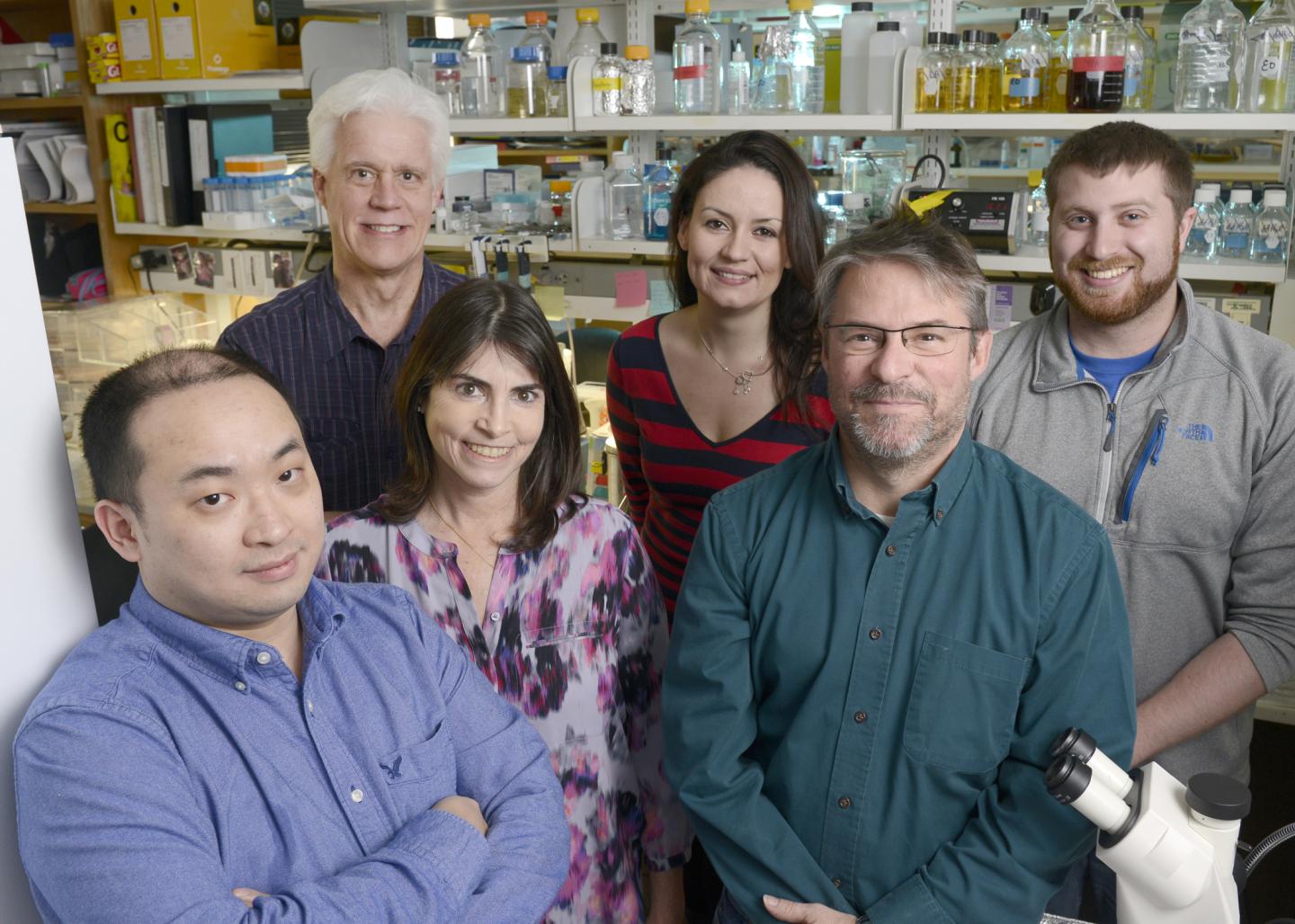
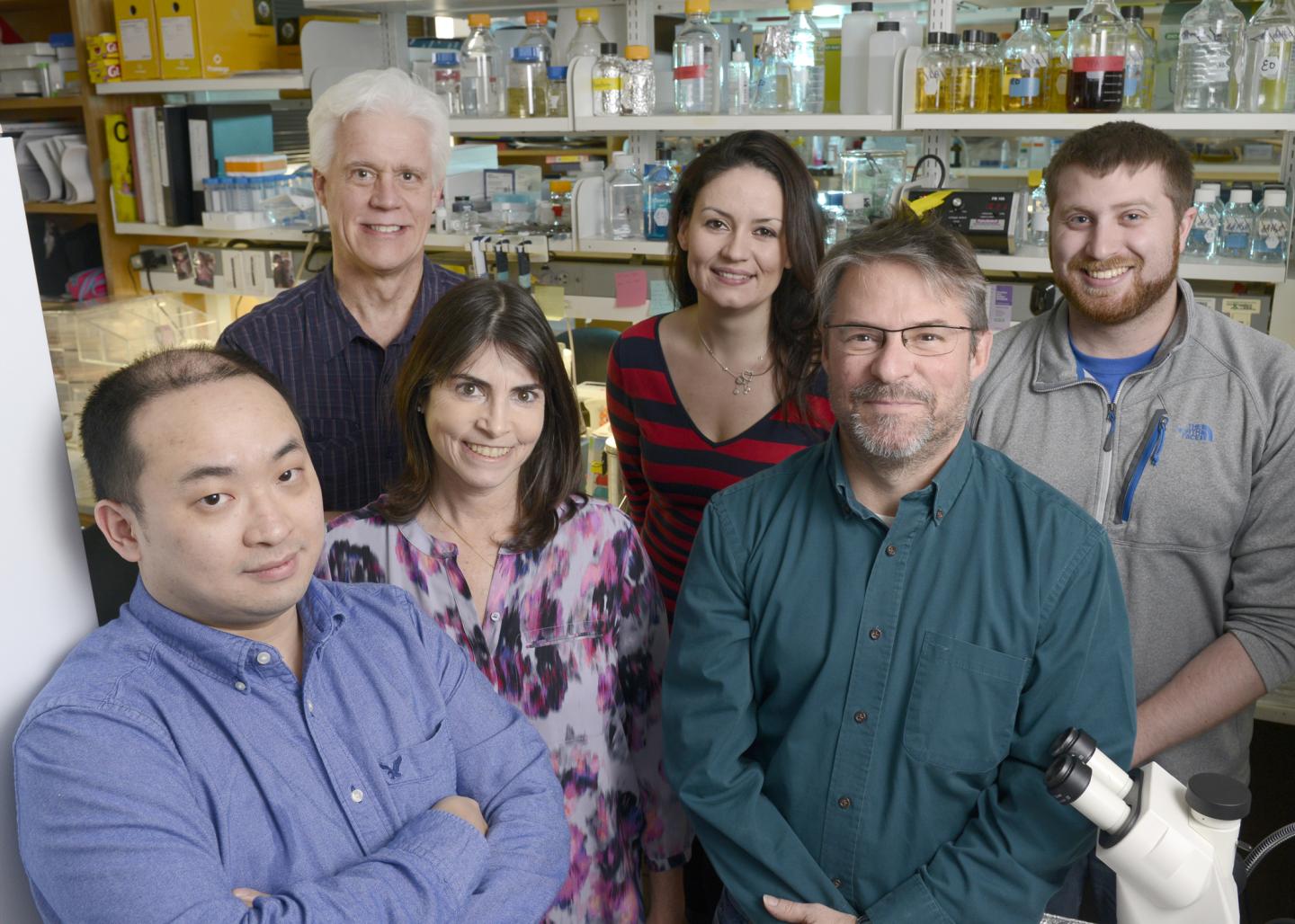
IMAGE: Members of the UT Southwestern team whose research successfully halted progression of a form of muscular dystrophy in mice included (l-r) Dr. Chengzu Long, Dr. Eric Olson, Dr. Rhonda Bassel-Duby,…
Credit: UT Southwestern Medical Center
DALLAS – Dec. 31, 2015 – Using a new gene-editing technique, a team of scientists from UT Southwestern Medical Center stopped progression of Duchenne muscular dystrophy (DMD) in young mice.
If efficiently and safely scaled up in DMD patients, this technique could lead to one of the first successful genome editing-based treatments for this fatal disease, researchers said.
DMD, the most common and severe form of muscular dystrophy among boys, is characterized by progressive muscle degeneration and weakness. It is caused by mutations in the X-linked DMD gene that encodes the protein dystrophin. The disease affects one in 3,500 to 5,000 boys, according to the Centers for Disease Control and Prevention and other estimates, and often leads to premature death by the early 30s.
Although the genetic cause of DMD has been known for nearly 30 years, no effective treatments exist. The disease breaks down muscle fibers and replaces them with fibrous or fatty tissue, causing the muscle to gradually weaken. This condition often results in heart muscle disease, or cardiomyopathy, the leading cause of death in these patients.
In the study published today in Science, UTSW researchers used a gene-editing approach to permanently correct the DMD mutation that causes the disease in young mice.
"This is different from other therapeutic approaches, because it eliminates the cause of the disease," said senior author Dr. Eric Olson, Chairman of Molecular Biology, and Co-Director of the Senator Paul D. Wellstone Muscular Dystrophy Cooperative Research Center at UT Southwestern.
In 2014, Dr. Olson's team first used this technique – called CRISPR/Cas9-mediated genome editing – to correct the mutation in the germ line of mice and prevent muscular dystrophy. This paved the way for novel genome editing-based therapeutics in DMD. It also raised several challenges for clinical applications of gene editing. Since germ line editing is not feasible in humans, strategies would need to be developed to deliver gene-editing components to postnatal tissues.
To test this out, researchers delivered gene-editing components to the mice via adeno-associated virus 9 (AAV9). DMD mice treated with this technique produced dystrophin protein and progressively showed improved structure and function of skeletal muscle and heart.
"AAV9 can efficiently infect humans in a tissue-specific manner, but it does not cause human disease or toxicity. It's a molecular missile for gene therapy," said Dr. Leonela Amoasii, a postdoctoral researcher in the Olson lab and co-lead author of the study with Dr. Chengzu Long, Instructor of Molecular Biology.
"The CRISPR/Cas9 system is an adaptive immune system of single-celled organisms against invading virus. Ironically, this system was hijacked, we packaged it into a nonpathogenic virus, and corrected a genetic mutation in an animal model," added Dr. Long.
The CRISPR genome-editing technology, which was developed by a researcher at University of California at Berkeley, was picked as the "Breakthrough of the Year" scientific development by Science.
"This study represents a very important translational application of genome editing of DMD mutations in young mice. It's a solid step toward a practical cure for DMD," said Dr. Rhonda Bassel-Duby, Professor of Molecular Biology and Co-Principal Investigator of a genomic editing project with Dr. Olson at the Wellstone Center.
"Importantly, in principle, the same strategy can be applied to numerous types of mutations within the human DMD patients," added Dr. Olson, who also serves as Director of the Hamon Center for Regenerative Science and Medicine, and holds the Annie and Willie Nelson Professorship in Stem Cell Research, the Pogue Distinguished Chair in Research on Cardiac Birth Defects, and the Robert A. Welch Distinguished Chair in Science.
Now, the research team is working to apply this gene-editing technique to cells from DMD patients and in larger preclinical animal models.
This marks the first major finding of the UTSW Wellstone Center, which was recently established with $7.8 million in funding from the National Institutes of Health. UTSW is one of six Wellstone Centers across the country, which work to translate scientific findings and technological developments into novel treatments for muscular dystrophy, and to promote basic, translational, and clinical research. UT Southwestern's Wellstone Center focuses on Duchenne muscular dystrophy.
"The recent groundbreaking discoveries from the Olson laboratory using genome editing to correct the genetic mutation that causes DMD have accelerated the race to find a cure for this deadly disease," said Dr. Pradeep Mammen, Associate Professor of Internal Medicine and Co-Director of the UTSW Wellstone Center. "The challenge now lies before Wellstone Center researchers to translate these discoveries in the mouse model of DMD into a therapy for patients with DMD."
###
Other UT Southwestern researchers who contributed to this research were Alex Mireault, research associate; John McAnally, senior scientist; Hui Li, research scientist; Efrain Sanchez-Ortiz, senior research associate; Samadrita Bhattacharyya, graduate student; John Shelton, senior research scientist; and Dr. Bassel-Duby.
UT Southwestern's Hamon Center for Regenerative Science and Medicine was made possible by a $10 million endowment gift from the Hamon Charitable Foundation. The Center's goal is to understand the basic mechanisms for tissue and organ formation, and then to use that knowledge to regenerate, repair, and replace tissues damaged by aging and injury.
About UT Southwestern Medical Center
UT Southwestern, one of the premier academic medical centers in the nation, integrates pioneering biomedical research with exceptional clinical care and education. The institution's distinguished faculty has included six who have been awarded Nobel Prizes since 1985. The faculty of more than 2,700 is responsible for groundbreaking medical advances and is committed to translating science-driven research quickly to new clinical treatments. UT Southwestern physicians provide medical care in 40 specialties to about 92,000 hospitalized patients and oversee approximately 2.1 million outpatient visits a year.
This news release is available on our home page at
http://www.utsouthwestern.edu/home/news/index.html