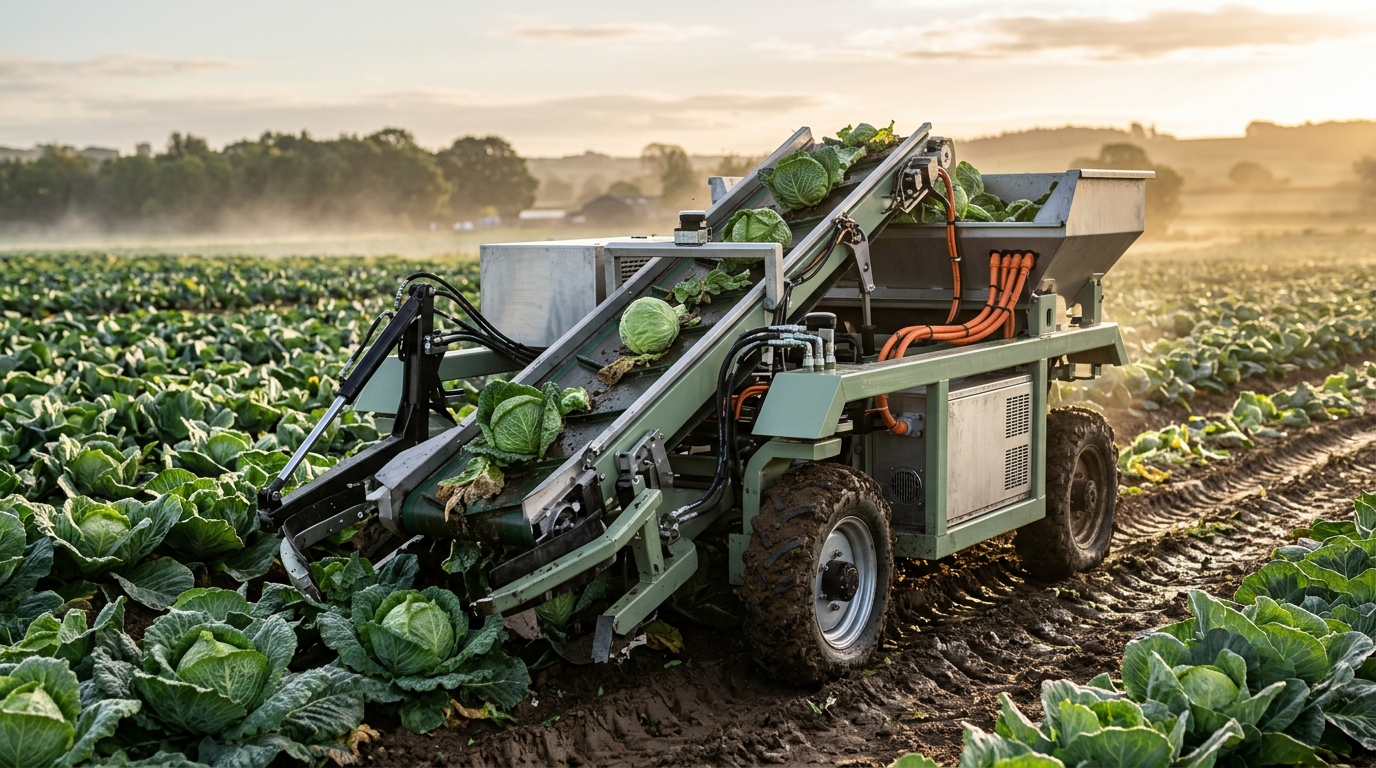
Researchers have demonstrated that an optimized Support Vector Regression model can accurately predict the real-time power consumption of an electric cabbage harvester, achieving a testing coefficient of determination of 0.997. The predictive framework was developed to dynamically estimate operating power requirements for domain-specific electric machinery in precision agriculture.
The experimental investigation evaluated power demand using three operational variables: cutting speed in revolutions per minute, forward speed in meters per second, and pusher shaft rotational speed in revolutions per minute. These mechanical parameters served as the primary independent inputs for modeling the total power required by the harvesting equipment.
To establish the most effective predictive method, the investigators trained and compared four separate algorithms: k-Nearest Neighbor, Random Forest Regression, Support Vector Regression, and Multiple Linear Regression. Among the baseline configurations, the Support Vector Regression model surpassed all competing algorithms, reaching a testing coefficient of determination of 0.861, a mean squared error of 165.06, a mean absolute error of 8.55 watts, and a root mean squared error of 12.85 watts.
Conversely, the Multiple Linear Regression model demonstrated comparatively limited performance when evaluated on the testing dataset. The linear formulation yielded a testing coefficient of determination of 0.2468, alongside an elevated mean absolute error of 23.35 watts and a root mean squared error of 29.91 watts.
The researchers subsequently enhanced the Support Vector Regression architecture by applying a radial basis function kernel configured with a penalty parameter C of 100 and an epsilon value of 1. This parameter optimization substantially improved modeling accuracy, producing a coefficient of determination of 0.998 on training data and 0.997 on testing data.
A sensitivity analysis established that cutting speed served as the principal factor influencing power consumption at 43.32 percent, followed by forward travel speed at 36.67 percent and pusher shaft speed at 20.01 percent.
Subject of Research: Machine learning estimation of electric cabbage harvester power consumption
Article Title: Machine learning based prediction of power consumption and development of GUI for an electric cabbage harvester
Article References: Sarkar, P., Raheman, H., Yadav, R., Chowdhury, M., Nagar, H., & Chouriya, A. (2026). Machine learning based prediction of power consumption and development of GUI for an electric cabbage harvester. Discover Applied Sciences. https://doi.org/10.1007/s42452-026-09917-y
Image Credits: AI Generated
DOI: 10.1007/s42452-026-09917-y
Keywords: electric cabbage harvester, power consumption prediction, support vector regression, precision agriculture, radial basis function, cutting speed, forward speed, pusher shaft speed, k-nearest neighbor, random forest regression, multiple linear regression, Tkinter, graphical user interface, sensitivity analysis, agricultural machinery, real-time power estimation
News Source: Teresa Odom. (November 28, 2026). Machine Learning Model Accurately Predicts Power Demand for Electric Cabbage Harvester. Scienmag.