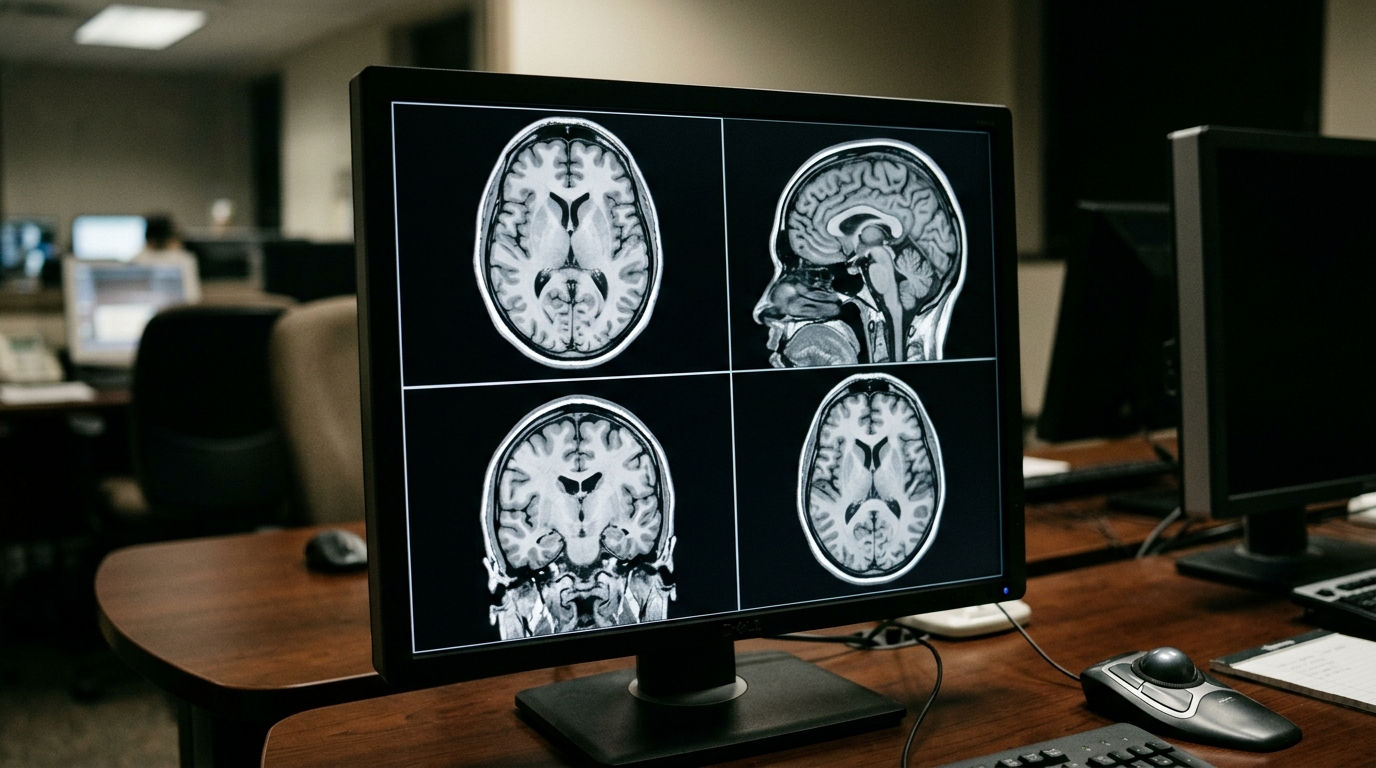
A computational framework combining generative adversarial data augmentation with a computationally efficient convolutional neural network has demonstrated an improved capacity to classify four distinct stages of Alzheimer’s disease from brain magnetic resonance imaging scans. In an experimental investigation published in the Egyptian Journal of Neurosurgery, researchers evaluated transfer learning architectures alongside traditional machine learning models to determine how targeted synthetic data generation influences stage categorization. When trained on an augmented dataset balanced through synthetic images, the compact EfficientNetB0 architecture attained an overall classification accuracy of 92 percent and an F1-score of 0.91 across four diagnostic categories. These metrics exceeded those recorded by substantially larger deep learning architectures, including VGG16 and ResNet50, while requiring significantly fewer model parameters and reduced training duration. The findings indicate that generative augmentation can mitigate the predictive bottlenecks created by severe class imbalance in medical image repositories, establishing a practical balance between diagnostic precision and computational economy.
Alzheimer’s disease represents a progressive and irreversible neurodegenerative condition characterized neuropathologically by the abnormal accumulation of tau and beta-amyloid proteins within cerebral tissue. According to data cited from the World Health Organization, the disorder currently impacts the daily lives of more than fifty million individuals across the globe, with total prevalence anticipated to triple by the year 2050. While existing clinical science cannot completely cure the condition, pharmacological medications and therapeutic interventions can suppress symptom intensity and decelerate underlying functional deterioration when initiated during earlier pathological phases. Structural brain imaging, specifically the quantitative assessment of cerebral volume reductions, serves as an essential radiological indicator of pathological advancement.
To investigate automated stage categorization under realistic data constraints, the research team acquired an open-source neuroimaging collection comprising 6,400 magnetic resonance imaging scans from the Kaggle platform repository. The archival images were distributed across four clinical diagnostic categories reflecting progressive cognitive impairment: Non-Demented, Very Mild Demented, Mild Demented, and Moderate Demented. A fundamental difficulty presented by this initial dataset was extreme numerical disparity among the diagnostic cohorts. In the unaugmented baseline distribution, the dominant Non-Demented and Very Mild Demented categories contained thousands of representative scans, whereas the Moderate Demented cohort contained a total of only 64 scans. Machine learning classifiers trained directly on such heavily skewed data typically develop systematic predictive biases toward over-represented categories, failing to establish robust feature boundaries for rarer clinical presentations that carry profound clinical significance.
Before introducing the scans into generative or classification workflows, the investigators executed a standardized three-step preprocessing routine to guarantee numerical uniformity across all experimental models. Every individual magnetic resonance image was first spatially resized to uniform dimensions of 128 by 128 pixels. Following dimensional standardization, the researchers applied min-max intensity normalization, rescaling raw pixel intensities into a continuous numerical range between zero and one to eliminate arbitrary contrast discrepancies arising from varied scanner calibrations. Finally, the complete image collection was partitioned using stratified random sampling, assigning 80 percent of the scan files to the training partition while retaining the remaining 20 percent exclusively for blind model evaluation. The stratified sampling protocol preserved exact class proportions across partitions, preventing artificial distribution shifts between optimization phases and final model testing.
To overcome the acute data deficiency within minority diagnostic cohorts, the authors implemented a Deep Convolutional Generative Adversarial Network, designated as DCGAN, to synthesize supplementary structural brain scans. The generative architecture operates through a continuous adversarial minimax optimization involving two competing convolutional sub-networks. The generator network accepts random latent input vectors and learns to map them into realistic, two-dimensional brain image matrices, while the discriminator network evaluates candidate images to distinguish authentic scans from synthetic reconstructions. As iterative training advances, the discriminator refines its capacity to detect artificial artifacts, compelling the generator to manufacture structural textures that become increasingly indistinguishable from clinical scans. Once convergence was achieved, the trained generator was deployed exclusively to synthesize supplementary training examples for the under-represented Mild Demented and Moderate Demented categories, expanding minority representation without altering baseline test partitions.
To establish a comparative baseline against automated deep representation learning, the study extracted handcrafted morphological texture metrics using the Gray-Level Co-occurrence Matrix, commonly known as GLCM. This classical image processing technique mathematically tabulates the spatial co-occurrence frequency of adjacent pixel gray-level intensities at defined displacement vectors, translating intricate structural textures into numerical feature vectors. The team calculated five standard statistical descriptors: contrast to quantify local intensity variability, dissimilarity to measure absolute neighbor variation, homogeneity to assess structural uniformity, energy to capture squared distribution compactness, and linear correlation to model coordinated spatial variations across rows and columns. These five-dimensional GLCM vectors were subsequently used to train five conventional machine learning classifiers: Random Forest containing 300 decision trees, Support Vector Machine configured with a linear kernel, Logistic Regression, Decision Tree, and Gaussian Naive Bayes.
Alongside conventional classifiers, the investigation assessed three deep convolutional neural network backbones via transfer learning: EfficientNetB0, VGG16, and ResNet50. Transfer learning leverages generalized visual features acquired from vast natural image databases, reallocating learned representations to specialized medical image domains where available sample sizes are constrained. EfficientNetB0 employs a compound scaling principle that uniformly coordinates network depth, channel width, and spatial resolution while leveraging Mobile Inverted Bottleneck Convolution blocks to capture complex diagnostic patterns with minimal parameter overhead. Conversely, VGG16 relies on a deep sequence of thirteen convolutional layers configured with uniform three-by-three receptive filters followed by dense fully connected layers, and ResNet50 incorporates residual shortcut connections designed to circumvent vanishing gradient phenomena during optimization. Model evaluation was structured around four standard statistical measures: accuracy, precision, recall or sensitivity, and the harmonic F1-score.
All computational pipelines and experimental scenarios were executed on a standardized local hardware workstation consisting of an Apple MacBook Pro equipped with an Apple M2 system-on-chip featuring an eight-core central processor, a sixteen-core Neural Engine, and sixteen gigabytes of unified system memory. The underlying software environment was assembled using Python version 3.9.12, TensorFlow 2.10.0 integrating Keras high-level interfaces, scikit-learn 1.1.1, NumPy 1.23.0, pandas 1.4.3, and Matplotlib 3.5.2 operated through Jupyter Notebook 6.4.12. Model testing was systematically partitioned into four distinct experimental scenarios designed to isolate the respective influences of class composition and generative augmentation. Scenario 1 evaluated original imbalanced four-class data; Scenario 2 evaluated original data across three classes by excluding Mild Demented scans; Scenario 3 deployed the complete four-class pipeline incorporating DCGAN augmentation; and Scenario 4 examined a three-class configuration augmented with DCGAN synthesis.
Experimental evaluation demonstrated that training balance and feature representation directly governed classification success across all tested configurations. In the baseline unaugmented four-class environment of Scenario 1, EfficientNetB0 recorded an accuracy of 82 percent alongside an F1-score of 0.79, while the top-performing classical model, Random Forest, achieved 55 percent accuracy. When minority classes were rebalanced through DCGAN image generation in Scenario 3, EfficientNetB0 surged by ten full percentage points to reach 92 percent accuracy and an F1-score of 0.91, while Random Forest climbed to 65 percent. Across every evaluated scenario, deep transfer learning models outperformed traditional GLCM-based classifiers by margins ranging from 13 to 30 percentage points. Furthermore, comparative analysis between three-class and four-class setups revealed that removing intermediate disease categories failed to produce the most capable diagnostic model, as balanced four-class training in Scenario 3 outperformed the augmented three-class accuracy of 90 percent recorded in Scenario 4.
In addition to raw predictive accuracy, the study revealed marked disparities in computational overhead and statistical separation among competing deep architectures in Scenario 3. EfficientNetB0 attained its 92 percent accuracy mark utilizing only 4.0 million trainable parameters and requiring 2,592.76 seconds of total training time, with an average inference speed of 0.0365 seconds per processed scan. By contrast, VGG16 required 138.4 million parameters and consumed 4,847.32 seconds of training time to reach 90 percent accuracy, while ResNet50 incorporated 25.6 million parameters across 3,915.61 seconds of training to achieve 88 percent accuracy. To establish whether these performance margins were mathematically robust rather than random artifacts, the investigators conducted McNemar’s statistical significance testing on blind test predictions. The analysis confirmed that the performance advantages of EfficientNetB0 over VGG16 (p = 0.012) and ResNet50 (p = 0.003) were statistically significant at standard confidence thresholds.
Granular inspection of the confusion matrix for the optimal EfficientNetB0 configuration illustrated that diagnostic difficulty remained unevenly distributed across stages, despite substantial gains from generative augmentation. Within the blind test cohort, the model correctly identified 632 Non-Demented scans with 28 misclassifications, and accurately categorized 598 Very Mild Demented scans with 42 errors, while achieving 348 correct predictions for Mild Demented and 344 for Moderate Demented categories alongside 52 and 56 misclassifications, respectively. Contextualizing these outcomes against published literature, the authors observed that their 92 percent accuracy exceeded prior benchmarks established by CNN-LSTM architectures (90.62 percent) and AlexNet models (91.70 percent), while remaining below specialized systems such as DEMNET paired with SMOTE (95.23 percent) or VGG19 applied to ADNI data (97 percent). The authors acknowledged key methodological boundaries, emphasizing that the scans originated from a single public repository, lacked external cohort verification, utilized two-dimensional slices rather than volumetric three-dimensional sequences, and were not subjected to formal radiological review. Consequently, future translation will require validation across diverse clinical registries such as ADNI, OASIS, and AIBL, direct clinical scrutiny of synthetic images, patient-level data partitioning, and interpretable saliency mapping before prospective clinical deployment.
Subject of Research: Deep learning and generative adversarial data augmentation for multi-stage Alzheimer’s disease classification from brain magnetic resonance imaging scans
Article Title: Alzheimer’s disease stage classification using DCGAN-Augmented brain MRI and EfficientNetB0
Article References: Hatipoglu, M. I., Raj, K., Vavekanand, R., & Singh, A. (2026). Alzheimer’s disease stage classification using DCGAN-Augmented brain MRI and EfficientNetB0. Egyptian Journal of Neurosurgery, 41(1), Article 218. https://doi.org/10.1186/s41984-026-00727-3
Image Credits: AI Generated
DOI: 10.1186/s41984-026-00727-3
Keywords: Alzheimer's disease, Magnetic resonance imaging, Deep learning, Generative adversarial networks, DCGAN, EfficientNetB0, Transfer learning, Medical image classification, Gray-Level Co-occurrence Matrix, Texture analysis, Class imbalance, Synthetic data augmentation, VGG16, ResNet50, Random forest, Neuroimaging, Computer-aided diagnosis
News Source: Cassandra Pierce. (November 28, 2026). Generative Data Augmentation Boosts Brain Scan Classification for Alzheimer’s Disease Stages. Scienmag.