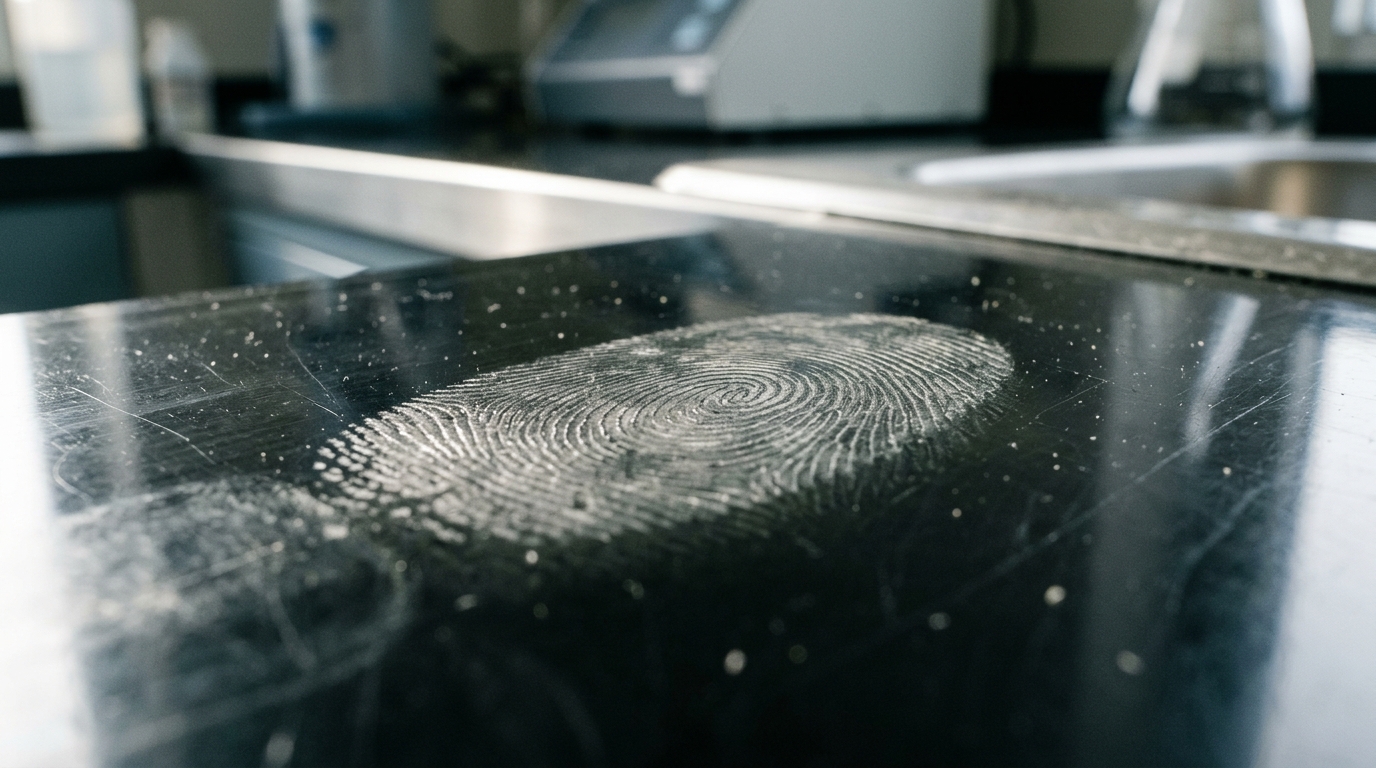
Bacterial traces deposited within human fingerprints can persist on hard surfaces for up to five days, according to research published in the International Journal of Legal Medicine. Researchers examined the transfer of hand-associated microbiota onto hard tabletop surfaces following the detection of fingerprints using an advanced forensic light source system. The findings suggest touch-associated microbial traces may offer valuable complementary biological information alongside conventional fingerprint and human DNA evidence, although the authors emphasize that further experimental validation is required to establish their practical forensic applicability.
Forensic investigations regularly employ multidisciplinary methods to establish causal links between specific individuals and crime scenes. However, external environmental exposure and operational delays in evidence collection can frequently hinder the recovery of traditional latent fingerprints and intact human DNA.
To investigate the physical transfer of hand-associated bacteria to surfaces and evaluate their time-dependent detectability, the study examined ten healthy volunteers. The experimental protocol involved collecting baseline finger microbiota samples from each volunteer alongside corresponding tabletop surface samples. Using a forensic light source system to locate the deposited fingerprints on the hard surface, the research team gathered post-deposition swab samples across three distinct observation points on Day 1, Day 3, and Day 5.
Following bacterial DNA isolation from the collected specimens, the team sequenced the full-length 16S ribosomal RNA gene spanning the V1 through V9 variable regions. This sequencing work was conducted on the Oxford Nanopore Technologies platform and coupled with bioinformatic analyses to examine community structure, measure diversity shifts, and assess which specific hand-derived taxa persisted on the hard surfaces over the multi-day period.
Taxonomic profiling identified Proteobacteria as the dominant phylum within the baseline finger-associated samples, displaying a mean relative abundance of 74.72 percent. When assessing the surface-associated microbial communities over time, the researchers observed that the relative representation of Proteobacteria progressively increased across the sampling days, demonstrating distinct temporal shifts following initial deposition on the hard surface.
Analyses conducted at finer taxonomic resolutions indicated that certain bacterial groups remained detectable on contacted surfaces across multiple sampling days, including the genera Acinetobacter and Staphylococcus. At the species level, donor-dependent patterns of detectability were observed through Day 5. Taxa such as Acinetobacter lwoffii, Mixta calida, and Staphylococcus hominis served as primary examples of bacterial species that remained detectable at the later sampling time points.
Alpha diversity analyses revealed marked inter-individual variability between the volunteers, while relative abundance profiles showed that post-contact microbial communities were frequently dominated by a limited number of taxa. Venn diagram analyses further demonstrated that, on average, 5.78 percent of taxa were shared between baseline hand microbiota and surface-associated microbiota across all three post-deposition sampling days, confirming persistence while highlighting the need for further validation before forensic implementation.
Subject of Research: Time-dependent detectability of touch microbiota deposited in fingerprints on hard surfaces
Article Title: Time-dependent stability of touch microbiota in fingerprints located using advanced FLS systems
Article References: Karadayı, S., Yılmaz, İ., Özbek, T., & Karadayı, B. (2026). Time-dependent stability of touch microbiota in fingerprints located using advanced FLS systems. International Journal of Legal Medicine. https://doi.org/10.1007/s00414-026-04079-3
Image Credits: AI Generated
DOI: 10.1007/s00414-026-04079-3
Keywords: touch microbiota, forensic light source, fingerprints, Oxford Nanopore Technologies, 16S rRNA sequencing, Proteobacteria, Acinetobacter, Staphylococcus, Acinetobacter lwoffii, Mixta calida, Staphylococcus hominis, microbial transfer, alpha diversity, relative abundance, forensic biology, hand microbiota, tabletop surfaces
News Source: Morgan Morrow. (November 28, 2026). Fingerprint Microbial Traces Remain Detectable on Hard Surfaces for Five Days. Scienmag.