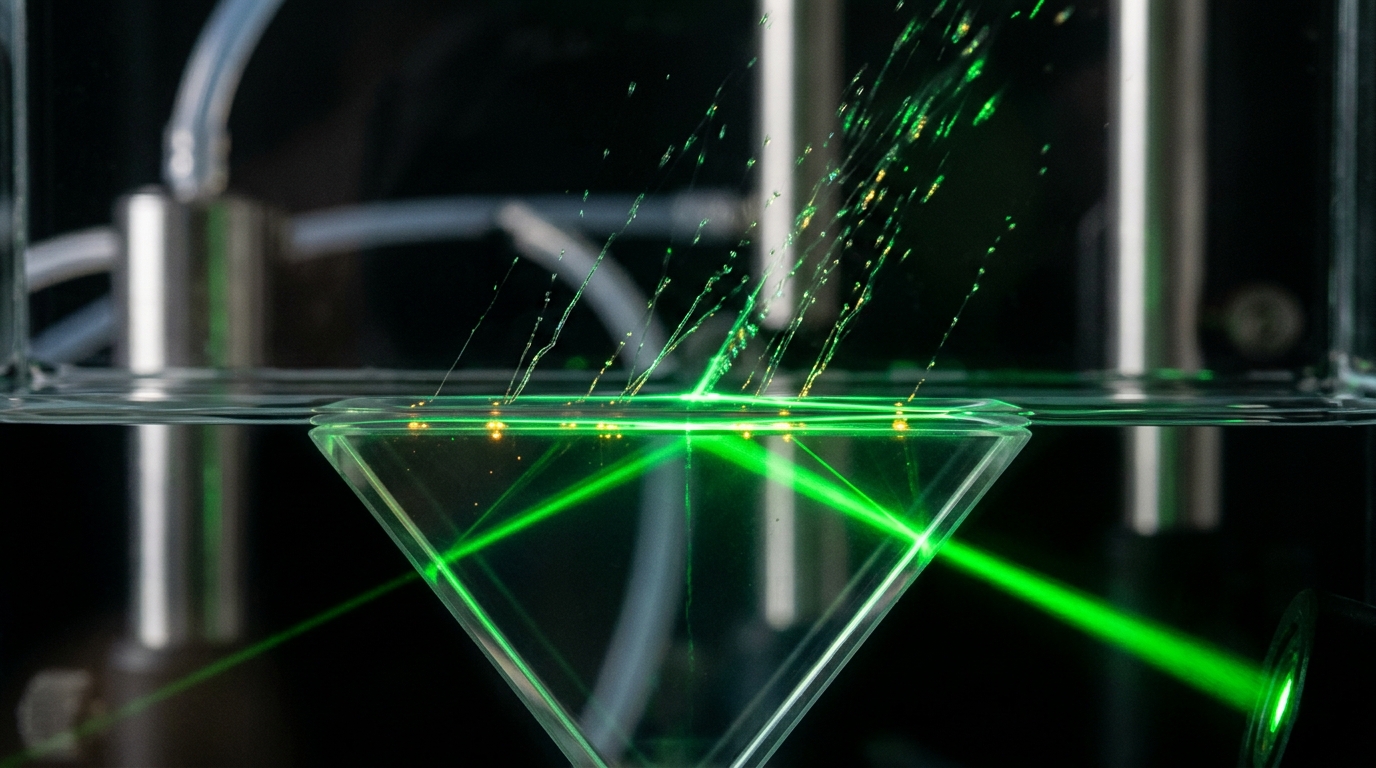
When high-energy pulsed laser beams undergo total internal reflection inside an optical prism, the resulting interference of incident and reflected waves typically concentrates destructive electromagnetic energy on the solid glass side of the boundary, causing substrate fracture rather than fluid motion. By introducing nanoscale metallic absorbers directly onto the interface, the experimental study confirms that the rapidly decaying boundary field can be harnessed to trigger rapid hydrodynamic responses. Across systematically controlled trials, increasing the surface number density of the gold nanoparticles produced a pronounced two-stage transition, shifting the fluid response from gentle surface oscillations at lower particle concentrations to consistent liquid jet formation at elevated particle loadings.
The physical challenge addressed by this work stems from the fundamental electromagnetic behavior of total internal reflection, which occurs when an optical beam travels through a higher-refractive-index medium toward a lower-refractive-index medium at an angle exceeding the critical threshold. In the experimental geometry evaluated by the authors, light passed from a glass hemispherical prism with a refractive index of 1.51 into pure water with a refractive index of 1.33, establishing a critical angle of approximately 61.7 degrees. Directing an infrared laser beam at an incident angle of 63 degrees generated a localized evanescent wave whose optical intensity decayed exponentially into the liquid with a calculated penetration depth of approximately 417 nanometers. However, finite-element simulations using COMSOL Multiphysics revealed that without absorbing nanostructures, optical field superposition produced a peak electric-field magnitude of 45.0 volts per meter within the glass substrate, representing a 2.01-fold enhancement over the reference incident field of 22.4 volts per meter. In preliminary physical verification tests, repeated pulsing at one-minute intervals caused visible glass fracturing after seven to nine laser shots without ever producing fluid ejection.
To redirect the localized electromagnetic energy toward the fluid side of the boundary, the investigators introduced gold nanoparticles to act as discrete photothermal conversion sites along the interface. When metallic nanospheres encounter an oscillating external optical field, their conduction electrons polarize, creating an induced dipole moment governed by the complex dielectric permittivity of gold and the surrounding dielectric medium. Unlike traditional plasmonic approaches that rely strictly on narrow, idealized plasmon resonance conditions, this experimental framework leverages the submicrometer confinement of the evanescent wave to localize optical absorption strictly adjacent to the water. The gold nanoparticles absorb optical energy and convert it into heat that rapidly diffuses into the adjacent boundary layer of water.
Numerical modeling of the electromagnetic interaction confirmed substantial performance advantages for evanescent excitation over conventional direct illumination of the metallic nanoparticles. The authors established a three-dimensional computational domain measuring 750 nanometers by 750 nanometers across the interface, featuring a single spherical gold nanoparticle with a diameter of 100 nanometers positioned at the origin on the glass boundary. Simulating optical wave propagation at a vacuum wavelength of 1064 nanometers revealed that direct normal incidence produced a localized peak electric-field magnitude of 89.0 volts per meter around the nanoparticle, corresponding to an enhancement factor of 3.97 relative to the reference field. In contrast, evanescent-field excitation at an incident angle of 63 degrees produced a peak electric field of 125 volts per meter, achieving an enhancement factor of 5.58. Crucially, the spatial distribution of this enhanced electromagnetic field extended prominently around the lateral sides of the nanoparticle into the surrounding liquid region, establishing an efficient localized pathway for interfacial energy transfer.
Coupled electrothermal simulations further illustrated how this concentrated electric field translates into localized photothermal heating within the water layer. Using optical constants derived from the Brendel-Bormann model and setting thermal parameters for water, glass, and gold, the authors simulated the transient temperature rise over a six-nanosecond duration corresponding to the laser pulse width. With an estimated incident peak intensity of 3.89 × 10¹³ watts per square meter, direct laser irradiation from an initial ambient temperature of 293.15 Kelvin yielded a maximum temperature of 484.7 Kelvin, representing a net temperature increase of 191.5 Kelvin. Under evanescent-field excitation, the maximum temperature climbed to 553.7 Kelvin, producing a substantially higher temperature rise of 260.6 Kelvin. The researchers explicitly emphasized that these electrothermal calculations served as a comparative metric of localized photothermal deposition rather than an exact thermodynamic prediction, because the numerical model deliberately omitted phase transitions, latent heat absorption, vapor generation, pressure variations, and cavitation bubble dynamics.
To validate the simulated behavior experimentally, the research team fabricated and characterized glass substrates bearing systematically varied coatings of commercial 100-nanometer gold nanoparticles. Glass slides were cleaned with acetone and purified water before receiving successive drop-casting cycles using ten-microliter aliquots of aqueous nanoparticle dispersion. Optical laser microscopy and scanning electron microscopy confirmed that repeated deposition cycles progressively increased particle coverage while leaving a large fraction of the gold nanospheres individually dispersed across the surface. By counting individual nanoparticles within calibrated 50-micrometer by 50-micrometer observation windows, the authors quantified the surface number density for each slide. The fabricated substrates were then sorted in ascending order of measured density and organized into eight distinct experimental groups of ten substrates each. The average particle number density ranged from 6.19 × 10⁶ particles per square centimeter in Group 1 up to 22.4 × 10⁶ particles per square centimeter in Group 8.
Experimental testing was conducted by mounting each coated slide onto a ten-millimeter-diameter hemispherical glass prism with index-matching immersion oil to maintain optical coupling across the glass boundary. A pure water droplet with an average volume of 66 ± 9.3 microliters was deposited onto the nanoparticle-coated surface, after which a Q-switched Nd:YAG laser delivered 1064-nanometer pulses with an average energy of 37.45 ± 0.97 millijoules and a pulse duration between 5 and 7 nanoseconds. Directed from below at an incident angle of 63 degrees, the beam formed an elliptical effective irradiation spot on the interface with mean axes of 1097 micrometers and 440 micrometers, corresponding to an area of 0.353 ± 0.051 square millimeters. Across this spot, the estimated total number of participating gold nanoparticles scaled from 2.19 × 10⁴ particles in Group 1 to 7.91 × 10⁴ particles in Group 8. High-speed video recording captured the fluid response over three successive laser shots per substrate, yielding thirty recorded trials for each density group.
Statistical evaluation of the recorded trials revealed a clear, two-stage probabilistic relationship governed by the nanoparticle number density. The fluid response was classified into three mutually exclusive categories: no response, surface oscillation without fluid ejection, and macroscopic liquid jet formation. On bare glass substrates without nanoparticles, neither oscillations nor liquid jets occurred. For Group 1, possessing the lowest average density of 6.19 × 10⁶ particles per square centimeter, the overall response probability reached approximately 30 percent, while the liquid jet generation probability was only 6.7 percent. As the particle density increased, the probability of surface motion rose sharply before liquid jet ejection became frequent. By Group 7, with a density of 18.2 × 10⁶ particles per square centimeter, the overall response probability attained approximately 93 percent and the liquid jet probability climbed to 57 percent. At the highest density of 22.4 × 10⁶ particles per square centimeter in Group 8, a fluid response was recorded in 100 percent of trials, with liquid jet generation occurring in 77 percent of cases.
High-speed camera recordings resolved the temporal dynamics of the phenomenon into two distinct, sequential physical regimes occurring over vastly different time scales. During the initial microsecond stage, a microscopic vapor bubble appeared near the interface immediately following laser excitation, expanded to its maximum dimensions within approximately 100 microseconds, and contracted until disappearing around 200 microseconds. Between 260 and 510 microseconds, a secondary aggregate of smaller bubbles exhibited rapid expansion and contraction cycles accompanied by lateral displacement and the violent ejection of microscopic droplets. Following the complete cessation of this early bubble-like activity, a macroscopic liquid column emerged during the millisecond regime. High-speed image sequences recorded at 2.0, 4.5, and 7.0 milliseconds showed the coherent water column progressively elongating upward from the droplet surface, growing increasingly slender as its leading tip traveled into the surrounding air.
Quantitative mechanical energy calculations and hydrodynamic scaling analyses confirmed that column growth was overwhelmingly governed by fluid inertia. Approximating the visible column as an extending cylinder with a linearly increasing axial velocity profile, the researchers determined that the tip velocity decreased from 2.10 meters per second at 2.0 milliseconds to 1.47 meters per second at 7.0 milliseconds while the column height expanded from 4.43 to 13.01 millimeters. The total mechanical energy associated with column formation was estimated at 20 to 30 microjoules, with kinetic energy contributing 15 to 20 microjoules as the dominant component, whereas surface tension and gravitational potential energy each accounted for only a few microjoules. Over this time span, the Weber number decreased from 82.1 to 30.0, the Froude number decreased from 10.1 to 4.12, and the Reynolds number dropped from 5630 to 2940. Because all three dimensionless values remained substantially greater than unity, the authors concluded that inertia dominated early column development, with surface tension and gravity exerting greater influence as the column extended, while viscous dissipation played an insignificant role throughout the expansion process.
Subject of Research: Evanescent-field excitation of gold nanoparticles for liquid jet generation at a solid-liquid interface
Article Title: Evanescent-field excitation of Au nanoparticles for liquid jet generation at a glass-water interface
Article References: Matsuya, I., Saito, T., Uehara, H., & Foudzi, F. M. (2026). Evanescent-field excitation of Au nanoparticles for liquid jet generation at a glass-water interface. Applied Physics B, 133(1), Article 2. https://doi.org/10.1007/s00340-026-08748-4
Image Credits: AI Generated
DOI: 10.1007/s00340-026-08748-4
Keywords: evanescent field, gold nanoparticles, liquid jet generation, glass-water interface, total internal reflection, photothermal conversion, pulsed laser irradiation, COMSOL Multiphysics, surface oscillation, high-speed imaging, two-stage response, Weber number, Reynolds number, Froude number, kinetic energy, fluid dynamics, cavitation dynamics, interfacial optics
News Source: Denise Maddox. (November 28, 2026). Evanescent Laser Fields Excite Gold Nanoparticles to Eject Directional Water Jets. Scienmag.