Noninvasive radiometric diagnostics combined with three-dimensional computational fluid dynamics simulations have demonstrated that the Energy-Minimization Multi-Scale drag model provides superior predictive fidelity over the traditional Gidaspow formulation when resolving gas-solid hydrodynamics inside a circulating fluidized bed riser. In an experimental investigation published in the Brazilian Journal of Chemical Engineering, researchers evaluated the two widely applied interphase drag closures against physical measurements captured across a pilot-scale cold circulating fluidized bed column. The study resolved the complex local distribution of solid catalyst particles suspended in high-velocity air, focusing specifically on cross-sectional solids volume fraction profiles and vertical pressure gradients. By contrasting numerical predictions directly with physical attenuation profiles recorded by gamma-ray detection stations, the authors established that incorporating multiscale energy minimization principles allows numerical solvers to capture localized particle clustering far more reliably than empirical continuum drag closures that assume uniform particle dispersion.
Circulating fluidized bed reactors serve as vital processing vessels across chemical, petrochemical, metallurgical, fossil fuel, calcination, and fluid catalytic cracking operations, where maximizing contact efficiency between gaseous fluids and particulate solids promotes elevated heat and mass transfer rates. Within these industrial installations, the vertical riser acts as the primary reaction conduit, transporting the upward-moving gas-solid suspension continuously toward downstream cyclonic separation units and solids return legs. Operating at elevated superficial gas velocities while maintaining continuous catalyst circulation gives circulating fluidized beds substantial advantages over fixed beds. However, the internal hydrodynamics of such multiphase mixtures are dominated by chaotic particle-particle collisions, cohesive clustering, and steep radial velocity gradients. Because local agglomerations of solid particles suppress interphase drag and alter residence time distributions, accurate computational models are necessary to predict cross-sectional solids concentrations, design commercial scale units, and prevent operational instabilities.
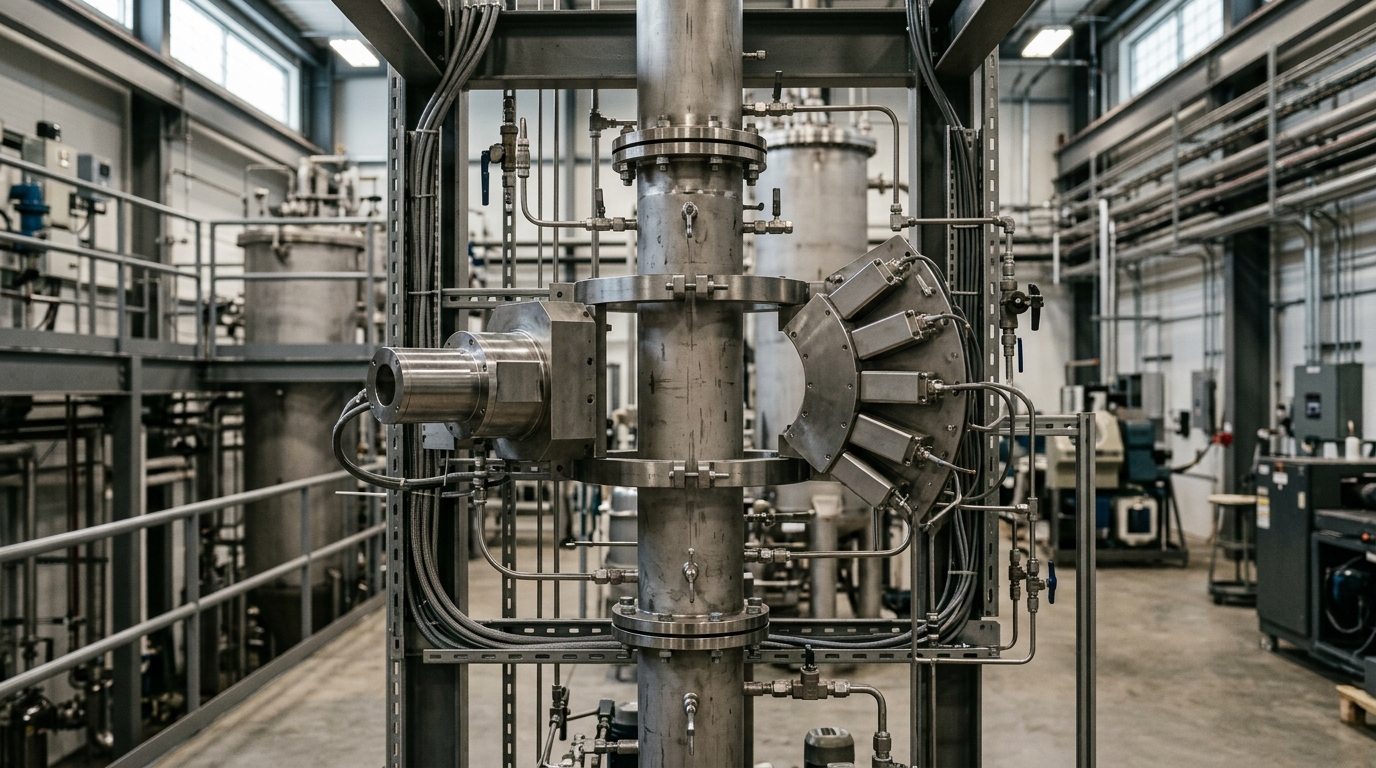
To establish an empirical baseline devoid of thermal and chemical complications, the research team conducted physical trials within a pilot-scale cold circulating fluidized bed unit constructed from transparent acrylic tubing. The physical riser featured an internal diameter of 0.092 meters and a vertical height of 5.74 meters, culminating in an upper bend discharging into four cyclonic separators designed to separate catalyst particles from fluidizing air. The recycled solid phase returned to the riser base through an acrylic downer column of identical diameter, where automated control valves regulated the solids feed. The particulate inventory comprised an inert catalyst with an average particle diameter of 76 micrometers and a bulk density of 900 kilograms per cubic meter. Fluidization was driven by compressed air at 15 degrees Celsius and 101.325 kilopascals, establishing a superficial gas velocity of 1.55 meters per second and a solids mass flow rate of 45 kilograms per square meter per second.
Each radiometric station integrated lead shielding, precision collimators, and an isotropic Americium-241 radioactive source exhibiting an activity of 4.7 times 10 to the ninth becquerels. Photons emitted by the source penetrated the acrylic riser walls and the gas-solid mixture before reaching a two-inch by two-inch thallium-doped sodium iodide scintillation detector linked to a Canberra Genie 2000 multichannel analyzer. The experimental team determined local solids volume fractions by integrating the 0.060 megaelectronvolt photopeak across empty-tube calibration conditions and active flow states, applying attenuation physics based on a measured catalyst mass absorption coefficient of 331 square meters per kilogram. A movable mounting framework permitted radial scanning across the riser cross section, generating point-by-point experimental holdup profiles without introducing intrusive physical probes into the suspension.
Complementing the radiometric density measurements, differential pressure sensors were positioned along the acrylic riser at heights of 0, 0.43, 1.76, 3.81, and 5.65 meters to record the axial static pressure profile during steady-state operation. The measured gauge pressure exhibited a characteristic monotonic decline with increasing column elevation, directly reflecting the decreasing cumulative weight of the suspended solids inventory and the progressive expansion of gas voidage. Because vertical pressure gradients in vertical risers are predominantly governed by the apparent hydrostatic head of the particulate suspension according to the differential relationship equating pressure drop to solid density, gravitational acceleration, and solids volume fraction, accurate pressure modeling hinges entirely on predicting local voidage. Both computational formulations successfully reproduced this overarching downward pressure trajectory from the riser base to the cyclone exit, confirming that bulk vertical pressure trends remain relatively robust even when local radial dispersion exhibits noticeable discrepancy between models.
To simulate the observed pilot-scale hydrodynamics, the authors formulated a three-dimensional Eulerian-Eulerian two-fluid framework within the Ansys Fluent software environment, treating both the gaseous air and the solid catalyst as interpenetrating continuous phases. In this continuum approach, separate Navier-Stokes continuity and momentum balance equations were resolved simultaneously for each phase, linked through interphase momentum exchange terms. Rheological closure for the solid particulate phase was supplied by the Kinetic Theory of Granular Flow, which draws an analogy between chaotic particle collisions and thermal molecular motion. The granular kinetic theory closure established governing transport equations for granular temperature, reflecting the fluctuating kinetic energy of the catalyst particles. These formulations supplied rigorous constitutive definitions for granular shear viscosity, solid bulk viscosity, solid-phase pressure, and collisional dissipation rates, accounting for particle diameter, restitution coefficients during inelastic collisions, and radial distribution functions that restrict maximum packing density.
Spatial and temporal numerical discretization of the coupled transport equations was executed using high-resolution numerical algorithms tailored specifically for high-gradient multiphase systems. Velocity-pressure coupling across the gas and particulate phases was resolved utilizing the Phase Coupled SIMPLE algorithm, ensuring consistent interphase mass conservation. Discretization of the continuous governing equations relied on the Green-Gauss Cell Based scheme, while convective transport of the solids volume fraction was captured using the Modified High-Resolution Interface Capturing approach to preserve phase boundaries. Pressure interpolation was managed through the PRESTO! staggering scheme to prevent non-physical pressure oscillations in regions displaying steep vertical pressure gradients. Convective momentum terms were discretized using the Third-Order MUSCL method to combine high formal accuracy with numerical stability, while turbulence inside the continuous gas phase was modeled via the RNG k-epsilon turbulence model equipped with Standard Wall Functions and Mixture formulation settings, maintaining default values for secondary interfacial forces.
To ensure that numerical findings were strictly free from spatial discretization artifacts, the investigators conducted a grid independence study across five structured computational grids generated in ANSYS ICEM. The meshes ranged from an initial coarse mesh containing 105,110 hexahedral elements to successive refinements comprising 220,535, 358,784, 466,053, and 516,053 cells. Monitoring section-centerline gas velocities at fixed coordinates, the authors calculated the observed order of convergence and applied Richardson extrapolation to estimate the zero-grid asymptotic continuum solution. Discretization uncertainty was formally assessed using the Grid Convergence Index with a safety factor of 1.25. Relative discrepancies against the finest grid decreased from 2.1796 percent on the coarsest mesh down to 0.0110 percent for the fourth grid configuration. Consequently, the fourth mesh containing 466,053 elements was selected for subsequent simulations, achieving asymptotic convergence while minimizing computational runtime. Temporal stability was preserved by adopting a fixed time step of 0.001 seconds, which maintained maximum Courant-Friedrichs-Lewy numbers below 0.5 throughout the twenty seconds of simulated riser operation.
The core numerical comparison evaluated the standard Gidaspow drag closure against the multiscale Energy-Minimization Multi-Scale model. The Gidaspow formulation represents a piecewise hybrid closure combining the Ergun pressure-drop equation for dense packed conditions where gas voidage remains below 0.80 with the Wen-Yu drag equation for dilute states where voidage equals or exceeds 0.80. While computationally robust and widely implemented across industrial engineering software, the Gidaspow model fundamentally assumes that solid particles are distributed homogeneously within any computational cell, neglecting subgrid heterogeneous structures. In contrast, the EMMS closure incorporates a multi-scale energy minimization paradigm that accounts for the simultaneous coexistence of dense particle clusters, a dilute gas-solid phase, and an interphase boundary layer. By introducing a dynamic scaling function that modifies the single-particle drag coefficient across varying porosity regimes, the EMMS model reduces effective interphase drag in regions subject to clustering, allowing gas to bypass agglomerated solids and replicating realistic slip velocities between phases.
Simulated instantaneous contours of solids concentration revealed marked qualitative divergences between the two computational closures along the vertical riser axis, reflecting distinct capabilities in capturing core-annular segregation and transient clustering. The Gidaspow simulation produced an unrealistically uniform distribution of solids across the column cross section, failing to capture the formation, descent, and breakup of particle clusters along the acrylic walls. In contrast, the EMMS model accurately resolved particle agglomeration dynamics, reproducing the dense annular wall layer and dilute ascending core observed experimentally. Across all stations, the global RMSE favored EMMS at 0.001811 over Gidaspow at 0.002456, demonstrating that multiscale closures provide superior resolution for industrial riser design.
Subject of Research: Hydrodynamic validation of multiphase drag models in a circulating fluidized bed riser using gamma-ray transmission
Article Title: CFD Simulation and experimental validation of a circulating fluidized bed riser with gamma transmission measurements
Article References: Filho, H. J. B. L., Dantas, C. C., Santos, V. A., Benachour, M., Filho, A. J. C., Lins, I. X., & Bomfim, J. L. L. (2026). CFD Simulation and experimental validation of a circulating fluidized bed riser with gamma transmission measurements. Brazilian Journal of Chemical Engineering, 43(4), 1751-1765. https://doi.org/10.1007/s43153-026-00650-y
Image Credits: AI Generated
DOI: 10.1007/s43153-026-00650-y
Keywords: circulating fluidized bed, multiphase flow, computational fluid dynamics, gamma transmission, EMMS model, Gidaspow model, drag coefficient, kinetic theory of granular flow, solids volume fraction, two-fluid model, riser hydrodynamics, particle clustering, grid convergence index, radiometric measurement, cold pilot unit, gas-solid flow, core-annular regime
News Source: Audrey Campbell. (November 28, 2026). Gamma Transmission Measurements Validate Multiscale Drag Modeling in Fluidized Bed Risers. Scienmag.