Credit: Damien Charabidze
The use of insects as indicators of post-mortem displacement is a familiar technique depicted on many crime investigation TV shows. In reality, this practice is far from clear-cut.
To cut through the hype, researchers have looked across existing studies to review how exactly insects have been used in legal investigations and to what extent these methods have been useful.
Based on more than 170 publications over the last century, this review, published in the open-access journal PeerJ, reveals weaknesses and mistaken beliefs regarding the use of forensic entomology as evidence of cadaver displacement as well as many promising aspects and development opportunities.
Though insect analysis has been used in legal investigation for decades, only a few forensic cases have successfully applied such a method to tell a body was moved.
Based on a case-by-case approach, species distribution, temporality, behavior and genetic analysis can be useful to infer postmortem relocation. However, such inferences should not be based on general trends or previous results at a broader scale but always rely on local experiments performed a posteriori to comply with the circumstances of a given forensic case.
Researchers also found that time is a key factor: a cadaver that remains only briefly in the first location is unlikely to be colonized by local insects, whereas a cadaver that remains for a very long period will have been abandoned by insects before cadaver relocation occurs.
###
Images:
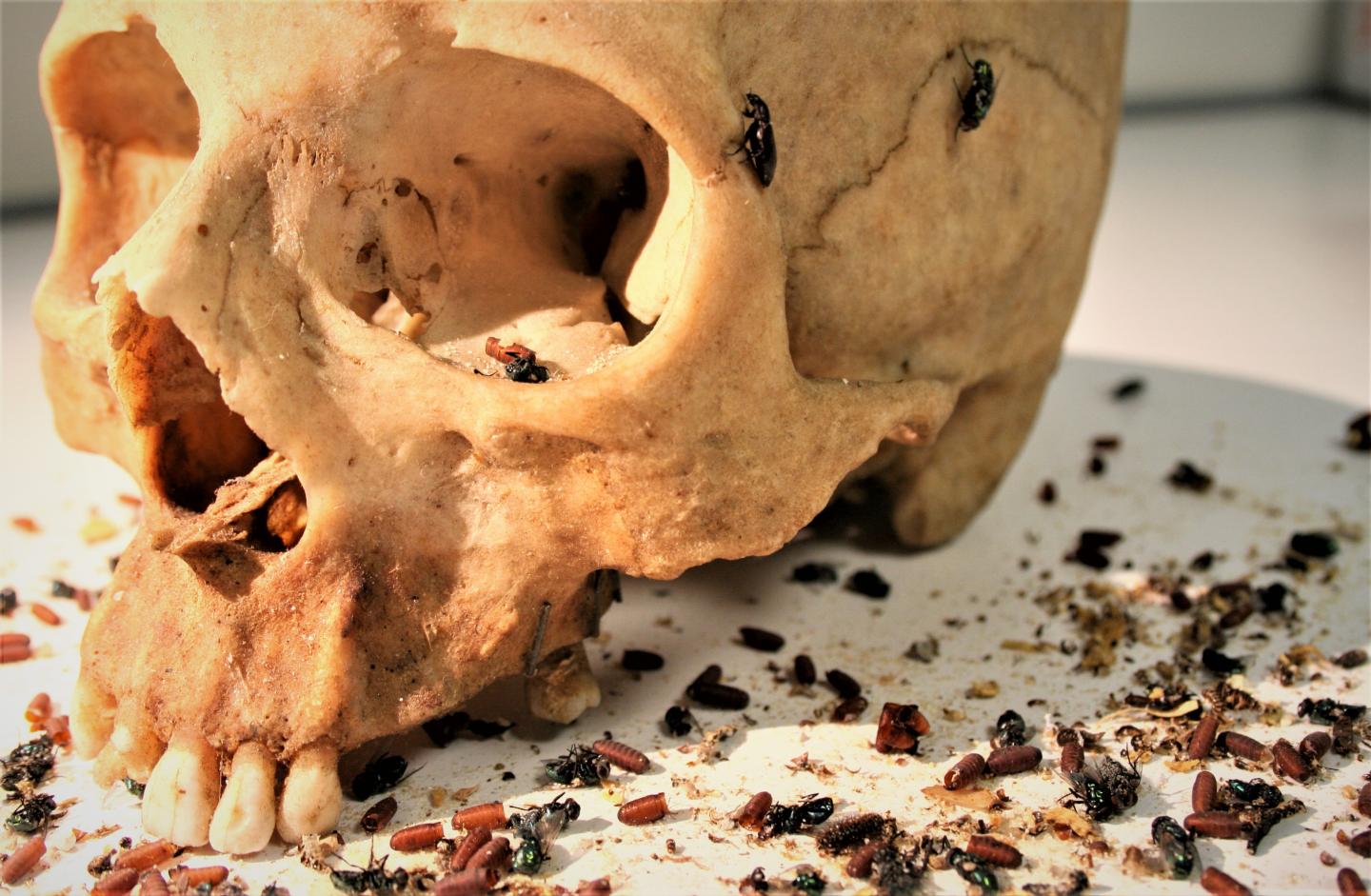
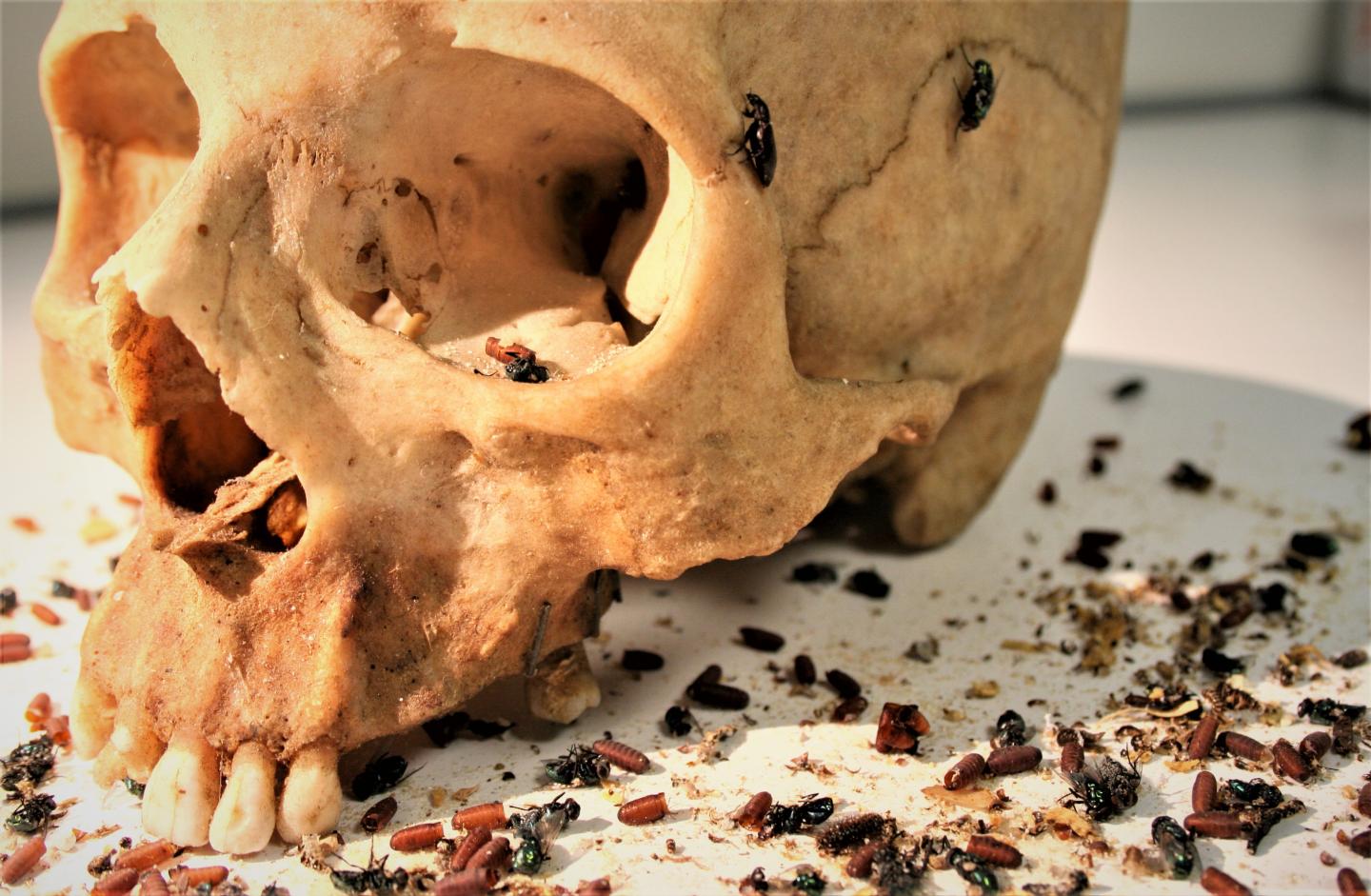
Image 1: Dermestid beetles and flies on a skeletonized human skull.
Credit: Damien Charabidze. Subject to no restrictions
Image 2: Necrophagous blow flies larvae feeding on a cadaver. Credit: Damien Charabidze. Subject to no restrictions
Image 3: Two blow flies feeding on a blood pool. Credit: Damien Charabidze. Subject to no restrictions
Full Media Pack including image: https://drive.google.com/open?id=0BzGrFBtalE6wMExiOWlyTGxwRDQ
Link to the Published Version of the article (quote this link in your story – the link will ONLY work after the embargo lifts): https://peerj.com/articles/3506 your readers will be able to freely access this article at this URL.
Citation to the article: Charabidze et al. (2017), Use of necrophagous insects as evidence of cadaver relocation: myth or reality? PeerJ 5: e3506; DOI 10.7717/peerj.3506
About:
PeerJ is an Open Access publisher of two peer-reviewed journals and a preprint server. PeerJ is based in San Diego, CA and the UK and can be accessed at https://peerj.com/. PeerJ's mission is to help the world efficiently publish its knowledge.
All works published in PeerJ are Open Access and published using a Creative Commons license (CC-BY 4.0). Everything is immediately available — to read, download, redistribute, include in databases and otherwise use–without cost to anyone, anywhere, subject only to the condition that the original authors and source are properly attributed.
PeerJ has an Editorial Board of over 1,600 respected academics, including 5 Nobel Laureates. PeerJ was the recipient of the 2013 ALPSP Award for Publishing Innovation. PeerJ Media Resources (including logos) can be found at: https://peerj.com/about/press/
Media Contacts
For the authors:
Damien CHARABIDZE
Institut de Médecine Légale
Université de LILLE
1 Rue A. VERHAEGHE?
59000 LILLE
03-20-62-35-01
[email protected]
For PeerJ: email: [email protected] , https://peerj.com/about/press/
Note: If you would like to join the PeerJ Press Release list, please register at: http://bit.ly/PressList
Media Contact
Damien CHARABIDZE
[email protected]
@ThePeerJ
http://https://peerj.com
Related Journal Article
http://dx.doi.org/10.7717/peerj.3506