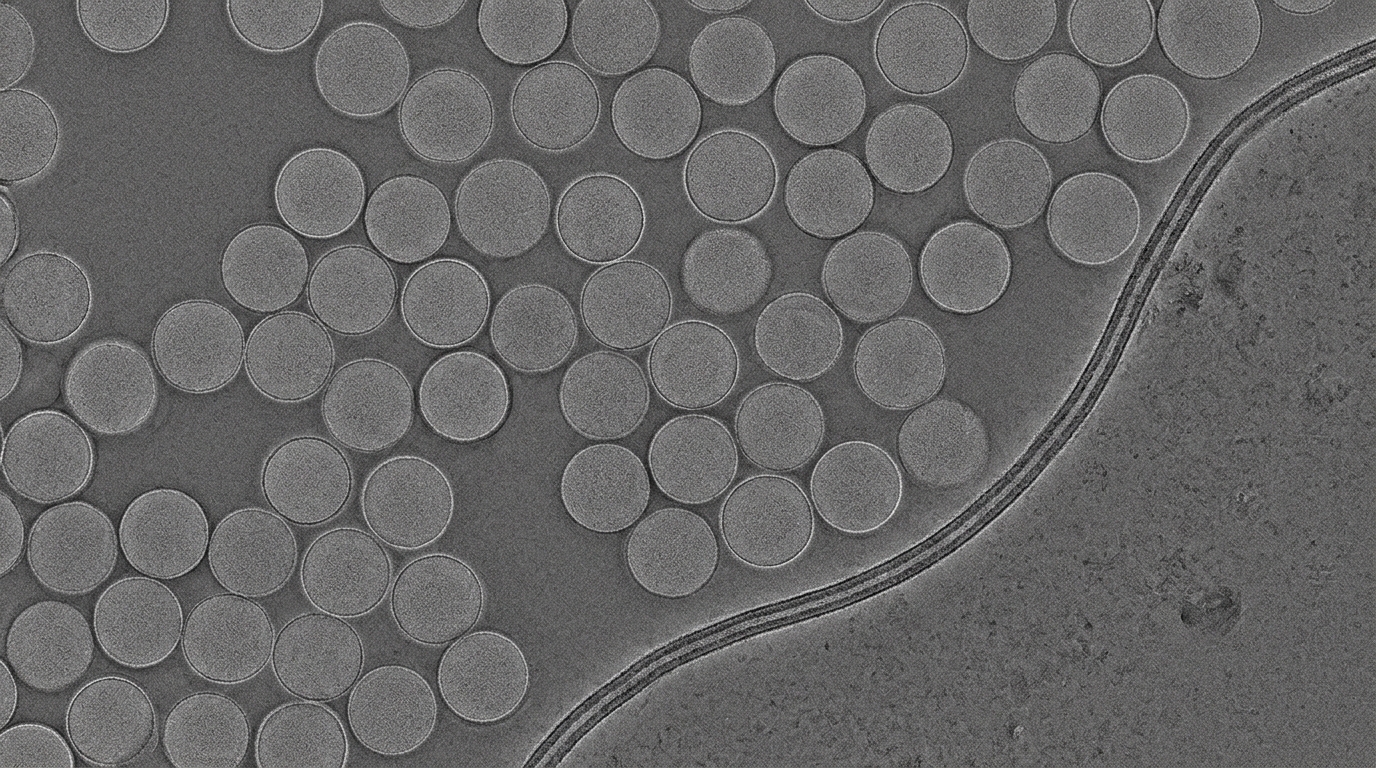
High drug-loading amorphous nanoparticles can balance physical stability and passive membrane permeation across aqueous suspension, drying, and redispersion when excipient selection directly targets specific particle growth pathways, according to an editorial review authored by pharmaceutical scientist Akshay Narula. Synthesizing doctoral research on poorly water-soluble compounds, the publication demonstrates that managing physical stability and biopharmaceutical performance simultaneously overcomes limitations observed in conventional amorphous solid dispersions, which frequently exhibit slower or incomplete release at elevated drug loadings.
The underlying formulation strategy relies on liquid-liquid phase separation, which occurs spontaneously when the concentration of a poorly water-soluble drug in water exceeds its amorphous solubility limit, generating drug-rich amorphous nanoparticles. While amorphous solid dispersions represent an established approach to enhance the solubility and oral absorption of poorly soluble drugs, their performance often deteriorates as drug loading increases. In contrast, amorphous nanosuspensions provide a practical route to elevate drug loading while preserving the solubility advantages of the amorphous state, supported by parallel translational evidence from a separate 45% drug-loaded amorphous nanoparticle program evaluated in humans.
Investigating particle growth mechanisms in dilute aqueous suspensions revealed that amorphous drug nanoparticles are metastable entities susceptible to flocculation, crystallization, coalescence, and Ostwald ripening. When experimental conditions suppressed flocculation and crystallization, particle enlargement in monodisperse aqueous suspensions proceeded sequentially through coalescence followed by Ostwald ripening. Coalescence initially produced larger particles, establishing the particle-size differences required to drive Ostwald ripening, which indicates that targeted chemical or physical inhibition of either pathway can arrest overall particle growth in solution.
Processing conditions fundamentally alter the active destabilization mechanism, demonstrating that particle growth cannot be addressed as an isolated or uniform phenomenon across manufacturing steps. During heat drying, the continuous removal of water forces nanoparticles into intimate spatial proximity, shifting the predominant mechanism of physical enlargement to coalescence. Concurrently, crystallization persists as an independent stability risk that requires distinct formulation control during thermal processing.
Mechanistic evaluation of excipients across multiple model drugs showed that stabilizer performance depends on how excipients interact with drug-rich particles rather than empirical screening attributes. Partitioning stabilizers, which dissolve or penetrate directly into the drug-rich particle phase, generally outperformed non-partitioning stabilizers that remained confined to the surrounding continuous aqueous phase. For non-partitioning excipients, stabilizing efficacy correlated with the wet glass transition temperatures of both drug and excipient, while strong ionic interactions between the drug and stabilizer significantly enhanced suspension stability.
Among the excipients evaluated, hydroxypropyl methylcellulose acetate succinate, known as HPMCAS, exhibited the highest stabilization performance across dilute aqueous systems. Mechanistic observations indicated that HPMCAS effectively inhibited both coalescence and Ostwald ripening. Operating below the wet glass transition temperature maintains the nanoparticles in a glassy state, whereas temperatures exceeding this threshold promote coalescence and subsequent Ostwald ripening.
Permeation studies using poorly water-soluble model compounds established that colloidal amorphous nanoparticles significantly enhance passive membrane transport through the particle drifting effect. Enhanced flux across membranes depended directly on particle size and drug partitioning between the aqueous phase and the membrane. Because a distinct flux plateau occurred above the amorphous solubility limit, mass transfer into the membrane proceeded exclusively via molecularly dissolved drug species rather than direct particle uptake by the barrier.
The particle drifting effect mitigates transport bottlenecks by enabling colloidal nanoparticles to diffuse through the unstirred water layer directly adjacent to the membrane surface. By moving into this hydrodynamic boundary layer, the colloidal particles continuously replenish dissolved drug molecules near the membrane interface, substantially lowering the diffusional resistance that typically restricts the absorption of poorly soluble compounds.
Transforming dilute suspensions into dry solid forms required excipients acting primarily as wall materials, which locate at the particle-medium interface to establish a physical barrier against particle contact. These wall materials necessitated higher relative concentrations for effective stabilization, with ionic interactions between drug and wall excipients markedly improving drying stability. Furthermore, batch scale directly impacted stability, as larger processing volumes required longer drying durations and increased thermal exposure, confirming that formulation composition and processing parameters must be integrated during development.
Following drying and subsequent redispersion, the recovered high drug-loading amorphous nanoparticles exhibited passive membrane permeability comparable to fast-releasing amorphous solid dispersions in the evaluated model systems. Although this mechanistic framework aligns particle growth, excipient selection, and redispersion, long-term storage stability against crystallization, redispersion kinetics across diverse chemical structures, downstream solid dosage manufacturing, and direct in vivo absorption correlations remain critical areas for ongoing investigation.
Within oral drug product development, poor aqueous solubility continues to present a primary obstacle to formulating viable oral dosage forms. Conventional formulation strategies have relied heavily on amorphous solid dispersions to enhance both apparent solubility and systemic absorption of challenging pharmaceutical compounds. However, the practical utility of conventional amorphous solid dispersions frequently encounters constraints when formulations must accommodate higher drug loadings. As the proportion of active compound increases within these solid dispersions, drug release can become significantly slower or fail to reach completion, creating severe practical complications for therapeutic molecules that require high oral doses. To bypass the limitations associated with high-dose amorphous solid dispersions, liquid-liquid phase separation provides an alternative route to generate high drug-loading formulations. When an aqueous concentration of a poorly water-soluble drug exceeds its intrinsic amorphous solubility limit, spontaneous separation occurs, forming distinct drug-rich amorphous nanoparticles. These nanoscale structures allow formulators to increase overall drug loading while retaining the solubility and dissolution benefits characteristic of the amorphous state, a strategy whose clinical viability has been corroborated by human clinical evaluation of a separate forty-five percent drug-loaded amorphous nanoparticle formulation.
A comprehensive understanding of particle growth dynamics requires evaluating the distinct destabilization pathways that metastable amorphous drug nanoparticles can undergo during handling and processing. In dilute aqueous media, amorphous particles are fundamentally susceptible to flocculation, crystallization, coalescence, and Ostwald ripening. When formulation conditions successfully suppress flocculation and crystallization, particle enlargement follows a sequential mechanistic trajectory. In monodisperse suspensions, coalescence initially forces individual nanoparticles to merge into larger entities, creating the polydispersity and size differentials that subsequently drive Ostwald ripening. Because these two processes operate in series, the targeted inhibition of either coalescence or Ostwald ripening can effectively halt overall particle growth in aqueous suspension. However, the physical mechanism governing particle growth shifts dramatically when moving from liquid suspensions into drying operations. During thermal drying, the removal of the continuous water phase brings particles into intimate physical proximity, causing coalescence to become the dominant pathway for physical enlargement while crystallization remains a persistent, independent thermodynamic risk throughout thermal exposure.
Thermal transitions dictate the physical state and susceptibility of amorphous nanoparticles to these growth mechanisms. Below the wet glass transition temperature, amorphous nanoparticles stay immobilized in a rigid, glassy state that resists deformation and fusion. Once the system exceeds this critical temperature threshold, the amorphous material gains molecular mobility, allowing coalescence to proceed and triggering subsequent Ostwald ripening. To counteract these destabilizing events, excipient selection must be guided by molecular interaction mechanisms rather than empirical trials. Excipients that partition directly into the drug-rich nanoparticle phase demonstrate superior stabilizing performance compared to non-partitioning excipients that remain restricted to the external continuous aqueous phase. For non-partitioning polymers, stabilizing performance is governed by the wet glass transition temperatures of both the drug substance and the excipient, alongside the formation of strong ionic interactions between the two components. Among evaluated pharmaceutical excipients, hydroxypropyl methylcellulose acetate succinate demonstrates exceptional stabilization efficacy because it simultaneously inhibits both coalescence and Ostwald ripening, preventing physical deterioration across varied processing conditions.
Beyond maintaining physical integrity in suspension, colloidal amorphous formulations provide substantial biopharmaceutical advantages by accelerating passive drug permeation across biological barriers. Permeation investigations with poorly water-soluble model compounds reveal that flux enhancement depends on colloidal particle size and the partitioning behavior of the drug between the aqueous medium and the membrane barrier. Experimental observation of a defined flux plateau above amorphous solubility confirms that mass transfer across the membrane occurs exclusively via molecularly dissolved drug species, rather than through direct cellular or membrane penetration of intact nanoparticles. The biological benefit of the colloidal state is mediated by the particle drifting effect, in which suspended nanoparticles travel into the unstirred water layer situated immediately adjacent to the membrane surface. By migrating directly into this static aqueous boundary layer, colloidal nanoparticles release and replenish molecularly dissolved drug molecules in close proximity to the absorbing surface, effectively diminishing the diffusional resistance that typically limits the absorption rate of poorly soluble therapeutics.
Transforming dilute colloidal suspensions into dried solid intermediates requires specialized formulation strategies to preserve redispersibility. Excipients functioning primarily as wall materials concentrate at the particle-medium interface, creating a physical barrier that restricts particle contact. These protective polymers require higher operational concentrations, though introducing strong ionic interactions between drug and excipient significantly enhances physical stability during drying. Thermal exposure also scales with batch volume, as larger batches demand extended drying cycles. Following reconstitution, the redispersed amorphous nanoparticles regain their colloidal properties, demonstrating passive membrane permeation comparable to fast-releasing amorphous solid dispersions.
Advancing these amorphous nanosystems toward commercial oral drug products requires establishing broader formulation rules across diverse compound classes. Future research must evaluate long-term solid-state storage stability against crystallization, monitor particle size variations upon reconstitution, and characterize downstream manufacturing effects on final dosage forms. Conducted at the University of Connecticut under the mentorship of Dr. Na Li, this doctoral research earned honors including the IPEC Foundation Excipient Graduate Student Award and the Steven Nail Emerging Researcher Award, providing mechanistic principles that continue to inform formulation science at Catalent.
Subject of Research: Mechanistic formulation principles balancing stability, drying, and passive permeability in amorphous drug nanoparticles
Article Title: Spotlighting rising researcher Akshay Narula: balancing stability and permeability in high drug-loading amorphous nanoparticle formulations
Article References: Narula, A. (2026). Spotlighting rising researcher Akshay Narula: balancing stability and permeability in high drug-loading amorphous nanoparticle formulations. AAPS Open, 12(1), Article 75. https://doi.org/10.1186/s41120-026-00215-w
Image Credits: AI Generated
DOI: 10.1186/s41120-026-00215-w
Keywords: amorphous nanoparticles, amorphous solid dispersions, high drug loading, liquid-liquid phase separation, particle coalescence, Ostwald ripening, particle drifting effect, unstirred water layer, passive membrane permeation, hydroxypropyl methylcellulose acetate succinate, wet glass transition temperature, partitioning stabilizers, wall materials, thermal drying, nanosuspension redispersion, poorly water-soluble drugs, oral drug delivery
News Source: Ophelia Keating. (November 27, 2026). High Drug-Loading Amorphous Nanoparticles Balance Physical Stability and Passive Membrane Permeability. Scienmag.