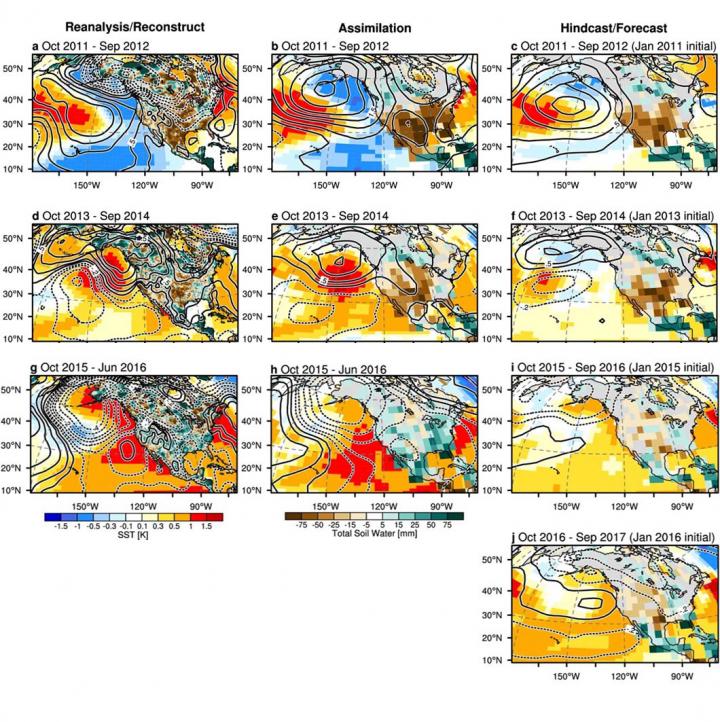
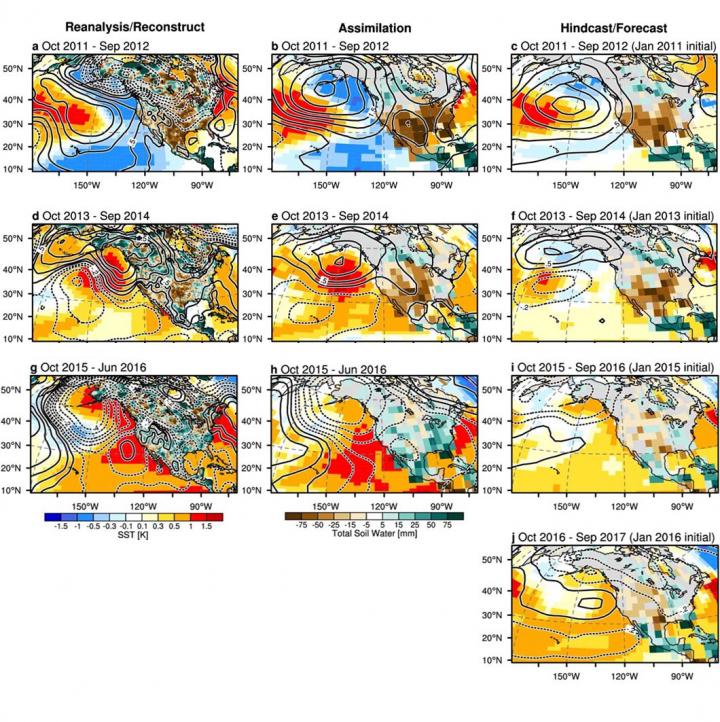
Credit: Chikamoto Y. et al.
An international team of climate researchers from the US, South Korea and the UK has developed a new wildfire and drought prediction model for southwestern North America. Extending far beyond the current seasonal forecast, this study published in the journal Scientific Reports could benefit the economies with a variety of applications in agriculture, water management and forestry.
Over the past 15 years, California and neighboring regions have experienced heightened drought conditions and an increase in wildfire numbers with considerable impacts on human livelihoods, agriculture, and terrestrial ecosystems. This new research shows that in addition to a discernible contribution from natural forcings and human-induced global warming, the large-scale difference between Atlantic and Pacific ocean temperatures plays a fundamental role in causing droughts, and enhancing wildfire risks.
"Our results document that a combination of processes is at work. Through an ensemble modeling approach, we were able to show that without anthropogenic effects, the droughts in the southwestern United States would have been less severe," says co-author Axel Timmermann, Director of the newly founded IBS Center for Climate Physics, within the Institute for Basics Science (IBS), and Distinguished Professor at Pusan National University in South Korea. "By prescribing the effects of man-made climate change and observed global ocean temperatures, our model can reproduce the observed shifts in weather patterns and wildfire occurrences."
The new findings show that a warm Atlantic and a relatively cold Pacific enhance the risk for drought and wildfire in the southwestern US. "According to our study, the Atlantic/Pacific temperature difference shows pronounced variations on timescales of more than 5 years. Like swings of a very slow pendulum, this implies that there is predictability in the large-scale atmosphere/ocean system, which we expect will have a substantial societal benefit," explains Yoshimitsu Chikamoto, lead author of the study and Assistant Professor at the University of Utah in Logan.
The new drought and wildfire predictability system developed by the authors expands beyond the typical timescale of seasonal climate forecast models, used for instance in El Niño predictions. It was tested with a 10-23 month forecasting time for wildfire and 10-45 for drought. "Of course, we cannot predict individual rainstorms in California and their local impacts months or seasons ahead, but we can use our climate computer model to determine whether on average the next year will have drier or wetter soils or more or less wildfires. Our yearly forecasts are far better than chance," states Lowell Stott, co-author of the study from the University of Southern California in Los Angeles.
Bringing together observed and simulated measurements on ocean temperatures, atmospheric pressure, water soil and wildfire occurrences, the researchers have a powerful tool in their hands, which they are willing to test in other regions of the world: "Using the same climate model configuration, we will also study the soil water and fire risk predictability in other parts of our world, such as the Mediterranean, Australia or parts of Asia", concludes Timmermann. "Our team is looking forward to developing new applications with stakeholder groups that can benefit from better soil water forecasts or assessments in future fire risk."
###
Media Contact
Jung Gyu Kim
[email protected]
@IBS_media
http://www.ibs.re.kr/en/
Related Journal Article
http://dx.doi.org/10.1038/s41598-017-06869-7