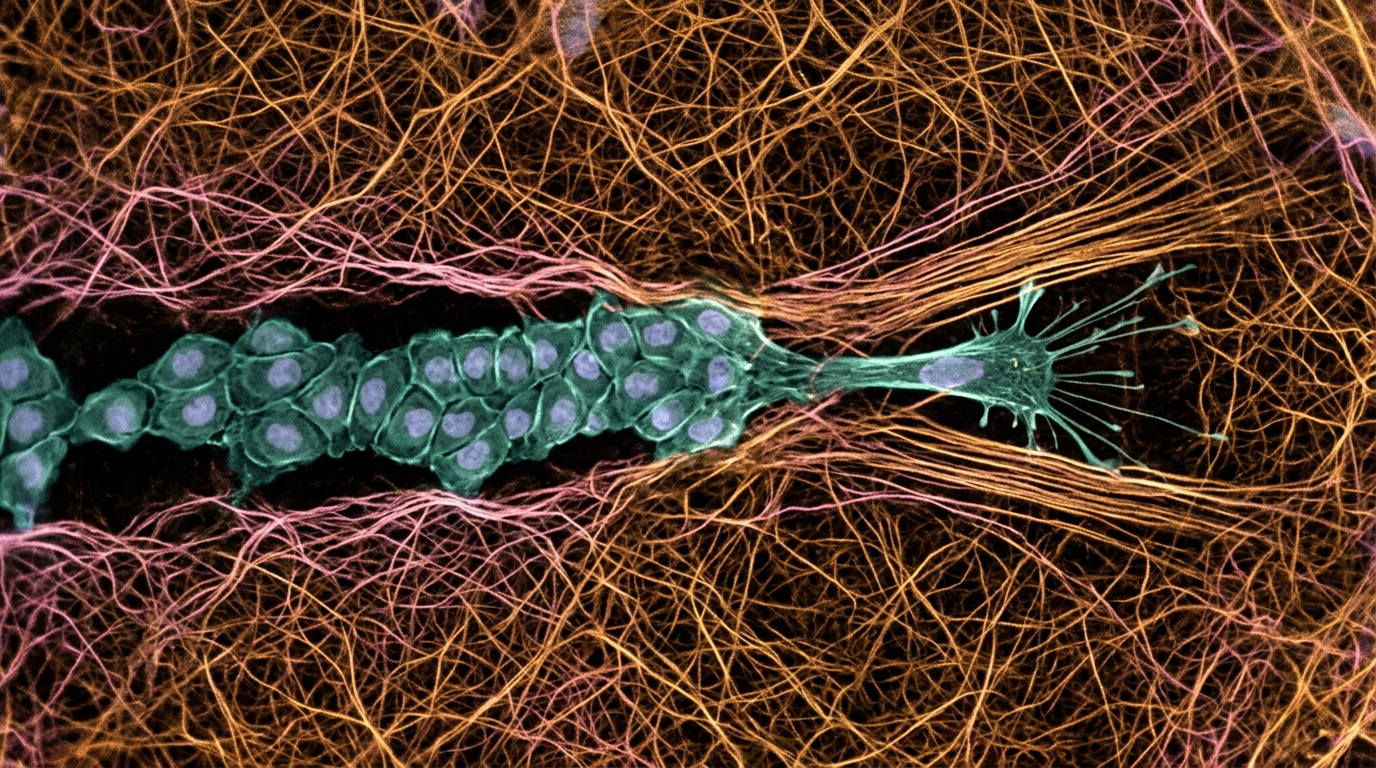
In a perspective article published in Frontiers in Cell and Developmental Biology, researchers propose a theoretical guide-path-follower circuit to explain how moving cell groups navigate tissues. Frederique Gaits-Iacovoni and Julie Batut, based at the Centre de Biologie Intégrative in Toulouse, France, suggest that chemokine-responsive cells transform directional signals into persistent extracellular matrix cues that potentially coordinate collective migration with subsequent tissue differentiation.
Scientific models commonly explain collective cell migration through chemokine sensing, leader-follower specialization, and intercellular force transmission across cell clusters. According to the authors, however, these three mechanisms do not fully explain how migrating cells overcome physical extracellular barriers, how they establish persistent migratory paths through complex environments, or how migrating populations coordinate their ongoing movement with developmental differentiation.
To provide a mechanistic precedent, the authors point to the behavior of cancer-associated fibroblasts during collective invasion. In tumor environments, cancer-associated fibroblasts mechanically couple to carcinoma cells, open pre-existing extracellular matrix barriers, and assemble or align new fibronectin tracks that guide invasion. Developing tissues, the authors propose, may transiently exhibit analogous matrix-remodeling guide-cell functions to direct collective migration, without needing to generate an entirely distinct cell type.
The perspective identifies cellular structures called invadosomes as candidate integrative interfaces capable of executing these guide functions. Invadosomes link phosphoinositide and Rho-GTPase signaling pathways directly to cellular mechanosensing, cytoskeletal force generation, localized proteolysis, and polarized secretion. The functional plasticity of invadosomes, which encompasses non-proteolytic matrix traction, suggests that candidate guide cells could actively coordinate matrix removal, structural rearrangement, and the establishment of a newly defined migratory niche.
Crucially, the proposal emphasizes that remodeled extracellular matrix functions as more than a simple physical migratory path for follower cells. Instead, the altered matrix acts as an instructive microenvironment that directs cellular responses through adhesion-dependent signaling pathways, the direct exposure or release of matrix-associated factors, and localized growth-factor shedding that alters local cellular signaling during migration.
To test these theoretical predictions in living tissue, the authors identify zebrafish olfactory placode morphogenesis as a tractable experimental model system where Cxcl12 and Cxcr4b signaling is coupled with neurogenesis. Nevertheless, Gaits-Iacovoni and Batut explicitly note the limits of current evidence, stressing that the involvement of invadosomes in structural extracellular matrix secretion and their proposed developmental guide-cell functions remain an intriguing hypothesis that still requires experimental testing.
Subject of Research: Proposed guide-cell matrix remodeling in collective cell migration and differentiation
Article Title: Beyond chemokines: matrix-remodeling guide cells as integrators of collective migration and differentiation
Article References: Gaits-Iacovoni, F., & Batut, J. (2026). Beyond chemokines: matrix-remodeling guide cells as integrators of collective migration and differentiation. Frontiers in Cell and Developmental Biology, 14, Article 2044419. https://doi.org/10.3389/fcell.2026.2044419
Image Credits: AI Generated
DOI: 10.3389/fcell.2026.2044419
Keywords: collective cell migration, extracellular matrix, guide cells, invadosomes, cancer-associated fibroblasts, fibronectin tracks, chemokine sensing, Cxcl12, Cxcr4b, zebrafish olfactory placode, neurogenesis, mechanosensing, Rho-GTPase signaling, phosphoinositide signaling, localized proteolysis, growth-factor shedding, leader-follower dynamics, cell differentiation
News Source: Drew Townsend. (November 27, 2026). Perspective Proposes Guide Cells Remodel Matrix to Direct Collective Migration. Scienmag.